


The Phonograph
Description
This section is from the book "Time Out for Living", by Ernest DeAlton Partridge and Catherine Mooney. Also available from Amazon: Time Out for Living.
The Phonograph
Did you ever stop to think how many things there are today that would have astounded your great-great-grandfather? He would certainly have thought you were talking about strange things if you mentioned talking machines, talking pictures, moving pictures, radio, and television. All of these are of very recent origin, and man has hardly had time to learn how to use them. The talking machine (phonograph or gramophone) was invented by a man who lived within the span of your own life. You have probably guessed who it was, if you did not know - Thomas A. Edison.
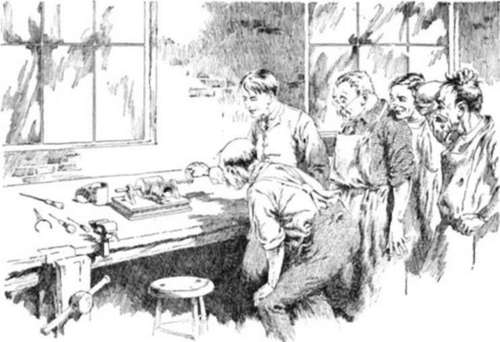
Edison's First Phonograph was an amazing invention. Little did he or others at the time realize how it would be developed into our modern instruments.
Since the invention of the first phonograph there have been tremendous improvements in this machine. At first, the music reproduced in the strange-looking thing Edison made was not too pleasing. The range of tone of the machine was narrow and the mechanical reproduction was very faulty. Even with these limitations, however, the phonograph went ahead rapidly in popularity. After many years of improvement, it is now capable of reproducing the human voice and other kinds of music with remarkable accuracy. If it is properly used, the phonograph can be an instrument of great value in the home.
Several styles of phonographs are used today, as you know. For those who move about, there is the light and compact portable. This can be taken to the country or from home to home as needed. Larger machines are available for the home and school. Some machines are wound by hand, while others operate by electricity. Perhaps the most convenient and usable machine is the combination radio and phonograph. Some of these have an attachment whereby you can make your own records. Making records is a great deal of fun. Like home "radio broadcasts," these records can be used to correct faults in speech and musical performance.
Caring For A Phonograph
A phonograph needs little care and it is ready at all times to do its part to enrich your musical life. The machine should be kept clean and free from collecting dust, and an occasional drop of oil on the bearings will keep it in running order. The modern phonograph has a loudspeaker attachment. It also has a set of tubes through which the recorded music passes and by means of which it is amplified. This device improves the quality of the phonograph record.
Most modern records are electrically recorded, that is, one speaks or plays into a "mike" in much the same way as in broadcasting, and a machine cuts into the grooves on the record to make the master record. The master record is then metal-plated before it is used to make the copies. The copies, or records which we use on the phonograph, are made of a material which has the consistency of dough. When such a record is first made and is still hot, the master record is pressed into it, and the grooves and vibrations are recorded in the soft material. After cooling, the record, or disk, becomes very hard and brittle and is permanent and ready for use.
With correct and careful use, a record will give good service and enjoy a long life. Without some care, it will soon wear until it gives an inferior reproduction. Here are some important things to observe in using your phonograph: Always keep your records in a moderately even temperature. Excessive heat will warp and spoil the record in a short time. Keep a record duster handy and clean your records before playing them. Dust may have sharp corners and when it collects in the grooves it will prove disastrous to the record when played.
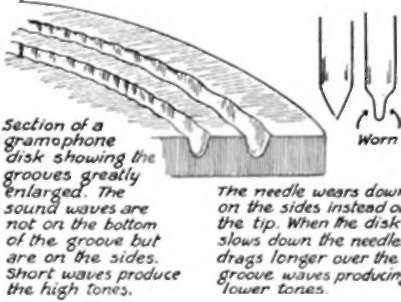
The most important thing in the care of records is the condition of the needles. How many times do you use the same needle in playing records? No doubt, using a needle over and over again is customary with you. It is with most people. And yet, when you understand the manner in which records are made and how the sound is recorded, you will see that used needles are very harmful to the records. The music recorded on the disks is really on the sides, not in the bottom, of the grooves. Even though you use needles of steel or some other substance which is extremely hard, there is a continuous wear on the needle and on the record. Take an old needle and compare it with a new one through a magnifying glass. A new needle comes gradually to a point; one which is old shows a shoulder at the very tip which has been worn there by use.
When the needle has been worn to the shape shown in the illustration, it should not be used. A worn needle not only gives poor reproduction, but also injures the record by wearing away the delicate cuttings along the sides of the groove. The accompanying pictures will help you understand this. The regular steel needle which is sold in packages at a very reasonable rate should be used. These needles come in various degrees of hardness. The hard needles produce hard, crisp tones, while the soft needles produce soft tones. If you wish to preserve your records for the greatest length of time, use a new needle for each face of the record. Fiber needles and needles made from the spines of cactus are also used. There is a special device with which these types of needles can be resharpened. Since they are softer than the steel needles, it is said that they cause less wear and tear on the record.
The life of the record depends also on the ordinary care you give it. Scraping the needles across the record, either when it is in motion or still, scratches the surface and interferes with good reproduction. Dropping the needle down on the record is another way to damage it. If you take reasonable care of your records, you will find them to be serviceable and valuable in your exploration of music.
Have you ever made a record? If you can find one of the combination radios and phonographs which were discussed above, you will agree that it is great fun as well as instructive to make a record. You may enjoy getting your friends together and making records of songs or of instrumental music. It is interesting to record a short skit written for some special occasion.
In most of our cities there are stores in which you can make your own records at a very reasonable rate. You can surprise your friends on their birthdays with a recorded greeting.
Advantages Of The Phonograph
A few years ago, when radio was a new sensation, older folks discarded their fine phonographs right and left for the new invention. Now they are beginning to realize that in some respects the phonograph is more convenient than the radio for reproducing music. For example, on a phonograph you can play your favorite pieces over and over as many times as you desire to hear a certain part or to become familiar with a certain strain. In studying a musical composition, such repetition is very useful. If you want to know more about Beethoven's Fifth Symphony, you can secure a miniature copy of the score. The main themes are printed before the beginning of the score. These you can either pick out on the piano yourself or have somebody else play. If you play the record, you will recognize each theme as it occurs. After a few repetitions of the work, you will be on speaking terms with a great piece of music.
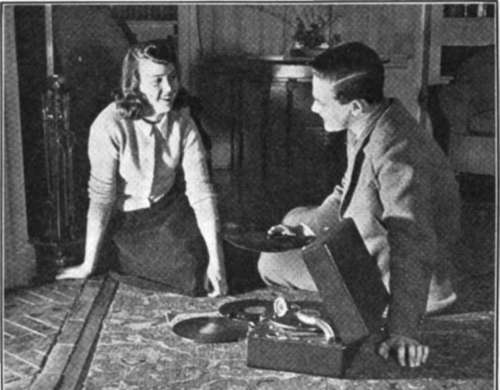
With your own phonograph you can choose your own music and play it when you like.
When you hear an orchestra play a fine piece of music, you will enjoy it much more if you have become familiar with it by means of your phonograph. To get the most enjoyment from hearing a piece, one should be familiar not only with the composition as a whole, but with many of the important features. Familiarity helps a good musician get very much pleasure from an orchestral concert.
The phonograph is important, also, because it is selective, that is, you can choose your own programs. You may be studying folk songs of a particular nation. By playing records of these songs, you can become familiar with them. You can ' also find records that will tell you about the various instruments of the orchestra, and you can become familiar with the tonal quality of these instruments. It is possible to buy two phonograph records of the same piece of music, on each of which the piece has been played by a different ensemble of instruments. These will help you become familiar with the use of instruments in producing modern music. All these activities lead to a better understanding and appreciation of what music really is, and the part that it plays in our lives.
Making up your own program is a fascinating pastime. The opportunities here arc almost without limit. For example, you can have a program of songs or of instrumental music. Perhaps you wish to compare the playing of some piece of music by different orchestras or bands, or the singing of a certain song by different singers. In selecting your records and building a music library, try to keep these possibilities in mind.
Volumes of the larger musical works are useful. You can buy entire symphonies and other large musical forms. In volumes of this type, you can get the rendition of a large number of pieces of music by a single orchestra or organization. If you are interested in primitive music, such as that of the North American Indians, you can find authentic recordings. These records arc valuable for the study of the development of music and of its history.
The phonograph can help you, too, in some of the other studies in school besides music. It is especially useful in the study of a foreign language, in drills in gymnastics, and other school activities. More and more records are being used to enhance the interest of programs in the academic fields.
Continue to:


My Books

