


Putting On A Show
Description
This section is from the book "Time Out for Living", by Ernest DeAlton Partridge and Catherine Mooney. Also available from Amazon: Time Out for Living.
Putting On A Show
Perhaps the most fun we had was putting on the show. Even while the marionettes and hand puppets were being made, we held short rehearsals several times a week, using old puppets Mr. Adams lent us or anything that happened to be around. Before long we found it necessary to select one of the members to be a director. Directing is no easy task, either. The director must know how to tell the puppeteers what to do and be ready to listen to suggestions from all members present.
As we went forward with our work and with the rehearsals, there were several new words that seemed important for us to learn because of the special meanings they have in puppetry.
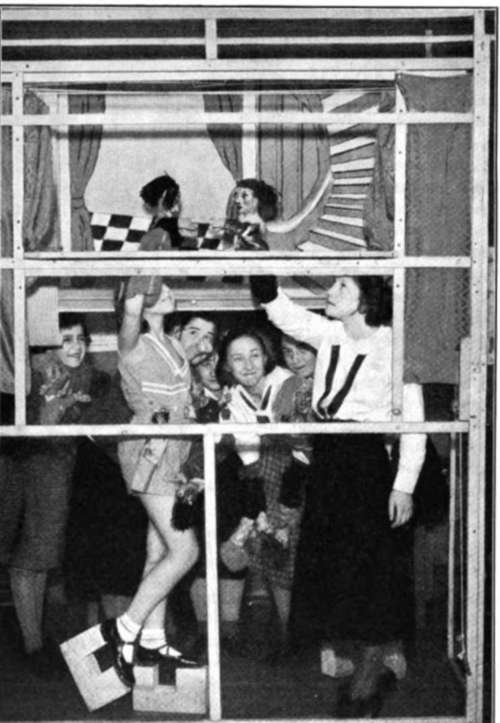
A Puppet Production of Shakespeare's The Taming of the Shrew. The curtains were removed for this photograph in order to show a backstage view of operations.
Here is a brief list of the more important ones:
Proscenium arch, an opening which frames the stage. Bridge, that part of the marionette stage on which the puppeteers stand.
Upstage and Downstage, toward the back and toward the front of the stage respectively. Stage right and Stage left, the puppeteers' (not the audience's) right and left.
Wings, spaces on the sides of the stage (not visible to the audience); wings also refer to pieces of scenery used to block off these spaces.
On-slage, in view of the audience.
Off-stage, out of sight of the audience.
We also found it advisable to appoint a stage manager, whose job it is to be responsible for all properties, puppets, and scenery before, during, and after the performance. He also sees to it that the stage is in order and that the curtain is drawn and closed at the proper time.
We did not write any definite script for our production of Jack and the Beanstalk. We all knew the story and how the scenes followed one another. One of the group kept track of particularly good bits of conversation that were used from time to time and then checked up to see that they stayed in the production from one rehearsal to the next. In this way, those handling the puppets had plenty of chance to show their originality, and after several practice periods the play moved along surprisingly well. By the time we were ready to put on the show, the lines were practically the same every time, although no attempt had been made to memorize them entirely.
You can sec that in this way each one of us had an opportunity to learn how to think as we spoke and how to add to the production each time.
The Night Of The Big Show
Our show was well advertised in advance. The business manager had posters made and placed in school, in churches, and in the corner drugstore. Some mimeographed handbills with pictures of puppets on them also aroused considerable interest in the neighborhood. Because of these efforts, and those of our many friends, we had a good crowd at the first performance. We charged a very small admission fee to help pay for some of the materials.
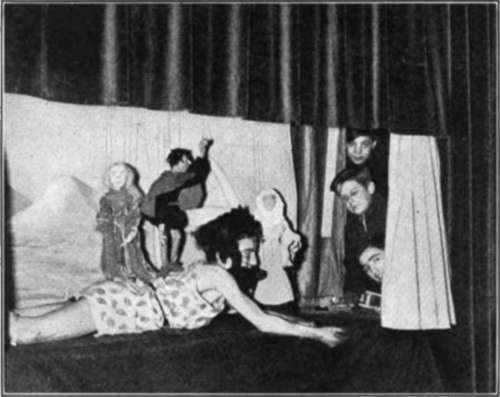
In this version of Jack and the Beanstalk a young boy played the part of the giant.
We were all very much excited. Programs had been mimeographed, and ushers showed the audience to their places. The stage manager handled the lights, turning off the house lights during the performance and turning them on during intermission. The stage manager was also busy checking up to sec if all the puppets and puppeteers were there and in the right places. Also, all scenery and properties were checked and in readiness at the appointed hour.
If I do say it myself, the first show was a success. At popular demand, we have agreed to put on another one in the near future. There is now enough money in the treasury to buy some much-needed equipment and tools. Now you see why we are all so enthusiastic about puppets. The trip to Chuck's granddad started it all, and heaven only knows where it will stop!
Some Interesting Things To Do
1. Make a stage for your marionettes. Design some scenery and devise ways of lighting it.
2. Make a hand puppet to show how you would like to look when you are thirty-five years of age.
3. Write a script for your hand puppet and give at least one performance for your friends.
4. Plan and produce a shadow play. The books listed at the end of this chapter will help you.
5. Start a file of pictures, from magazines, that will give you good ideas of background effects for puppet shows of the future.
6. Puppet shows call for artists to design costumes, sets, backgrounds, and the like. At the end of the chapter is a list of some fine books that will aid you in developing the art, no matter how poorly skilled you are. Have a group report to the class on the books that they found most helpful.
7. If you have not already done so, now is the time to start a file that will forever be valuable to you. File pictures under headings such as heads (male, female, grotesque, child, etc.), costumes of countries and periods, scenery (outdoor and indoor). Twelve-by-eighteen-inch cardboard folded in two will make good nine-by-twelve-inch folders when doubled.
8. What sound effects could be used for a puppet show? Name the material used, tell how it is used, and what the result is.
9. Music lends great charm to a puppet show. What records do you know that would be appropriate for various scenes that might be described as "dangerous," "beautiful," "cheerful," "dark and dreary," "exciting"?
10. Appoint a bulletin-board committee to scout out articles and pictures on marionettes and puppets.
11. As a class, build a hand cart or wheelbarrow on which you can transport all the paraphernalia for a puppet show to a near-by park or play center and give performances for the people there. If you are interested in this project, you will enjoy looking back into English history for tales of how such a performance used to be done.
12. Some other ideas for puppet shows may come to you as you read through this book; for example, an outstanding experience on a hike, the story of life in your community, or some amusing episode of school life. Make a list of these possibilities for future reference.
Helpful References
Bufano, R., Be a Puppet Showman. Merrill and Fleming, Play-Making and Evans, M., Costume throughout the Ages. Plays.
Ferris, H., Producing Amateur Entertain- Mills and Dunn, Shadow Plays and ments. How to Produce Them.
Hobbs, M. F., Play Production Made Rossbach, E. C, Making Marionettes.
Easy. Wilkinson, W., Peep-Show.
Lester, K. M., Historic Costume.
Continue to:


My Books

