


How To Operate Puppets
Description
This section is from the book "Time Out for Living", by Ernest DeAlton Partridge and Catherine Mooney. Also available from Amazon: Time Out for Living.
How To Operate Puppets
Hand Puppets
Of course, it was necessary for all of us to become experts in the manipulation of all kinds of puppets. It did not take us as long as we had feared because we were all so interested in getting ready for the opening night. Here are some of the things we learned.

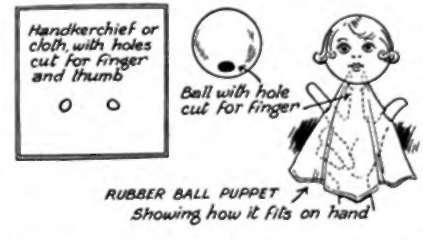
To operate the hand puppet, the index finger is placed in the head. The thumb and middle finger are the arms. The two small fingers are kept close to the palm of the hand. In this way the puppets can be worked on either hand or on both hands at the same time. The main thing is to practice a great deal with the puppet on your hand. Try to make him say "Yes," "No," clap his hands, pick up something, take a bow, look for something, dance with someone.
When operating the puppet on a stage, it is necessary to hold him higher when he is upstage (away from the front) or he will disappear from the audience. Always hold his head up and have him look at the person to whom he's talking. When he talks, move his head and hands in time to the speech. Never bring him on or take him off in the middle of the stage, but at the sides, where he can't be seen.
Marionettes
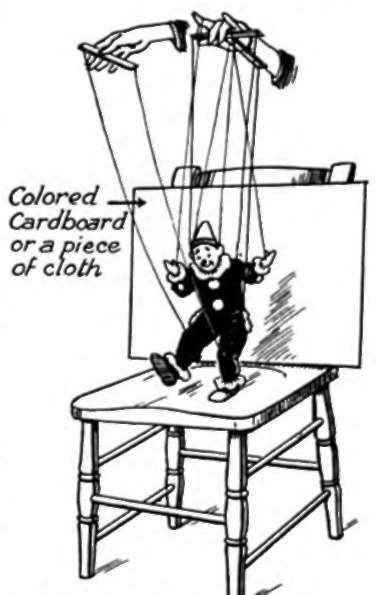
There is a little more to working marionettes, and it usually takes more practice than manipulating hand puppets. The puppet's feet should always be on the ground, with the knees straight. Take hold of the upper part of the control in the fashion shown in the illustration on page 317. Let the puppet down slowly until his feet just touch the stage. Practice lifting him up and down until you know just where the stage floor is. Try rocking the top part of the control from side to side so that the ends of the crosspiece holding the knee strings go up and down. The feet go up and down too. Now, if the control is lifted every time one of the feet comes up, and lowered when the foot comes down, it will look as if Mr. Puppet is walking, when in reality he is merely standing in the same spot. It is now necessary to learn how to advance him slowly while going through the motions described above. To advance slowly is one of the most difficult things to make a puppet do and requires considerable practice, as we found out.
To make the puppet move his head, pick up the bottom part of the control with the same hand that is holding the top and tip both of them forward a little so that the puppet is being held up on his back string. Now by rocking the control you can make the head move.
Your free hand is used to work the hand strings. Practice setting your puppet down and standing him up. He must back up with his heels against the chair before he bends his body to sit down. Be sure the chair is low enough to allow the feet to rest on the ground when he is sitting.
Puppets that are talking must move their heads and hands as they talk. All the others should be still unless they have stage business to do at the time.
CHAIR STAGE
Continue to:


My Books

