


On The Trail. Continued
Description
This section is from the book "Time Out for Living", by Ernest DeAlton Partridge and Catherine Mooney. Also available from Amazon: Time Out for Living.
On The Trail. Continued
Some Things To Avoid
There are relatively few dangers associated with hiking if one is skillful and intelligent. Snakes are greatly overrated as a menace and can almost be ruled off the list of dangers, provided one knows how to recognize poisonous snakes and does not go out of his way looking for trouble. In northeastern United States and the Middle West there are only two snakes that need to be avoided, the rattler and the copperhead. The rattler usually sounds his warning in plenty of time, and if you know it when you hear it you need not fear.
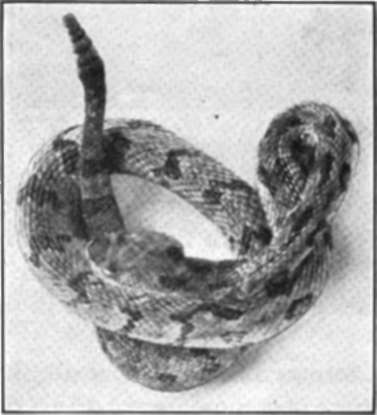
A Rattler can be dangerous. Learn to recognize him.
The copperhead, on the other hand, must be recognized by sight. For this purpose one should consult a good book with colored plates, or, better yet, have someone who is an expert show some actual specimens and describe how to identify them in the woods.
In the Far West the rattler is the only poisonous snake. In the South there is an additional poisonous snake, the water moccasin, or cotton mouth as it is sometimes called. This latter name is given to the reptile because the inside of its mouth is white. It has a habit of opening its mouth when approached.
Poisonous plants are much more annoying than snakes to the hiker if he does not know how to recognize them. A good dose of poison ivy, for example, can be very painful and distressing. One should know how to recognize this three-leaved nuisance in all stages of development. The accompanying picture will help those who are not familiar with the plant, but the best thing is to learn to recognize it in the field in its many sizes.
Other poisonous plants are poison sumac and poison oak, the latter being very common in the West.
Common Sense
Above all, the hiker should carry along a good share of common sense on every trip. The skillful camper learns early that only fools take unnecessary chances in the woods or on the trail. Hiking is a safe, healthful sport for those who learn to take care of themselves. But to those who go wandering off the trail into strange woods without a compass, or who clamber over loose ledges, drink any water that they come across, build fires wherever they feel like it - these people have never learned how to take care of themselves. Sooner or later Mother Nature will punish them. The forces of nature will punish without asking questions; they are no respecters of persons. It is great fun to meet Mother Nature with your chin up if you know where you are going. There is nothing to gain by taking chances, and much to lose. Caution is a mighty good rule for the trail.
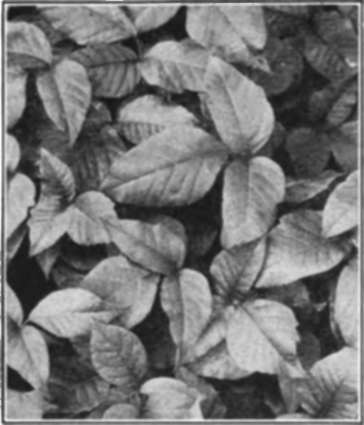
Poison Ivy, an enemy to avoid.
If you are not used to hiking, harden yourself slowly. The human body can stand a great deal if it is properly prepared. It takes time, however, to get the feet into condition for long hikes. The tenderfoot who starts out merrily for the first time with a pack on his back is likely to come back with more blisters and pains than pleasant memories. Work up to long strenuous hikes slowly, so that you will not regret them. Start out at first by hiking only two or three miles, with a light pack.
Every hiker should carry an identification card giving his name, address, and whom to notify in case of emergency. This card should be of waterproof paper or cardboard, if possible. By inking the information on a heavy card and dipping it in hot wax or covering it with a thin coating of shellac, you can make a very durable card.
Friends On The Trail
The hiker will find it to his advantage if he plans his trip to include two or three friends. This should be an invariable rule. Not only do these friends add to the enjoyment of the trip, but they also add to its safety. In times of emergency or need, an extra pair of legs to run for help or to assist a companion out of a tough spot may mean saving a life or a limb. A hike is more enjoyable, too, if the duties of cooking and clean-up are divided evenly among several companions.
Continue to:


My Books

