


Chapter Four. On The Trail
Description
This section is from the book "Time Out for Living", by Ernest DeAlton Partridge and Catherine Mooney. Also available from Amazon: Time Out for Living.
Chapter Four. On The Trail
Hiking, like many other things, needs to be planned carefully if one is really to enjoy it. There are certain rules of the game that need to be observed if the hiker is to come home safely and in good spirits. Men and women who have hiked for many years have discovered certain facts that will help the new hiker. In this section you will find many of these facts suggested for your use. Remember, these are not just idle "don'ts" - they are the result of years of hiking and of many painful experiences. You will be healthier and happier if you heed the advice of those who know the trail.
Highways Are for Automobiles. Modern, hard-surfaced roads were built for powerful cars. At best, the highway is a dangerous place to walk on. The real joy of hiking comes from the narrow trails, the shaded woods, the mountain slope. Whenever possible, the hiker should plan his jaunts away from the beaten paths.
Sometimes, in order to get to the hidden trails, or from one trail to another, it is necessary to travel on main highways. When this is the case, the hiker should keep off the road. Walking on earth is less tiring than walking on a hard surface, and the danger of being hit by an automobile is reduced. When hiking on the road, always walk on the left side of the road facing the traffic* It is much easier to see oncoming cars and to step out of the way. When hiking at night, one should carry a light whenever possible and tie a white handkerchief around his head, and perhaps one around his leg near the calf. Before crossing a traveled road look both ways. Do not play hide-and-seek with the oncoming motorists.
Knights Of The Thumb
Hitchhiking is one of the diseases of modern times. In many states it is against the law to thumb a ride, and well it should be. Hitchhiking is a dangerous busi-ness. It is dangerous for the hitchhiker and for the motorist. Police files are full of cases in which hitchhikers have met with accident or foul play. Other cases on record show that motorists who picked up hitchhikers were robbed or injured by ungracious ride-beggars. Hikers should plan their trips in such a way that they do not have to beg rides. Be independent. Stand on your own legs and don't beg for rides unless some emergency makes it necessary to do so. If it is necessary for you to get transportation to some distant point in order to start your hike, either use public conveyances or arrange to ride with a friend.
Weapons Of Combat
In modern America a hiker is quite safe from wild animals or bands of robbers. There is no need for carrying weapons unless one is going on a hunting trip. Guns are heavy, awkward, and dangerous. Many serious accidents have occurred because some hiker mixed hiking for fun with transporting artillery. Leave the gun home if you are hiking for fun.
* Unless your state law requires otherwise.
Knives and axes should be carried in sheaths to prevent accidents. The simple ax case shown here is sufficient and can easily be made from scrap leather. A pattern should first be made from heavy paper to make sure it fits the ax. The small ax is usually of little value on a hike; it is heavy and awkward. A good knife is suitable for most ordinary purposes.
Private Property
The hiker should always remember that when hiking through the woods he is on the property of some individual or on public land. Regardless of who owns the land, however, one should practice the golden rule of treating it as if it were his own. This insures a welcome to other hikers who may come later and encourages landowners to invite those who love the outdoors to use their woods. A few thoughtless hikers can ruin the chances for enjoyment of everyone else. Here are a few suggestions:
If it is necessary for you to cross fences, do so in such a way that you do not destroy property. When climbing a fence is the only way to pass it, be sure that you select a strong place to climb.
Never chop or otherwise mar a live tree unless you have permission from the owner.
Make certain that you build fires only where they are permitted and then see that they are put out completely when you are through. A fire can easily be put out with water or by covering it with loose dirt.
Whenever possible, thank those who permit you to use their property and report any individuals who destroy property.
Care Of The Feet
The experienced hiker always takes good care of his feet. He knows that if for some reason they should be injured, hiking may be out of the question. A cut on the arm, leg, or face is much less serious for the hiker than a blister on the heel. Long experience has shown that an ounce of prevention is worth many pounds of cure where the feet are concerned. It is much easier to prevent a blister than to make it well.
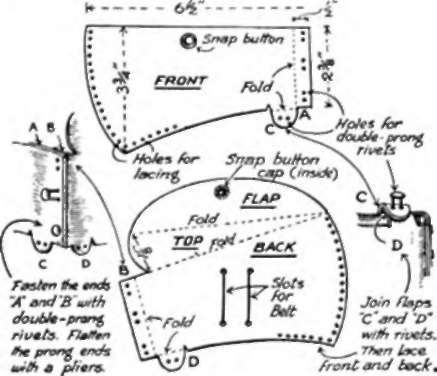
MAKING AN AX SHEATH
One of the first rules about feet is to keep them clean. On the trail they should be washed often, dried carefully, and clean socks put on them at least once a day. If at the end of the day the feet are swollen and tired, they should be washed in hot salty water and dried thoroughly.
If by any chance your feet should begin to get sore on the hike, stop immediately and see if you can find the difficulty. If chafing has started, place a piece of adhesive tape over the chafed area. It may be that a hole in the sock or a wrinkle or a tack is causing the difficulty. Find out before it is too late. If a blister has formed and broken, treat it immediately as you would any other wound - cleanse it and tape some gauze over it. Wounds on the feet are especially dangerous if they come into contact with unclean surfaces.
Continue to:


My Books

