


Part 14. Fine Feathered Friends. Chapter Thirty-One. Who Are These Birds?
Description
This section is from the book "Time Out for Living", by Ernest DeAlton Partridge and Catherine Mooney. Also available from Amazon: Time Out for Living.
Part 14. Fine Feathered Friends. Chapter Thirty-One. Who Are These Birds?
A Friendly Army Invades
Every spring the entire continent of North America is invaded by an army many times larger than the army of any modern nation. Swiftly and effectively this great host, numbering into the millions of individuals, sends its representatives to every village, town, city, and woodland, where to the accompaniment of their own music they go about ferreting out and destroying the enemies of man.
Dressed in brilliant colors, the various regiments of this army move northward with the first signs of spring and pass by in an ever-moving stream. So silently and swiftly do they pass that many people do not know of their existence and never wonder at the fact that they are here today and gone tomorrow. Many of the travelers move by night only. During the day they stop to gather food and prepare for their further journeying. If they find much food, they may stay for several days, eating off the fat of the land; then all of a sudden, like a fleeting cloud, they are off with the wind during the dark hours of the night, toward the north.
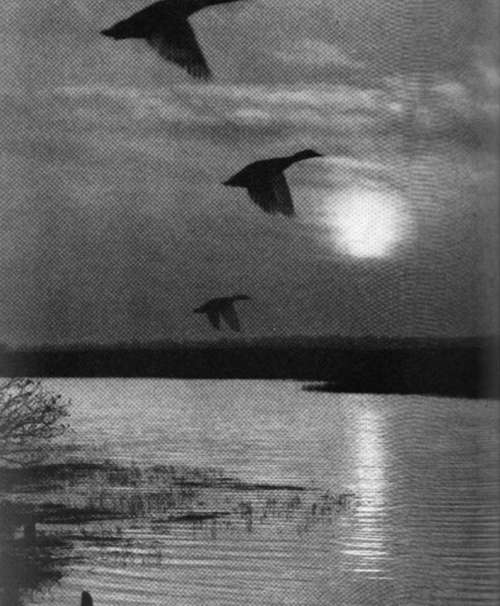
Southbound for the Winter.
While this feathered army has no generals, no other officers, nor any quartermaster corps to feed them, they seem to divide up the work to be done in a very systematic way. No part of the insect world escapes their onslaught, and the numbers of man's enemies that meet their destruction in this way are so great that it would be almost impossible to estimate them.
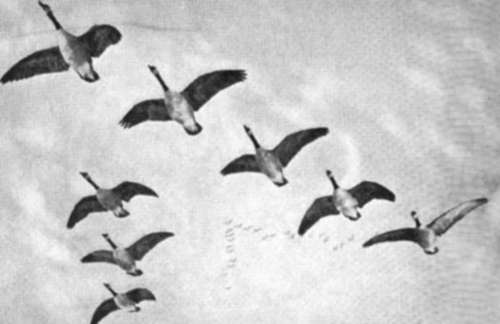
Wild Geese in flight.
The main army is usually preceded by several scouts, who seem to be feeling out the enemy territory to see if Old Man Winter has really left for the year. These scouts are frequency jet black with red bars on their upper wings. They are red-winged blackbirds. If you walk out into the meadows early in the spring, you are apt to see this fellow (and fellow he is, if he has red on his wings, because the male of the species comes before his female partner). Another early bird is the robin. Sometimes he stays all winter in the northern part of the United States, but rarely, because he feeds largely upon ground worms of various kinds and in the cold winters of the North heavy snow covers his food.
Now, as the main army comes along, you will note, if you look closely, that every part of the insect world is attacked. The small insects, such as mosquitoes and gnats, are hunted down by the swallows, swifts, small hawks, and whippoorwills. You can see these birds in the evenings especially, dipping about, gathering up their food. It would be impossible to estimate the number of mosquito bites from which man is saved by these birds who keep the air clean of such small pests.
Large insects, such as flies and grasshoppers, are sought out by kingbirds and phoebes, while the even larger insects are taken care of by the robins and other thrushes, bluebirds, meadow larks, mocking birds, orioles, catbirds, thrashers, wrens, and tanagers. Just within the week the writer has watched a mother catbird carrying load after load of insects to the gaping mouths of her young in a hollow tree.
Even before insects are born they are in danger of being destroyed by the small birds that feed in the treetops. Warblers and vireos keep busy looking for clusters of small worms that will later hatch into flies and plant lice. They love to feed from the ends of leafy branches in search of these tasty morsels, and as they feed they sing a great variety of notes.
Then There Are The Woodpeckers
These birds do a tremendous job in cleaning out the trees. Insects are not safe when they dig into the bark of a tree where human eye cannot see them nor human ear hear them. The woodpecker is a skillful hunter. Clutching the bark with his feet, and propping himself up with his stiff tail, he looks and listens. He can tell where small worms or grubs have dug into the bark and he can hear them. With his chisel bill he goes after them, making a hole large enough for his hooked tongue to reach in and spear the food.
It would be almost impossible to estimate the value of the contribution that birds make to man's welfare each year. Some men who have studied birds for years claim that if the birds were to disappear, insects would multiply so rapidly that man could not combat them. The insects would grow into great hordes and consume every green thing on the face of the earth. Certainly, when one considers the tremendous numbers of insects that are consumed by birds each year, this condition is not hard to imagine. As a matter of fact, history records examples of how birds have saved the crops of men.
Sea Gulls To The Rescue
In Temple Square in Salt Lake City, Utah, there stands a marble shaft on top of which are sculptured several sea gulls. This is, perhaps, the first monument ever built to a bird, and it expresses the gratitude of the people of Utah for the way in which the sea gulls saved the crops nearly a hundred years ago.
Throughout weeks of toil and hardships the men and women who settled the Salt Lake Valley had carried precious seeds of grain from the eastern part of the United States across the plains. They planted these seeds in the earth, looking forward to the time when they could harvest the grain and have plenty of food to eat. Presently the wheat came up in tender green shoots, and the people rejoiced because the shoots meant bread.
Carefully the farmers led water into the fields through small ditches and watched the first stand of grain slowly grow. Then a terrible thing happened. Great swarms of crickets suddenly began to appear out of the sky and sweep down upon the green fields of tender young wheat shoots. These insects went through the fields consuming every green sprout as though a huge lawn mower had been at work. The hardy pioneers tried everything they could think of to beat off the pests. They drove them into ditches filled with water, they plowed them under after driving them into furrows, they burned them, and they watched and prayed. Slowly and surely their food was being devoured. They seemed helpless . . . they were helpless. Nothing that man's ingenuity could devise at that time seemed to succeed in protecting the grain.
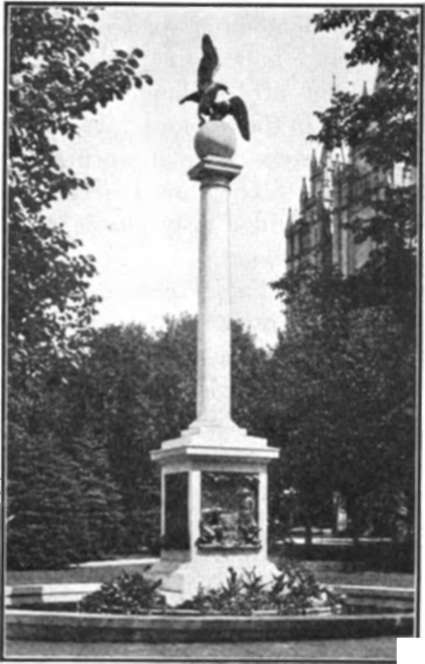
The Monument to the Sea Gulls, in Temple Square, Salt Lake City.
One day from the west there appeared another cloud in the sky. The people were afraid it was even more of the dreaded crickets. As the cloud came nearer, it could be seen that great flocks of sea gulls were coming up from the lake. These graceful birds settled down upon the fields and devoured the pests. Thus, with the aid of their feathered friends the Mormon pioneers saved their crops and harvested a fairly good amount of grain for the coming winter. A marble monument is little enough by way of tribute. The state of Utah now forbids the shooting of sea gulls because of the good turn they did many years ago.
According to those who have studied birds, it is quite customary for them to congregate quickly at localities where there is an abundance of food. An unusual number of mice, for example, will bring hawks to hunt them. If grasshoppers or other insects multiply noticeably, birds come in great numbers to feed upon them.
Continue to:


My Books

