


Variable Stars
Description
This section is from the book "Time Out for Living", by Ernest DeAlton Partridge and Catherine Mooney. Also available from Amazon: Time Out for Living.
Variable Stars
Our sun seems to give the same amount of light year after year. Scientists in the Smithsonian Institution at Washington, D. C, have proved that this is not so. The sun's heat does vary a little from year to year. Fortunately for us, this variation is slight. There are stars in which these variations are enormous. Anyone living near one of these "variable stars," as they are called, would be dodging the intense heat at one end of the week and trying to keep from freezing at the other end. It is not uncommon to find stars which become ten or fifteen times more brilliant in a few months and then return to their previous brightness. With the exception of a few dozen variable stars that seem to explode, the cause of this remarkable change in brightness is unknown.
Many of these variable stars are visible to the naked eye and are marked on star charts. An observer who is familiar with the constellations can easily identify the stars which are known to be variable. The dates when they are expected to reach maximum brightness arc published in the periodical Sky* and also by the Harvard College Observatory, Cambridge, Mass.
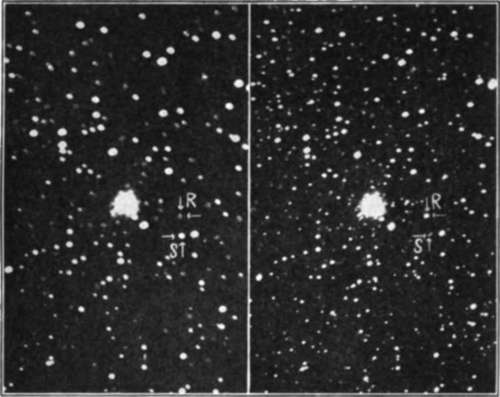
Some stars vary in brightness. They are called "variable stars." The star R is faint in the left-hand photograph and bright in the right-hand one. The star S varies in just the opposite way.
When an observer watches a few of these variable stars from night to night, he realizes that the stars in the sky are not the constant points of light that his ancestors thought they were. When he reads more about the researches of astronomers, he will realize that the stars live, die, and meet with terrible accidents, as do the plants, animals, and man himself.
One good way to learn the names of the stars and the constellations is to visit some planetarium, if there is one near by. The observer sits in a dome and sees a marvelous imitation of the night sky thrown upon the ceiling by an ingenious instrument containing scores of miniature lantern slides. It is an impressive sight and also extremely entertaining. The number of American planetaria is increasing. At present four cities have planetaria: Los Angeles, Chicago, Philadelphia, and New York City.
Continue to:


My Books

