


Making A Telescope
Description
This section is from the book "Time Out for Living", by Ernest DeAlton Partridge and Catherine Mooney. Also available from Amazon: Time Out for Living.
Making A Telescope
Making your own telescope is a fascinating astronomy project. At first that sounds like a big job, but it is surprisingly easy. Many hours of careful work are necessary, it is true, but when compared with the fun of doing the job and the greater joy of bringing the moon and planets nearer to you, the length of time it takes means very little. The cost, too, is small, as you will see from the description of the process given below. If several persons co-operate in the task, the cost and the work alike is shared for the first telescope. The chances are that each member of the group will want an instrument of his own, once he has seen the craters of the moon and the rings of Saturn.
Space will not permit a complete description here of the process involved in grinding a mirror for a telescope. Because it is advisable to follow detailed directions carefully when making a telescope, the reader should consult one of the references at the end of the chapter if he wishes to make an instrument that will produce results.
* American Museum of Natural History, New York City, New York.
In brief, the process followed is that of shaping a flat piece of glass into a curved mirror by grinding it over a second piece of glass known as a tool. The two pieces of glass are entirely flat at the beginning of the grinding process, but by fastening the tool glass to a bench or a barrel top, sprinkling some carborundum powder on it and then moving the top glass across in a rotary motion, moving around slowly as you do it, the glass is ground into the right shape. This grinding causes the tool to be rounded and the other piece to be hollowed.
By using finer and finer grinding powders as one progresses, finally finishing with a jeweler's rouge, the glass is highly polished and ready to be covered with a silver reflecting surface.
The cost comes in the purchase of the glass, the grinding powder, the pitch (used for gluing the tool in place and the handle on the mirror glass), and the chemicals for silvering the finished mirror. Most of the tools needed, outside of hammer, screw driver, and others commonly found in the household, can be made quite easily.
The glass to be used should be one sixth as thick as it is wide, that is, if a six-inch mirror is to be made, the glass should be one inch thick. If a three-inch mirror is made, the glass should be one-half inch thick, and so on. Sometimes it is possible to secure a piece of glass from some second-hand dealer. Old porthole glasses are especially good. If glass is not available from such sources, it can be purchased in the desired thickness, cut to the right dimension, from a large glass-manufacturing company.
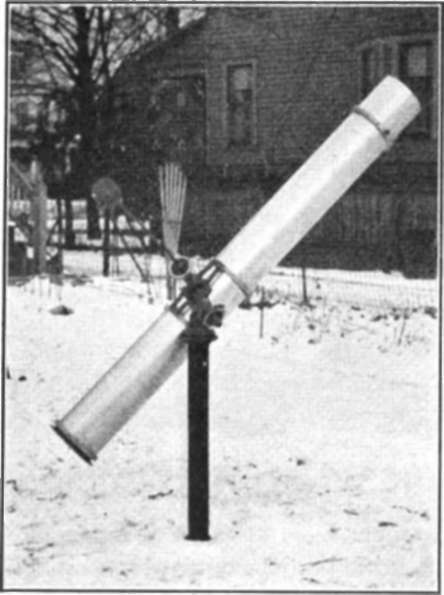
A good homemade telescope brings many new things within the range of the owner's eyes.
If some person in your city has made a telescope, it would be wise to talk the whole matter over with him before proceeding. A talk will save you much time and trouble. It may be that such a person would be willing to supervise your work in making the first telescope.
Many persons have adopted astronomy as a hobby. It offers many kinds of activities. For those who arc mechanically inclined, the making of telescopes or other instruments for observing stars has an appeal. Photography enthusiasts trace the trails of stars on their sensitive plates or snap pictures of sun spots or perhaps make a portrait of the moon. Others who prefer myths and legends enjoy tracing out the constellations in the heavens with the aid of their star maps. A person who likes to work with facts and figures will enjoy learning about the great distances, the relative sizes of the stars and planets, and how our world compares with them.
Today, amateur astronomers form clubs and meet to discuss their hobby. Sometimes it is possible to invite a scientist to discuss his latest findings with the group. When some special event comes along, such as an eclipse of the sun or moon, a shower of meteors or a comet, the members of the club get together to compare notes or make observations. If there is an observatory or planetarium near by, an occasional visit will add to the zest of the meetings.
When I Heard the Learn'd Astronomer When I heard the learn'd astronomer,
When the proofs, the figures, were ranged in columns before me, When I was shown the charts and diagrams, to add, divide, and measure them,
When I sitting heard the astronomer where he lectured with much applause in the lecture-room,
How soon unaccountable I became tired and sick, Till rising and gliding out I wander'd off by myself, In the mystical moist night-air, and from time to time, Look'd up in perfect silence at the stars.
- From Leaves of Grass by walt whitman some interesting things to do
1. Find out how the Indians reckoned time and what they called the moon.
2. If you are interested in mathematics, find out how the distance from the earth to the moon is figured by the method of triangulation. Make a diagram to illustrate your exploration.
3. Make a diagram that shows why summer is warmer than winter.
4. Make a model of the solar system on a large cardboard, showing the location of the planets and their relative sizes.
5. Make a colorful chart or graph contrasting the sun's gifts versus the moon's to life on this planet.
6. Make a star chart outlining twelve of the constellations.
7. Make a family album of the planets. Be sure that you indicate the name of the planet and why it was so named, its color, distance from the sun, when discovered, by whom, and other interesting facts of size, moons, position, etc.
8. Make a star map for the present month, including the important constellations you can see.
9. Make your own star map by copying one given in the book. Pierce small holes in it with a darning needle, hold a flashlight behind it, and see where the constellations are.
10. Make a luminous star chart according to the instructions given on page 166.
11. Mount a pipe or mailing tube upon a pedestal in your backyard in such a way that you can look through it at some star or planet. Fix it on a star or planet and leave it for a few minutes. Presently you will notice that the star is moving out of sight (or out of the field, as the astronomers would say), and you will have to move your improvised telescope if you are to continue seeing the star. This simple instrument will illustrate to you the rotation of the ^ earth. If you mark a dot on a stationary board each night at the same time to show the position of your tube when looking at a given star, you will see how the stars change.
12. If possible, visit a modern astronomical observatory and report to the class about your experience. If a visit is not possible, find out all you can about one of the large observatories.
13. Keep track of the evening and morning stars during the remainder of the year. Find these stars in the heavens, and make a note of the time of their appearance and disappearance. Note also how their position changes in reference to the other stars.
14. Make an umbrella planetarium with chalk marks inside for stars. See the diagram on page 169.
15. What legends, stories, and poems can you find that have been inspired by the stars? Plan an All Star Program and give it for your class.
16. Find out from an almanac what eclipses arc due in the coming year. Plan to see one of them if it is possible.
17. Draw a map of the southern sky. What stars in this sky are not visible to you? Why?
18. Plan a scenario on the life of Galileo centered especially in his star studies.
19. Meteors are always interesting. Write a news article for your school paper telling their story.
20. Find out how to make a single telescope, then figure what the total cost would be to make one. Report this to the class. The books at the end of the chapter will help you.
21. Make a sundial.
22. You will find many interesting pictures, notes, and articles on the heavens in the newspapers, which you may wish to refer to in the future. Make a neatly arranged scrapbook for this valuable reference material for future use and enjoyment.
23. Find out if anyone in your community has astronomy as a hobby. If you find someone, talk to him about it.
24. Write a brief article for your school paper on Star Gazing as a Hobby.
25. Plan to form a Meteor Club and at your first opportunity send your information to the Fowler Observatory as suggested on page 171.
26. Start a Heavens Above Club for star appreciation. Members could be given star names, meetings could be held in the evenings, and games and entertainment could be centered about the heavens.
27. Write imaginary stories of life on another planet, the moon, stars, etc., or draw imaginary pictures of life on another planet. Check your facts to make sure that you have good reasons for showing what you do in your picture or story.
Helpful References
American Museum of Natural History, New York City, Handbooks oj the Heavens.
Baker, R. H., Introduction to Astronomy.
Baker, R. H., When the Stars Come Out.
Barton and Barton, Guide to the Constellations.
Barton and Joseph, Starcrajt.
Bell, L., The Telescope.
Draper and Lockwood, The Story oj Astronomy.
Fath, E. A., Through the Telescope.
Fontany, E., Other Worlds than This.
Frost, E. B., An Astronomer's Life.
Frost, E. B., Let's Look at the Stars.
Grondal, F. A., The Romance of Astronomy.
Ingalls, A. (editor), Amateur Telescope Making.
Jeans, J. H., The Mysterious Universe.
Johnson, G., The Stars for Children.
Johnson, G., Discover the Stars.
Junior Astronomy Club, Hayden Planetarium, New York City, Handbook of the Heavens.
King, E. S., A Manual of Celestial Photography. Lewis, I. M., Astronomy for Young Folks. McCready, K., A Beginners' Guide to the Stars. Menzel, D. H., Stars and Planets. Newcomb, S., Astronomy for Everybody. Olcott, W. T., Book of the Stars for Young People. Olcott, W. T., Star Lore of All Ages. Olcott and Putnam, Field Book of the Skies.
Pendray, E., At en, Mirrors and Stars. Reed, W. M., The Stars for Sam. Reh, F., Astronomy for the Layman. Russell, H. N., Tlie Solar System and Its Origin.
Scientific American Publishing Co., Amateur Telescope Making. Swezey and Gable, Boy's Book of Astronomy. Williams, H. S., The Great Astronomers. Wilson, P. W., The Romance of the Calendar.
Continue to:


My Books

