


Cooking In Camp
Description
This section is from the book "Handbook For Scoutmasters. Volume 1 & 2", by Boy Scouts of America. Also available from Amazon: Handbook For Scoutmasters.
Cooking In Camp
It is, of course, important that the camp menu be planned taking into consideration that the meals are to be prepared away from the conveniences of a modern kitchen and by boys of varying cooking experience.
This does not mean that the menus may not be ambitious. On the contrary, camp gives hoys an opportunity to acquire skill in the preparation of favorite dishes and to master specialties that every out-doorsman likes to prepare. The Chief Scout Executive has this to say on the subject:
"Cooking has interested me all my life. I learned how to cook in the open as a boy, when I used to take a crowd of younger children into the woods on Saturday afternoon hikes. Since then I have cooked over camp fires and kitchen stoves, with equipment ranging from the latest gadgets to a tin pail and a jack-knife—and I still think cooking is fun.
"Cooking is a man-sized job, and every good out-doorsman knows how to do it. He has to. Foresters, surveyors, mining engineers—most of them are good cooks as well as vigorous, self-reliant woodsmen.
"A Troop cooking its own meals is playing one of the most fascinating games of Scouting.
"When you get to the point where you can have your juicy steak broiling sweetly over a bed of coals, your corn on the cob steaming in the kettle, while you slice the red-ripe tomatoes and prepare the fruit, happy and cool and unconcerned—my boy, you're a man."
The important thing here, then, is preliminary training. "Be Prepared" applies to cooking also.
Training In Cooking
The Assistant Scoutmaster in charge should see to it that the Patrols start this training early by cooking by Patrols on the Troop's hikes and short-term camps during the spring and early summer.
But don't stop here. Secure the aid of the mothers in training their boys. There are certain things which may be more readily learned in the family kitchen than in camp, such things as: The consistency of pancake batter and biscuit dough, how to test to see if potatoes, stringbeans and other vegetables are done, and making gravy.
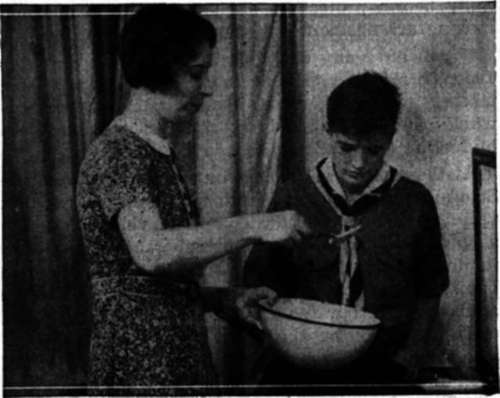
No place like mother's kitchen for learning the consistency of pencake batter and many other tricks.
Making Preparations
Planning meals and cooking for the group is, as we have said, a big responsibility, but never forget that it should also be a joyous experience.
Don't feel alarmed at the many details that are given you in the following pages. These are fundamentals that you should have if you are going to assume charge of the health and safety and happiness of a group of boys for overnight or week-end or longer period.
The Local Council is charged with the responsibility of seeing to it that you are qualified to take your Troop into the open before permission is given you to do so, and that the plans for your camp, especially health protection—including your menus and cooking arrangement—are what they should be.
If you have any doubt as to the capability of the Troop, it is better to take an expert cook along, as a teacher and coach, rather than risk failure of your whole camp and possibly cause sickness to the boys by having a breakdown in your cooking.
At the same time it must be remembered that the Scout method involves learning by doing and that it will be to the credit of the Troop to develop as quickly as possible within its own membership a sufficient number of Scouts in each Patrol to enable them to banish the professional cook (or for that matter the adult cook) from the camp. The trained cook can teach the Patrols anything they don't know and supervise their cooking, or perhaps he may help a Patrol cook one or more meals each day for the whole Troop on a Troop basis.
It should not be the job of you nor of the Assistant Scoutmaster in charge to do the cooking but rather to direct and supervise it.
With the cooking done by Patrols, the responsible leader should divide his attention and supervise all the cooks. If it should be necessary, in an emergency, to call on an adult to do the cooking, here again it should be on the basis of teaching and coaching.
Cooking for a Patrol is something different from cooking a meal for an individual, and ordinarily it is only at the Troop's long-term camp that the Scouts get the opportunity to master this art of Patrol Cookery.
In the Handbook for Patrol Leaders most of the essential information that boys need to learn to do their own cooking and menu planning is given. What you will find in the following pages are the things that you as a leader need to know.
Continue to:


My Books

