


Troop Cooking
Description
This section is from the book "Handbook For Scoutmasters. Volume 1 & 2", by Boy Scouts of America. Also available from Amazon: Handbook For Scoutmasters.
Troop Cooking
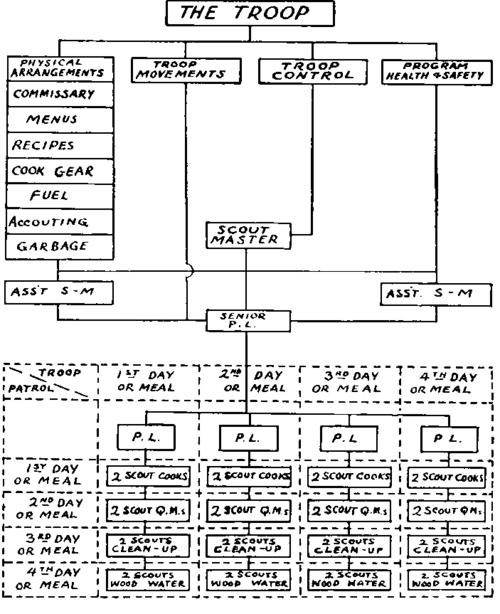
This Troop Chart shows how to divide work among the Patrols. Every one does something; every one varies his work constantly.
Developing The Menus
In developing the menus it should be kept in mind that it is a long time between the night meal and the next morning's breakfast—14 to 15 hours in most cases—therefore, the first meal of the day should be large.
While the noon meal should not be heavy, it should be sufficient to take care of the boy's desire for food. Proteins should be served largely at the night meal, which should be the largest of the three to conform with the home habits of the Scouts, and also to give them the greater bulk at the time when it will be best assimilated and put to use.
It is a good idea on cold mornings to serve warm milk with hot cereals. Cold milk will chill the food and make it less palatable.
So-called "one-pot" meals which consist of thick soups, such as bean, pea and lentil, and with meat stock of ham, beef or frankfurters; and stews such as vegetable with meat stock of beef, pork or veal; hunters' stews, fish stews and chowders are extremely popular and satisfying concentrated foods. They should not be served on extremely hot days, particularly at noon. The preparation of some stews may take as much as five or six hours and plans should be made accordingly.
It is the practice in many camps to serve a few crackers to boys in the mid-afternoon if desired.
It is well to remember that the choice of food varies as Scouting moves from one section of the country to another, and that menus that may appear to be highly satisfactory in one section, would be a dismal failure in another. Even Scouts in the same Council, or in some instances the same city, may have decidedly different tastes.
There are also people who have food idiosyncrasies over which they have no control, and if foods which they cannot tolerate are eaten, illness follows. A thoughtful leader will determine this by inquiry before preparing the menu, and boys who are so affected should be given consideration and arrangements should be made accordingly.
It is, therefore, well to take the boys in on the menu making in order that the greatest value may be received from the money expended. The National Jamboree menus, printed on following pages, will form a basis for such discussion with the boy leaders.
The Commissary List
In deciding upon the amounts, keep in mind that, as we have before stated, a growing boy requires more food than a grown man doing the same amount of work—and so should be allowed ten to fifteen per cent more than the leaders.
The commissary list will contain the daily amounts needed of "perishables" and of "staples." The perishables must be purchased daily, while the staples may be assembled for longer periods, provided a satisfactory place is available for storage. Many Troops even use the method of including in the' camp fee certain staples to be provided by each home, such as sugar, potatoes, onions, flour, jams and marmalade, on the contention that Scout parents may have food stuffs available while the purse may be slim.
After the list is finished, the Assistant Scoutmaster in charge should consult local tradesmen to make certain that the items may be secured on the dates scheduled or whether changes will have to be made. If the Troop is going to a Local Council site, a check-up should be made with the persons in charge of the camp trading post.
Suggested menus with commissary lists for eight days in camp are printed later in this Chat. See also the Camp Cookery section in the Bibliography at the end of this volume for helpful books on this subject
Continue to:


My Books

