


The Advancement Program. Continued
Description
This section is from the book "Handbook For Scoutmasters. Volume 1 & 2", by Boy Scouts of America. Also available from Amazon: Handbook For Scoutmasters.
The Advancement Program. Continued
The Merit Badges
In preparation for his Second Class and First Class Requirements, the boy traversed the trails and fields, ready to help in an emergency, but for the most part, busy about the affairs of the woods. Then, some day, he sets out on the Merit Badge trail.
While some of the more than one hundred Merit Badge subjects will carry him further in the skill of the out-of-doors, many of them take him out into the busy enterprises of organized society. He gets glimpses of the complications of life, stimulating to his thought and character development, and he sees relationships, problems, and opportunities. His sense of responsibility to become a useful and intelligent citizen deepens, his interest in hobbies is strengthened, and his ideas about his life-work become more concrete. He is exposed to contact with men of high character, and feels, possibly for the first time, that the outside world has a keen interest in him and his future.

This farm Scout demonstrates harnessing a "dummy" horse. He has earned his Leather Work Merit Badge.
Climbing the Merit Badge ladder toward the advanced ranks of Star Scout, Life Scout and Eagle Scout, is reserved for the boy who has met the First Class Scout Requirements—but from forty prescribed Merit Badge subjects, a Second Class Scout may earn a maximum of five Merit Badges before he becomes a First Class Scout; It is important that the Second Class Scout shall know about his opportunity to get these Merit Badges for which he is eligible. They have a value for the Second Class Scout whose interest is not kept going to earn First Class Rank or who is prevented from doing so because of his inability to meet some particular requirement (as, for example, the fifty yard swim) without extended practice. A list of these forty subjects, as well as a full list of all Merit Badge subjects appears in Chat 37, "The Merit Badge Program."
Dangers Of The Advancement Program*
That boy who comes through his Scout Requirements, as the result of genuine effort and who meets the counselor with open face and courageous heart, has started or strengthened the habit of self-mastery as exemplified in painstaking and honest work. He has experienced the joy of achievement accompanied by painless pleasure. He is living the life of a true Scout. That Scoutmaster or counselor who justly tells a boy that he has not yet fully met the requirements, and then points out with encouraging and helpful words the virtues of thorough preparation, the joy of effort and the grit required to be a real Scout, paves the way for the establishment of the habit of perseverance. Moreover, he serves the boy and the Scout Movement in the manner of an enlightened teacher and alert leader, rather than in the manner of a privileged dispenser of favors. In all probability, he has been rated by the boy as a "straight guy," rather than as an "easy mark."
And yet, of great value as it is, the Advancement Program with its badge awards is not without dangers.
When conducted in an haphazard manner, without definite and high standards and without rigid supervision, it is capable of encouraging the formation of negative and even bad habits. That boy who fails to make an honest and painstaking effort to prepare himself in advance for meeting a Scout Requirement, and who goes forth to see the counselor, hoping to "get by," or who bides his time in a search for an "easy examiner," is likely to develop the habit of trying to get "something for nothing," of "sliding in under the ropes." That Scoutmaster or counselor who fails to check the boy in such an endeavor, softens the boy's fiber and violates the ideals of our Movement.
* Adapted from E. B. De Groot, Los Angeles, Calif.

Merit Badge Counselors have opened many a wide vista of higher achievement to Scours talcing the Merit Badge trail.
And then we must remind ourselves again of the danger that exists if we allow the Scout to be motivated in his advancement primarily by a desire to win badges, rather than to become skillful and able.
A Means, Not An End
Let us never forget that the awards given in the Advancement Program are not the ends in themselves, but only means toward an end—the means of equipping boys to play the game of Scouting successfully and thereby obtain from it satisfaction and growth.
There are Scouts who have not advanced beyond Second Class, and yet who have the real Scout spirit of the Good Turn, of unselfishness and thought for others. And there are others who are capable in the field of technical knowledge and yet entirely lacking in the spirit of Scouting. A combination of both achievement and the Good Turn spirit is most desirable, of course.
In the last analysis, a Scout is measured by the spirit of his heart and not the badges on his sleeve.
Administration Of The Advancement Program
If well administered, with high standards, the Advancement Program is one of our greatest means of holding and influencing the boy. If poorly administered, on the other hand, it may break down in the boy's mind the ideals for which Scouting stands.
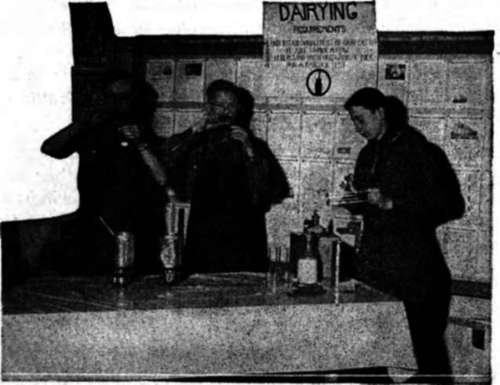
Many doors of opportunity are opened by the Merit Badge Program. Dairying is a Merit Badge especially for Rural Scouts.
It is for this reason, that a very definite procedure has been established for its administration—for the protection and aid of the boy.
Responsibility For Administration
The responsibility for upholding the standards of the Scout Requirements in the various sections of the country rests squarely upon the Local Councils. They were created to a great extent for this specific purpose.
To carry on this responsibility each Local Council has established a Council Committee on Scout Advancement, according to the charge in the By-Laws of the Boy Scouts of America (Art. XV, Sec. 3):
"The Committee on Scout Advancement of each Local Council shall be responsible for seeing that the Second and First Class Examinations, as well as examinations for Merit Badges and higher ranks in Scouting are given in such manner, and under such auspices, as will lead to a strict adherence to the standards as set forth in the official publications of the Boy Scouts of America."
The Council Committee gives direction to the entire Advancement Program and determines whether one or both of the following methods of administering the Advancement Program shall be used in that Council: a—The Troop Plan of Scout Advancement, under which the Troop and its Committee, as the administrative body, handles Second and First Class advancement.
b—The Council Plan of Scout Advancement, which on a neighborhood, District or Council basis, administers Merit Badge advancement—and, In those Councils where the Troop Plan is not in use, provides for Second and First Class reviews and awards.
Leadership Of The Two Plans
Since the Council Committee on Scout Advancement is directly in charge of the Council Advancement Plan, the leadership for this is provided by the Council Committee itself.
The leadership of the Troop Advancement Plan is placed in the hands of the Troop Leaders under the guidance and advice of the Local Council, but only after the Troop has proved to the satisfaction of the Council Committee on Scout Advancement that it is capable of assuming the responsibility. Since the purpose behind careful administration of the Advancement Program is. to maintain high standards, it is obvious that no Troop will want to undertake the

Keep an advancement chart where it can be seen and studied by the Scouts. It will keep them on their toes. Present it graphically.
Troop Plan unless it is positive that it can keep the standards to which its Scouts are entitled. The use of the Troop Plan should be possible in strong Troops with effective Patrols and Troop Committees, but will seldom be possible, for example, in new Troops which are just rinding themselves, in Troops where the leadership has suddenly been changed, in Troops where the Patrols are under reorganization, in Troops where efficient Troop Committees are still to be developed.
Processes Of Scout Advancement
The administration by one method or the other involves the four processes of all Scout Advancement —PREPARATION, EXAMINATION, REVIEW and AWARD, and is based upon the following features:
1. "Counselors"—Scouters or reliable Scouts (for Merit Badges Scouters only), designated to aid Scouts in PREPARATION for their advancement and to give them the necessary EXAMINATION.
2. "Boards of Review"—a group of men who REVIEW the Scout subsequent to the examination.
3. "Courts of Honor"—public or semi-public, impressive functions, at which the presentation of the AWARD is made to the boy.
Approval By Local Council
The Local Council is specifically charged by the National Council to approve the Troop Plan of Scout Advancement only for such Troops as are qualified according to approved standards and are in a position to provide effective administration of the four processes just outlined. The Council is also charged to provide District or Council Boards of Review and Courts of Honor to meet the needs of Troops not yet authorized to administer the Troop Plan.
Continue to:


My Books

