


Thomas William Silloway
Description
This section is from "The American Cyclopaedia", by George Ripley And Charles A. Dana. Also available from Amazon: The New American Cyclopædia. 16 volumes complete..
Thomas William Silloway
Thomas William Silloway, an American architect, born in Newburyport, Mass., Aug. 7, 1828. He began to practise his profession in Boston in 1851, and in the 20 years following more than 200 church edifices were built or remodelled under his superintendence. He designed the new capitol, Montpelier, Vt. (1859) Buchtel college, Akron, O. (1872), etc. While pursuing his profession as an architect, he acted as a Universalist preacher from 1852, and was ordained a clergyman in 1862. He has published "Theognis, a Lamp in the Cavern of Evil" (Boston, 1856); " Text Book of Modern Carpentry" (1858); "Warming and Ventilation" (18G0); "Atkinson Memorial," a series of 18 discourses (1861); " The Conference Melodist" (1863); "The Cantica Sacra," a book of church service (1865); and " Service of the Church of the Redeemer" at Brighton (1867). With George M. Harding he edited an improved edition of Shaw's " Civil Architecture " (1852). SILPHIUM (Gr. σίλфιον, the ancient name of some resin-bearing plant), a genus of coarse, robust, perennial plants of the composite family, which have a copious resinous juice and large heads of flowers, resembling those of the sunflower, but quite different in structure.
In silphium the numerous ray flowers are pistillate and fertile; those of the disk, though they are apparently perfect, are sterile; the broad flat akenes are winged and without pappus. The genus comprises about 20 species, all North American; some are very abundant on the western prairies, while others are peculiarly southern. The best known species is S. laciniatum, called rosin weed; it has a large thick root, from which arise numerous radical, long-petioled leaves, from 12 to 30 in. long; they are very thick, and rough with bristly hairs; their general outline is ovate, but they are deeply pinnately cut and parted, and the divisions themselves often cut-lobed; the stem, usually 3 to 6 ft. high, sometimes reaches 11 ft., and bears near its base numerous leaves similar to those from the root, and fewer leaves above. The flower heads, borne in a kind of raceme at the upper part of the stem, are 3 to 5 in. across, and, as in all the other species, yellow. The resinous juice of this and others exudes either spontaneously or from the puncturing of insects, appearing in small translucent tears upon the stem and foliage. This resin and the plant itself have been regarded as useful remedies in asthma and similar diseases of horses.
A tincture of the root and leaves is sometimes used as a domestic tonic and diaphoretic. The erect leaves of this plant, when growing in the open prairie, commonly stand with their edges pointing north and south; hence it has been called compass plant, pilot weed, and polar plant. This species occurs from the prairies of Michigan southward and westward. A closely related species, found from Ohio west and south, called prairie burdock or prairie dock, is S. terebinthinaceum, having also large and coarse leaves, which are not cut, but only serrate on the margins, and rough and scurfy especially on the under surface; the tall stems are smooth, and the heads of flowers are smaller than in the preceding. This species produces resin abundantly, the leaves being often sprinkled with it. One of the most striking species is S. perfoliatum, called the cup plant; its square stem bears opposite leaves, a foot or more long; these are united by their bases around the stem, and form a concave disk, which after a rain contains a considerable quantity of water.
This has a similar geographical range to the preceding, but having long been cultivated in gardens on account of its curious leaves, it has been introduced much further east.
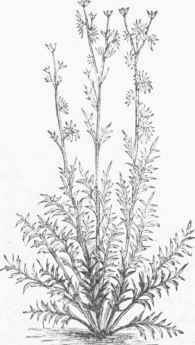
Rosin Weed (Silphium laciniatum).
Continue to:


My Books

