


Tiger Flower
Description
This section is from "The American Cyclopaedia", by George Ripley And Charles A. Dana. Also available from Amazon: The New American Cyclopædia. 16 volumes complete..
Tiger Flower
Tiger Flower, a species of tigridia, both names referring (from Lat. tigris, a tiger) to the spotted flowers. It is a Mexican genus of bulb-bearing plants, belonging to the iris family; the long sword-like leaves are much plaited, and the stems, about 2 ft. high, produce a succession of large and very showy but ephemeral flowers. The flowers, 5 or 6 in. across, have three very large outer divisions with a concave base, and together form a cup; the three inner divisions are smaller and fiddle-shaped. The species in cultivation are T. pa-vonia, having rich scarlet flowers variegated with bright yellow and spotted with black, and T. conchijlora, orange and yellow with black spots; there are garden varieties of both, differing in the depth of color and markings. Their cultivation is very simple; the bulbs are planted in any good garden soil after cold rains are over, and taken up at the first frosts, dried, and kept until spring where mice cannot destroy them. TIGER MOTH. See Moth. TIGHE, Mary (Blackford), an Irish authoress, born in Dublin in 1773, died at Woodstock, Kilkenny co., March 24, 1810. She married in 1793 her cousin, Henry Tighe, of county Wicklow, a member of the Irish parliament, and in 1805 printed for private circulation her " Psyche," a poem founded on the story of Cupid and Psyche as related in the "Golden Ass " of Apuleius. It reached a fifth edition in 1816. She died of consumption after several years of suffering.
In 1811 appeared a complete edition of her poetical works, containing many devotional pieces.
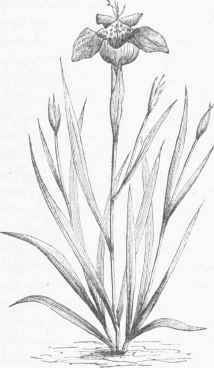
Tiger Flower (Tigridia pavonia).
Continue to:


My Books

