


Tunny
Description
This section is from "The American Cyclopaedia", by George Ripley And Charles A. Dana. Also available from Amazon: The New American Cyclopædia. 16 volumes complete..
Tunny
Tunny, a marine fish of the mackerel family, and genus thynnus (Cuv.). The body is elongated and compressed, with a slender tail keeled in the middle, and with two oblique cutaneous folds at the base of the caudal fin on each side; mouth large, with the teeth small, awl-shaped, in a single row on each jaw, and fine and crowded on the vomer and palate; there are two dorsals, near together, the posterior followed by nine or ten finlets opposite those of the anal fin; scales largest around the pectoral region, forming a kind of corslet, on the anterior part of the back, and along the lateral line; cerebellum remarkably large. The common tunny of Europe (T. vulgaris, Cuv.) attains a length of 15 to 20 ft., and a weight of more than 1,000 lbs.; it is dark blue above, the corslet lighter, sides of head white, and below grayish white spotted with silvery; first dorsal, pectorals, and ventrals black, the other fins mostly flesh-colored; the pectorals are scytheshaped, and one fifth the length of the body.
It is very active and voracious, feeding on herring and the small migratory species. Tunnies are very abundant at the E. and W. ends of the Mediterranean, and in its narrowest portions generally, approaching the shores in summer in large shoals for the purpose of spawning; at this time they are captured in large nets arranged in a funnel-like form. The flesh is highly esteemed, almost like meat, as firm as that of the sturgeon, but liner flavored. It is found also in the Atlantic and in the North sea. The principal fishery of the present time is carried on in Sicily and Sardinia. - The American tunny (T. secundo-dorsalis, Storer), called also horse mackerel and albicore, attains a length of 9 to 12 ft.; it is nearly black above, silvery on the sides, and white below; gill covers and pectorals silvery gray; iris golden; ventrals black above and white below; finlets mostly yellow; the second dorsal is much higher than the first, anal further back than in the European tunny, and the pectorals are shorter.
It is found from New York to Nova Scotia, coming into Massachusetts bay about the middle of June and remaining through September; it gets very fat by the end of August, and is then valuable for the oil, which is obtained by boiling the head and the abdomen; a single fish yields about 20 gallons; it is taken by the harpoon, and is active, strong, and tenacious of life; it feeds on menhaden and other small shoal fish; its flesh, which is rarely used here except for mackerel bait, resembles lean pork, with a fine mackerel taste. - The tunny of the tropics (T. pelamys, Cuv.), with other allied genera of the family, has been described under Bonito.
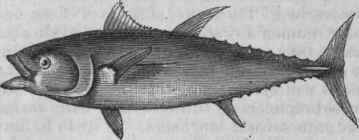
American Tunny (Thynnus secundo-dorsalis).
Continue to:


My Books

