


Turnip
Description
This section is from "The American Cyclopaedia", by George Ripley And Charles A. Dana. Also available from Amazon: The New American Cyclopædia. 16 volumes complete..
Turnip
Turnip, a variety of trassica campestris, having two very marked forms: one with small root, but abundant stems and leaves, cultivated for its foliage and its oleiferous seeds, as rape; the other with a large, fleshy root, and comparatively little foliage, which is important in agriculture, and presents numerous sub varieties, all included under turnip. The genus brassica, of the family cruciferoe, is described and figured under another species (see Mustaed), and the characters of B. campestris are given under Rape. Both forms of the species, rape and turnip, are recognized in the wild state, though there the root of the turnip is comparatively small; when the two are sown together, they cross very freely and produce a great number of intermediate forms; the turnip form is spontaneous in Armenia, Russia, and Scandinavia, and is a weed' of cultivation in various countries. There are two very distinct classes of turnips: 1, those with the root rounded and often broader than long, and usually lobed, hairy, and rough radical leaves; these are called common, round, and English turnips, and when turnip is used by cultivators without a prefix, this kind is intended; 2, those with larger, elongated, and more solid roots, and with the radical leaves smooth and covered with a bloom, like those of the cabbage; these are known as Swedish or Russian turnips (by English farmers as " Swedes"), and more generally as ruta-bagas (Sw. rota-taggar, root rams). There are yellow- and whitefleshed varieties in both classes, and the exterior is often more or less colored, from rosepurple to dark violet.
All are biennials, at least in cultivation, and as their roots are not perfectly hardy, they must be stored for the winter. Turnips are cultivated as a garden and as a field crop. The early garden crop is of some of the quick-growing round kinds, such as the flat Dutch; the seeds must be sown as early as the soil can be worked, as hot weather soon makes the roots spongy. The main crop in garden or field is sown later; the ruta-baga sorts require a longer season, and are sown late in June or early in July, and other varieties, according to their requirements, until early in September, and in the southern states much later. In field culture, the rutabagas and other large kinds are sown in drills, and kept well cultivated, while the quicker growing, smaller sorts are often sown broadcast; good crops of these are frequently obtained by sowing the seed broadcast among Indian corn, just before that crop is cultivated for the last time. Turnips, when just germinated, suffer much from the attacks of the small flea beetle (haltica), which are often very disastrous (see Tttknip Fly); the only remedy is to use an abundance of seed, and to sprinkle the young plants copiously with slaked lime or ashes.
These, with other roots, do not occupy the important place in our agriculture that they do in that of England, our abundance of Indian corn rendering them less a necessity as winter food for animals; still their value as affording a variety is becoming more appreciated, and their culture is rapidly increasing. The ruta-baga sorts, though costing more labor to raise, are the most nutritious and the best keepers; they are preserved in cool cellars or in heaps in the open ground, the roots being stacked in pyramidal piles and covered with sufficient straw and earth to prevent severe freezing. Turnips are most valued as food for cattle and sheep; they are sliced and sometimes pulped in a machine for the purpose. In England, and in some parts of this country, turnips are fed to sheep in the field; a space is enclosed with hurdles or movable fences, and when the sheep have cleared off the turnips from this portion, the hurdles are removed to enclose another section; for swine and horses they are less valued than other roots.
The amount of nutritive matter in turnips is very small; the common kinds have from 90 to 92 and the ruta-bagas about 87 per cent, of water; the albuminoids are from 1 to 16 per cent., and the carbohydrates vary from 5 per cent, in the common to 9 per cent, in the ruta-bagas. The leading garden sorts, besides the white Dutch already mentioned as the earliest, are: the red-top strapleaved, the best of the flat kinds; the cowhorn, a foot long and 3 in. through, the half which grows above ground being green - also grown as a field crop; and yellow Aberdeen, purplish above and yellow below, with a yellow flesh. The white French, one of the rutabaga kinds, has the root all below ground, is twice as long as thick, of medium size, and keeps well; though called French, its origin is unknown; it is superior to all others for the table, unless it be the sweet German, which differs only in being broader than long; both are probably strains of the same variety, differing in the shape of the root. The Teltow is a great favorite with the Germans; the root is about 3 in. long and an inch thick, with a very piquant flavor which resides in the rind; it is valued for flavoring soups and stews.
In England the list of ruta-bagas or Swedes for field culture is long, and each year adds new varieties; in this country varieties known as the improved American, Skirving's purple-top, Carter's, and Laing's ruta-bagas are the principal sorts cultivated.
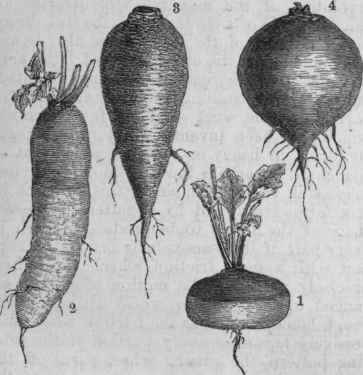
Varieties of the Turnip. 1. Red-top Strap Leaf. 2. Cowhorn. 3. Long White French. 4. Ruta-baga.
Continue to:


My Books

