


Weigela
Description
This section is from "The American Cyclopaedia", by George Ripley And Charles A. Dana. Also available from Amazon: The New American Cyclopædia. 16 volumes complete..
Weigela
Weigela, a shrub introduced from China by Robert Fortune, named Weigela rosea by Thunberg, after Weigel, a German botanist. It is not sufficiently distinct from a much older genus, Diervilla, after a French surgeon named Dierville, who early in the last century carried the plant to Tournefort from Canada. Being the older, Diervilla must be taken as the correct botanical name of these shrubs, but weigela, being so thoroughly established, must servo as the common name. Diervilla differs from the honeysuckle (Lonicera) in its slender calyx lobes, its nearly regular corolla, and the fruit, which in the honeysuckle is a berry, but in this is a many-seeded, two-valved pod. We have two native forms, popularly known as bush honeysuckle. The northern species, D. triftda, is quite common in the middle and northern states, extending to Hudson bay, and westward to the Rocky mountains; it is a neat bush, 1 to 4 ft. high, with oblong-ovate, taper-pointed, petioled leaves, and pale yellow flowers, usually three on a stalk, from the axils of the upper leaves and terminal. The southern bush honeysuckle, D. sessilifolia, found along the southern Alleghanies, has sessile leaves and many flowers upon a stalk. These are far less showy than those from Japan and China. The nomenclature of these is in much confusion.
The one first introduced as W. rosea, now called by some D. Japonica, has given origin to many varieties; it grows about 5 ft. high, with numerous erect stems, ovate-lanceolate, serrate leaves, and a profusion of rosy or nearly white flowers, an inch or more long. What is called D. (or Weigela) amabilis is much taller, with recurving branches and larger leaves. Both of these have given varieties, and there has been much crossing, so that the list of named sorts is long; they differ in the color and abundance of their flowers, and there are two with variegated foliage. Among the desirable varieties are hortensis nivea, with pure white flowers and blooming a long time; Isoline, with white flowers having a yellow blotch in the throat, and changing to blush; and Desboisii, with flowers of the deepest rose color, and so abundant as to make the stem a continuous garland. Others are described in the catalogues, and new varieties are frequently added. These plants are perfectly hardy, and multiplied by cuttings from the recent shoots taken just as they begin to harden.
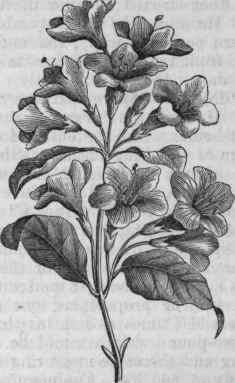
Rose Weigela (Diervilla rosea).
Continue to:


My Books

