


Elba
Description
This section is from "The American Cyclopaedia", by George Ripley And Charles A. Dana. Also available from Amazon: The New American Cyclopædia. 16 volumes complete..
Elba
Elba, an island in the Mediterranean, belonging to the Italian province of Livorno, separated from the mainland by the strait of Piom-bino; length about 18 m., greatest breadth 12 m.; area, about 90 sq. m.; pop. about 20,000. Its outline is irregular, the mountains which traverse the island rising in some parts more than 3,000 ft., and being indented by deep gulfs and inlets, so that its breadth in some places does not exceed 3 m. The soil is fertile, but only a small portion is under tillage. The valleys abound with fruit trees, but are not well cultivated, and the fruits are of inferior quality, excepting oranges. Among the annual products of the island and its waters are red and white wine, marine salt, tunnies, sardines, anchovies, and other fish, and iron, for which the island has always been celebrated. The iron is found in a mountain near Rio, on the E. coast, about 2 m. in circumference, 500 ft. high, and yielding from 50 to 75 per cent. pure metal. There are quarries of granite in the S. W. part of the island, in which crystals of red and green tourmaline and emeralds are found. The principal towns are Porto Ferrajo, Porto Longone, Rio, and Marciana. The island was called AEthalia by the Greeks and Ilva by the Romans, and was noted for its minerals.
Ancient ruins are still visible in several places. During the middle ages it was ruled by various Italian princes and chiefs. In 1548 Charles V. ceded the territory of Porto Ferrajo to Tuscany. Afterward the island was successively governed by Spain, Naples, and the lords of Piombino.
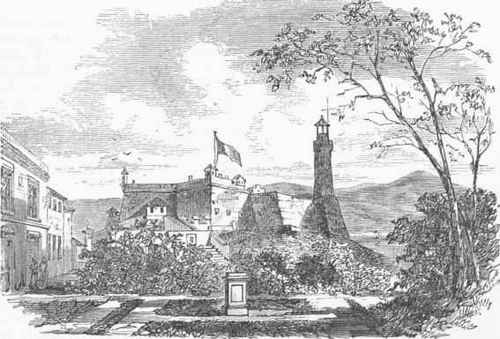
Porto Ferrajo, Elba.
From July, 1796, to April, 1797, it was occupied by the British. It was then ceded to France, and in 1801 united with the new kingdom of Etruria. The treaty of Paris in 1814 erected Elba into a sovereignty for Napoleon I., who resided there from May 4, 1814, to Feb. 26, 1815. During his brief sovereignty Napoleon caused a road to be built uniting Porto Ferrajo with Porto Longone. The villa of San Martino near Porto Ferrajo, which was occupied by Napoleon, has been converted into a Napoleonic museum, and contains various objects of interest relating to the first empire. (See Napoleon d Vile d'Elbe, by Amedee Pichot, Paris, 1873.) In 1815 Elba reverted to the grand duke of Tuscany, and with the rest of his territory was annexed to the kingdom of Italy in 1860.
Continue to:


My Books

