


Hyrax
Description
This section is from "The American Cyclopaedia", by George Ripley And Charles A. Dana. Also available from Amazon: The New American Cyclopædia. 16 volumes complete..
Hyrax
Hyrax, a small pachyderm, coming nearest to the rhinoceros family, but looking much like a diminutive hare, and in some respects seeming to form one of the connecting links with the rodents, constituting the family lam-nungia of Illiger. The old naturalists had always placed it among the rodents, but Cu-vier, from its anatomical structure, ranked it with the pachyderms, of which Swainson calls it the gliriform type. The number of ribs is 21 pairs, greater by 6 than in any rodent, of which 7 are true; the sternum consists of 6 pieces;* there are no clavicles; the suborbital foramen is small; the dental formula is: incisors 2/4, canines none, molars 7/7-7/7 or 6/6-6/6, with distinct roots; the extinct pachyderm toxodon has long and curved molars, without roots, and incisors with arched sockets, forming another link in the chain of rodent affinities in this order. The toes are four before and three behind, as in the tapir; the hoofs are small and flat, but the inner toe of the hind foot has a curved claw. The genus hyrax (Hermann) is the only one in the family, and contains four or five species. The body is covered with short, thick fur, with a few long bristles scattered among the shorter hair, and others around the nostrils and orbits; a tubercle in the place of the tail.
The common name of the species is daman; it seems to bear the same relation to the rhinoceros as the existing sloths to the extinct megatherium; it lives among rocks, and is sometimes called rock rabbit and Cape badger. The Syrian hyrax (H. Syriacus, Schreb.) is about 11 in. long and 10 in. high; the upper parts are brownish gray, the sides yellowish, and the lower parts white. Its movements are quick, and its habits much like those of rodents; it delights in heat, in cold weather rolling itself up; it searches for narrow openings in which to hide itself, as its soft feet are not adapted for digging burrows like many rodents; its sense of smell is acute, and by it the food, which is wholly vegetable, is obtained; it is of mild disposition, with little intelligence and little fear. It is found on the mountains near the Red sea, and in Ethiopia and Abyssinia in caverns in the rocks, dozens being seen at a time warming themselves in the sun. This animal, according to Bruce, is called in Arabia and Syria Israel's sheep, and is the shaphan of the Hebrews, generally translated rabbit or cony.
The Cape hyrax (H. Capensis, Pall.) is about the size of the rabbit, but with shorter legs, more clumsy form, thick head, and obtuse muzzle; the color is uniform grayish brown, darkest along the back; it lives in the rocky regions of the south of Africa; its flesh is delicate and savory. Other species are described in the woods of Africa.
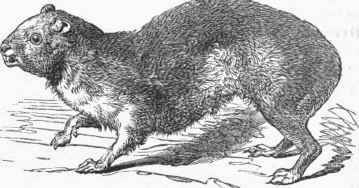
Hyrax Capensis.
Continue to:


My Books

