


Mycenae Or Myccne
Description
This section is from "The American Cyclopaedia", by George Ripley And Charles A. Dana. Also available from Amazon: The New American Cyclopædia. 16 volumes complete..
Mycenae Or Myccne
Mycenae Or Myccne, a city of ancient Greece, situated on a rocky hill at the N. E. extremity of the plain of Argos. It is said to have been founded by Perseus, and its massive walls were deemed the work of the Cyclops. It is spoken of as the favorite residence of the Pelopidae, and as the principal city of Greece during the reign of Agamemnon. From the period of the Dorian conquest its importance declined; but it still maintained its independence, and in the Persian war contributed its quota of troops. This brought upon it the enmity of the other Argives, who about 468 B. C. laid siege to My-cente, reduced it by famine, and destroyed it. It was never rebuilt, but its remains, near the modern village of Kharvati, are among the grandest and most interesting of the antiquities of Greece. Part of the walls of the acropolis, to the height in some places of 15 or 20 ft., are still standing, and at the N. W. angle may yet be seen the great entrance to the citadel, styled the " gate of lions " from the two beasts, considered lions, sculptured in a triangular block of gray limestone, supported by two massive uprights.
Some suppose that it represented the altar of the deity of the sun, worshipped at Mycenae. The most remarkable of its other antiquities is the subterranean vault commonly called " the treasury of Atreus," consisting of two chambers, the larger of which is of circular form, 40 ft. high and 50 ft. broad. The lintel of the entrance is formed by two huge blocks, the lower of which is 25 ft. long, 20 ft. wide, and 4 ft. thick, and the other, still covered with earth, is probably of the same dimensions. Except in the ruins of Baalbek, these are the largest blocks found in the walls of buildings. The circular room consists of numerous horizontal rows of stones placed above each other in circles gradually diminishing in diameter. Several archaeological societies and private persons, among them Schliemann, have recently entered upon negotiations with the Greek government for the disinterment of the entire acropolis.
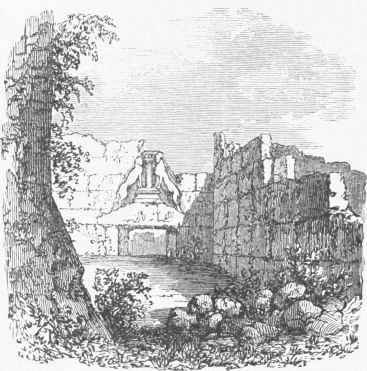
Gate of Lions, Mycenae.
Continue to:


My Books

