


Aerolite. Continued
Description
This section is from "The American Cyclopaedia", by George Ripley And Charles A. Dana. Also available from Amazon: The New American Cyclopædia. 16 volumes complete..
Aerolite. Continued
It is certain that such falls were just as frequent in former centuries as they are now, only the records are lacking. In regard to the ancient geological eras, there is no doubt that the falls of meteoric masses were even more frequent; it is highly probable even that a portion of the earth's and moon's mass is largely made up of such aerolites, which are not now found in the lower strata of the earth for the simple reason that they are very oxid-izable, and have been disintegrated by air and water and mixed with the original terrestrial matter, by the immense changes through which our earth's crust has passed; they may therefore exist in a better state of preservation on the moon's surface. Olbers supposes that the earth has during countless ages hollowed out for itself a kind of comparatively empty rut among those flying aerolites, attracting all within the reach of its gravitation, and that now, by the periodical inequalities and perturbations of its orbit, it occasionally appropriates some masses which had before escaped its attractive power, or that the earth occasionally comes in the neighborhood of masses having an orbit which intersects its own. (See Meteor.) In regard to the sizes, the largest masses on record were heard of by Capt. Ross in 1818, when the Esquimaux of Baffin bay informed him of their existence on the W. coast of Greenland. They were found in 1870 by the Swedish Arctic expedition, which brought some of them to Stockholm, where they excited so much interest that in 1871 20 more specimens were collected, now in the royal academy of Stockholm, the largest weighing 25 tons, with a maximum sectional area of 42 square feet.
The next in size weighs 10 tons, and has been presented to the museum of Copenhagen. In Mexico and Brazil similar masses have been found. The British museum possesses one of more than five tons. In the museum in St. Petersburg is a mass of 1,680 lbs. found in Siberia in 1772. Yale college, New Haven, possesses, among more than 100 specimens, one aerolite of 1,635 lbs., which fell in Texas in 1808. The Smithsonian institution possesses a very remarkable annular specimen discovered about 1700 in Mexico, which, according to an Indian tradition, fell there about 200 years before during a shower of stones; its weight is 1,400 lbs. Aerolites of a weight of 200 to 400 lbs. are not uncommon in collections, and those of 100 lbs. and less are very common. - In regard to the chemical composition of these stones, it must be observed that in passing through our atmosphere they undergo some change, as they always take fire in the upper regions, and arrive at the ground quite hot, sometimes making a dee]) hole.
Combustible substances in their composition, and perhaps an atmosphere of combustible gases surrounding them, combined with the immense velocity with which they enter our atmosphere, cause on the sudden diminution of that motion a most intense rise of temperature, ignition.
and very often one or more exceedingly violent explosions. It is therefore not surprising that they all present the appearance of having been subjected to great heat. Chemical analysis has shown that there are two principal kinds, the stony and the metallic aerolites, which by further investigation have been divided into several groups, in accordance with the elements contained and the character of their combinations. Stony aerolites resemble the peridot, a universal scoria from the earth's deep interior, underlying the aluminous basic rocks, the granite and gneiss; the latter, being stratified rocks, are never found among aerolites. The specific gravity of stony aerolites is 3.5 to 3.8, while that of stratified formations, gneiss and granite, and of lava, is only 2.6 to 2.9. Metallic aerolites have a specific gravity of from 6.5 to 8, and consist chiefly of iron, always combined with nickel, usually containing 60 per cent, or more of iron and 5 to 25 of nickel, a compound never found on earth; the other elements are chiefly phosphorus, silicon, aluminum, cobalt, and manganese.
Other substances which have been found in different specimens are: magnesium, titanium, tin, copper, chromium, arsenic, calcium, potassium, sodium, sulphur, carbon, chlorine, nitrogen, and hydrogen in occlusion (see Absorption of Gases by Solids), making 22 elements, one third of those of which the earth is composed. Some aerolites are of a mixed stony and metallic character, but they are never homogeneous; even the metallic ones, which appear to be an alloy, are very heterogeneous. This is manifested by grinding and polishing a face and then acting on it with nitric acid, when some portions will dissolve, and more resistant small crystals will become prominent, showing a decided crystalline structure. The figures thus formed are called, after their discoverer, Widmanstaett's figures, and they may be made so prominent as to allow the surface to be used as an engraved plate and printed. Our figure represents an aerolite found in Wisconsin, preserved in the cabinet of I. A. Lapham of Milwaukee, and engraved after the photograph of a section prepared by Dr. J. Lawrence Smith, showing the Widmannstaettian figures. - The idea suggested by Sir William Thompson before the British association for the advancement of science in 1871, that the existence of vegetable and animal life on our planet may be accounted for by aerolites having brought the first organized germs hither, substitutes for the difficult question as to the terrestrial origin of organisms, the still more perplexing one of how they originated on the aerolites. - See further Phipson's '"Treatise on Meteors, Aerolites, and Falling Stars" (London, 1866); Daubree, Rapport sur les progres de la geologie experimentale (Paris, 1867). The latter is very exhaustive, and contains accounts of experiments in imitating the different kinds of aerolites.
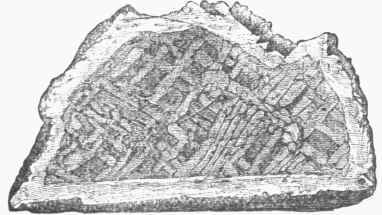
Widmannstaett's Figures.
Continue to:


My Books

