


Artillery. Part 9
Description
This section is from "The American Cyclopaedia", by George Ripley And Charles A. Dana. Also available from Amazon: The New American Cyclopædia. 16 volumes complete..
Artillery. Part 9
The Krupp guns are made of cast steel, composed of puddled steel and pure wrought iron, melted in crucibles and then run into large ingots, which are worked under powerful steam hammers; the fermature consists of a block sliding in a horizontal mortise crossing the bore, which is continued through the gun; the gas check is a steel ring, which by its expansion prevents the escape of the gas. In loading, the breech block is only drawn out far enough to allow the charge and projectile to pass through a hole in its end; an exterior lever working on a hinge starts the block, which being guided by proper grooves can be readily moved in or out. The rifling is polygrooved, the lands being very much narrowed at the breech, which relieves the initial strain due to the forcing of the projectile into the grooves. The various calibres are forged from a single ingot up to the 9-inch, in which the trunnion ring is a separate forging; the larger guns are built up by shrinking successive hoops of steel over a central steel tube, the fermature in the experimental 14-inch being slightly modified so that the charge and projectile are inserted at the side of the breech instead of through the end. The Krupp projectiles are of cast steel lead-coated, and take the rifling at four raised rings on their surface.
The deep grooves cut in the steel to retain the lead reduce the strength of the shells so much that they can only contain very small bursting charges compared with those of other systems; the Armstrong and Whitworth 9-inch shells carrying charges of from 10 to 14 lbs., while that of the Krupp 9-inch is less than 4 lbs. The Krupp cannon sometimes use Gruson's chilled iron projectiles. Krupp sixes and fours, firing 13-8-lb. and 8'5-lb. projectiles respectively, were adopted in the Prussian field artillery in 1864, and gave so much satisfaction that they were exclusively used in the war of 1800 with Austria, although one third of the Prussian batteries were then armed with the old 12-pdr. smooth-bore. In the late war with France the marked superiority of the Prussian field guns was greatly enhanced by the skilful manner in which they were handled. The principal battles, from Weissen-burg and Forbach to Gravelotte, Beaumont, Sedan, and Metz, as well as the engagements with the French army of the north and second army of the Loire, were to a great extent a series of artillery combats: and both French and Prussians attribute the unprecedented successes of the latter mainly to the artillery, which whenever practicable was employed in mass.
At Worth a grand battery of 96 guns covered the overwhelming attack on MacMa-hon; near Gravelotte over 300 guns deployed on the road to the right of St. Privat and forced the French infantry to retire; and at Sedan, the greatest artillery battle of the war, the fire of more than 750 guns repeatedly drove back the French troops, with the enormous loss of 10,000 killed and 20,000 wounded. The heaviest Krupp guns used at the siege of Paris were 6-inch (15-centimetre), weighing about 6,000 lbs. and firing 55 to 60-lb. projectiles; they were opposed to the heaviest French naval guns. As a matter of economy, converted twelves and twenty-fours of bronze and cast iron are temporarily retained in the Prussian service for siege and reserve purposes. The larger Krupp calibres are from 6 to 8, 8 to 9, 9 to 10, 11, 12, and 14 inches, most of them being used in both the land and naval services of Prussia. The 8-inch sea-coast gun (209-lb. projectile) can be used with great effect up to 1,800 yards against ships covered by 4 1/2-inch plates; and within the same range the 9-inch gun (297-lb. projectile) can do very serious injury to 6-inch armor plates; up to 700 yards the 9-inch gun can breach an 8-inch shield, but at greater distances 11-inch guns must be employed, which, with their 495-lb. projectiles, are very effective against the heaviest ironclads at 2,000 yards.
But two 14-inch guns have been made; with an 150-lb. charge they fire shells weighing 1,080 lbs., exclusive of a bursting charge of 17 lbs., the weight of the solid shot being 1,212 lbs. The 14-inch, with its carriage and turntable, weighs about 90 tons; the gun alone 112,000 lbs., not quite as much as the American 20-inch Rodman. The English have always deemed steel guns dangerous, which is true so far as large solid steel guns are concerned; the built-up guns of this material have however shown remarkable endurance, but in justice to other systems it should be stated that the Rodman prismatic powder, exclusively used in the Krupp guns, gives extremely low pressures. In a recent competitive trial of endurance, however, between a 9-inch Krupp and a 9-inch Armstrong, both using prismatic powder, the German gun had a decided advantage. To Prussia also belongs the credit of the introduction of the new 8 1/4-inch rifled mortar, the projectile having a bursting charge of 15 lbs., and exploding by a percussion fuse; it was used during the late war at the sieges of Paris, Bel-fort, and other places, the precision of its fire being very remarkable.
Russia adopted in 1859 French bronze rifled fours; these have been given up and replaced by Krupp fours and nines, as well as by bronze breech-loading fours and nines, the bores lined with steel tubes, made at the arsenals so as to utilize the old material. The fours weigh 765 lbs., their projectiles 16 lbs.; the nines 1,382 lbs., and the projectiles 31 1/3 lbs. The Krupp system has been also adopted for heavy guns, some of which are constructed by the government at the Abukoff works near St. Petersburg; the 8 and 9-inch guns were the largest calibres up to 1868, when the 11-inch gun was added.
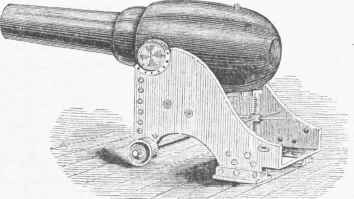
Fig. 10. - Whitworth Gun.
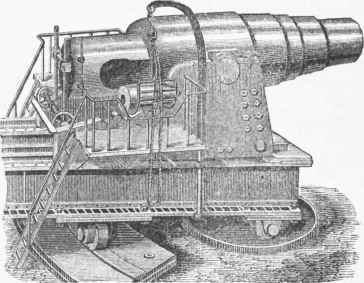
Fig. 11. - Krupp Gun.
Russia has also adopted the Prussian rifled mortar; there are two calibres, 8 and 6-inch, weighing 8,624 and 3,360 lbs., with 195 and 90-lb. projectiles, the charges being 19 and 8 lbs. respectively. Immediately after the Italian campaign of 1859 the Austrians put in service field guns very similar to the French fours; later they had rifled guns on the Lenk system, which were fired with guncotton instead of powder; finally in 1863 they adopted an entirely new system of muzzle-loading bronze guns, of two calibres, eights and fours, weighing 1.099 and 580 lbs. respectively, with 14 1/2 and 8-lb. projectiles. For mountain service bronze rifled threes are used, weighing only 185 lbs. and firing a 5-lb. projectile. The Krupp system has been adopted for all their heavy guns. Italy and Spain adopted without modification the French system of bronze muzzle-loading rifles, which in the latter country were replaced in 1868 by Krupp field pieces, some bronze breech-loaders being also made. Following the example of France, Spain had her large cast-iron cannon hooped to increase their durability, the results giving great satisfaction.
Continue to:


My Books

