


Ferrara
Description
This section is from "The American Cyclopaedia", by George Ripley And Charles A. Dana. Also available from Amazon: The New American Cyclopædia. 16 volumes complete..
Ferrara
Ferrara. I. A province of Italy, formerly a part of the Papal States, bounded N. by the main branch of the Po, which divides it from Lombardy, E. by the Adriatic, S. by the provinces of Ravenna and Bologna, and W. by Modena, from which it is partly separated by the river Panaro; area, 1,009 sq. m.; pop. in 1871, 215,369. The surface is flat, and in many parts below the level of the Po, and protected from inundation by embankments along the river. A considerable portion of the E. part of the province is almost constantly under water. In June, 1872, there was a terrible inundation by which 20,000 people were rendered homeless. The soil is rich and fertile, but the vast swamps render the atmosphere more or less unwholesome, especially in summer. The chief products are grain, rice, flax, hemp, wine, olives, and silk. Extensive pastures favor the rearing of cattle, and the fisheries are of some importance. The province formerly constituted the greater part of the duchy of Ferrara, which was ruled by the house of Este from the early part of the 13th century to 1598, when it was annexed to the Papal States. In 1796 it was taken by the French and formed part first of the Cisalpine republic, and afterward of the kingdom of Italy, till 1814, when it was restored to the pope, with the exception of a small portion between the Po di Goro and the Po della Maestra, which was secured to Austria by the congress of Vienna, together with the right of garrisoning the citadel of Ferrara. The province was governed by a papal legate or cardinal, and was called a legation, until November, 1850, when it came under the administration of an inferior prelate.
In June, 1859, the Austrian troops were withdrawn from the capital, and in March, 1860, it was annexed to the kingdom of Sardinia, The principal towns besides the capital are Lugo, Cento, Bagnacavallo, and Comacchio, the last a fortified town, situated on an island in the midst of extensive swamps, and noted for its fisheries, which are celebrated by Tasso and Ari-osto.
II. A city, capital of the province, situated in a flat unhealthy country, only about 7 ft, above the level of the sea, on the left bank of the Volano, branch of the Po, about 5 m. S. of the main channel of that river, 26 m. N. E. of Bologna and 38 m. N. W. of Ravenna; pop. as a commune, in 1871, 72,447, of whom less than one half were in the city proper. Ferrara was a small village until the beginning of the 7th century, when it was walled by the exarch of Ravenna. The bishopric of Ferrara dates from 661, the archbishopric from 1735. A general council was convened here in 1338, but was removed to Florence. (See Eugenius IV., and Florence, Council of.) Under the rule of the princes of Este the city gained great importance, especially in the 16th century, when it was celebrated for learning, poetry, art, and the refinement and splendor of its ducal court. In the 15th centurv it was famous for its school of painting. In the early part of the 16th it gave an asylum to Calvin and other religious reformers. Guarini, Boiar-do, Ariosto, and Tasso were among the most illustrious ornaments of its court. The city had in its most prosperous period about 100,-000 inhabitants. It still retains many vestiges of its former splendor.
The churches contain fine works of art, especially that of the Campo Santo, which occupies the site of the old Certosa convent. The cathedral of St. Paul was consecrated in 1135, and contains the tomb of Urban III. Santa Maria del Vado is the oldest church, but has been entirely altered by modern restoration. That of San Francesco is famous for its echo, which has 16 reverberations. Ariosto was buried in the church of San Benedetto, but in 1801 his remains were removed to the public library.
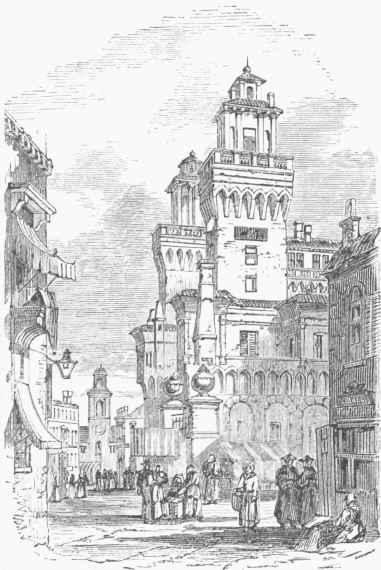
Castle of Ferrara.
The finest of the palaces of Ferrara are the Diamond palace, or Villa Ercole, and the palazzo del Magistro, where the accademia Ariostea holds its sittings. In the hospital of Santa Anna a small room on the ground floor is still shown in which Tasso is said to have been confined as a lunatic for many years by Alfonso II., but the identity of this room with his place of confinement is now very generally disbelieved; and near the city is the villa Bel Rignardo, where the poet enjoyed the society of Eleonora of Este. The university of Ferrara was founded in 1321, renovated in 1402, closed in 1797, and reopened in 1824. It was again closed during the revolutionary troubles of 1848-'9, and reopened Nov. 1, 1850, after the reestablishment of the papal authority. It is chiefly renowned as a school of jurisprudence and medicine, and is attended by 200 to 300 students. It contains a collection of antiquities, a library of 80,000 volumes and 900 MSS., comprising some of Guarini, Ariosto, and Tasso, and many valuable editions of the 15th and 16th centuries. Ferrara possesses one of the finest and largest theatres of Italy, a botanical garden, and many charitable institutions and convents.
In the centre of the city is a castle flanked with towers and surrounded by wet ditches, which was formerly the palace of the dukes. The population is chiefly collected in the vicinity of this castle, and but thinly scattered elsewhere. The city is enclosed with walls and defended on the W. side by the citadel. The Austrians took possession of the whole city in August, 1847, but the troops were withdrawn in Decern her, and the Austrian occupation remained confined to the citadel until July 14, 1848, when the city was again seized by Prince Liechtenstein. On Feb. 18, 1849, it was occupied for a short time by Gen. Haynau, who imposed upon the inhabitants a contribution of 200,000 scudi. In June, 1859, after the battle of Magenta, the Austrian forces withdrew from the citadel, and it was destroyed.
Continue to:


My Books

