


Breeding Canaries
Description
This section is from the book "The Corner Cupboard; Or, Facts For Everybody", by Robert Kemp Philp. Also available from Amazon: The Corner Cupboard; or Facts for Everybody.
Breeding Canaries
Breeding. Canaries should not be allowed to pair before the beginning of April, as the cold weather of a backward spring frequently kills the young birds. If they are loose in a room together, or in a cage where the cocks and hens can have access to each other, they will be most likely to obey the call of St. Valentine, and make up their matches very early; it is therefore best, as soon as you see an inclination to pair, to shut up in separate cages such males and females as you intend to breed from; these, however, should have passed the winter in each other's society; or, when the happy time does come, it is quite likely that they will refuse all intercourse. Male birds for pairing should be at least two years old, and if these are put with hens older than themselves, the majority of the progeny will be males. It requires some judgment to choose good breeding birds. Particular attention should be paid to temper and temperament. Some cocks are melancholy and phlegmatic ; some fiery and passionate, so much so as to fight with the hen bird, and kill their offspring ; others, again, are so ardent in their love-making as to teaze and annoy the female while she is sitting, to tear the nest and break the eggs. The hens, too, have their faults; some are impatient, and will not wait long for results of their labours, forsaking their eggs almost as soon as laid, and beginning to build and pair again; some break their eggs or destroy their young through awkwardness; some are careless, and let them die for want of attention ; others are spiteful, and bite their young and pull out their feathers, so that they die miserably ; and it sometimes happens that the hens are too weak to bear the exhausting pains and cares of maternity; they lay their egg3 with difficulty ana at long intervals, and are unable to bestow the requisite attention on family matters, so that everything goes wrong, as our fair readers know it must do when the presiding genius of the house is sick or indolent.
In selecting your birds for pairing, take it as an invariable rule that the cock and hen must not both be crested; if they are, you will most likely have the progeny bald, or with some disfigurement about the head. With regard to the matching of colours, let it be observed that the union of opposites produces the most beautiful and harmonious results. All late experience goes to prove this; although some of the older authorities say, put together birds of the same colour; but if you do this, you will have, not increase of beauty, but deterioration. The great secret of fancy breeding seems to consist in this - not apposition, but opposition of colours; thus, for instance, a fine, full, richly-tinted jonquecock, should be matched with a good mealy or variegated hen, and vice versa. A spangle-marked cock with a mealy hen will produce a more full-toned and regularly spangled back than if both parents had been like the father. Innumerable instances might be cited to show how this principle operates; but enough has been said, we trust, for the guidance of the breeders, whose stock, at first, should consist of about three cocks, carefully selected, and half a dozen hens; these, deducting largely for casualties, will produce twenty or thirty young birds in a season, quite as many as can well be managed without extraordinary facilities.
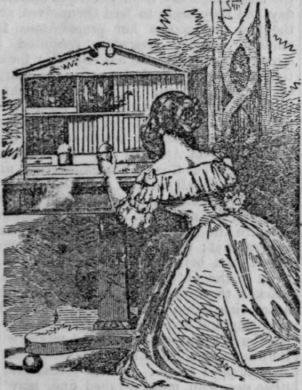
The following directions will be of service to those who breed canaries in cages: - When the proper time arrives, place your birds, a cock and one or two hens, together in a breeding-cage, so constructed that you can, if necessary, separate the birds. At one end, near the top, should be hung two nest-bags, or boxes, as far apart as the width of the cage will allow, and behind each of these let there be a square door opening outwards, by which you can at any time watch the progress of affairs without disturbing the sitters. If you find a coldness and disinclination to pair in the birds, place the hen or hens in one division of the cage and the cock in the other, and let them remain so that they can see each other without being able to come together; or else put the cock in a smaller cage, and hang it up near to, without touching, that in which the hens are. In a few days, probably, the male bird will begin to sing with extraordinary loudness and energy, and peck at the bars which confine him ; he may then be placed again with the hens, and the desired results will no doubt follow. You will soon see one of the hens, whichever happens to be the favourite, busy in the construction of her nest, and in about a week the first egg will be laid, and each day it will be followed by another, until there are five or six. It sometimes happens that the attentions of the male are bestowed wholly upon one hen; if this is the case, as soon as the favourite begins to lay, shut up the cock with the other hen in the separate division of the cage, and do not open the door until you see symptoms of an amicable understanding between the prisoners, or at all events, until a reasonable time has elapsed. Sometimes this second pairing does not take place, and the neglected hen has to be sent about her business. It is customary with some breeders to remove the eggs as they are laid, and replace them with ivory imitations, putting the whole back together when the number is completed; but we do not think this is a good plan ; and the end in view, that of having the young birds all hatched together, is of questionable advantage. In these simple operations of nature the birds should be left to themselves as much as possible. Watch them without appearing to do so; and if all is going on right, by no means interfere with them. If on the thirteenth day of sitting the young birds do not begin to make their appearance, you had better take the eggs very carefully, one at a time, and hold them for a minute or so in lukewarm water, replacing them under the hen directly they come out of the bath. The same operation may be performed on young birds, when, as is sometimes the case in cold seasons, the feathers are not developed so quickly as they should be. Great care, however, should be taken that they do not get a chill. To obviate the danger of this, it has been recommended to syringe the young birds in the nest with warm water, discharged from such a distance that it falls in a gentle spray. When the fledgelings are from twelve to fourteen days old they begin to feed themselves, and the hen commences her preparations for another brood; somewhat recruited in strength by the rest she has enjoyed; for on the cock has devolved the principle charge of attending to the young family, which by this time are scarcely fully fledged. A strong hen canary, paired with a chosen cock, will produce four broods in the season - that is, from April to September - sometimes five; but this is too exhausting, and should not be allowed.
Continue to:


My Books

