


3063. Unstoppering
Description
This section is from the book "Facts Worth Knowing", by Robert Kemp Philip. Also available from Amazon: Inquire Within for Anything You Want to Know.
3063. Unstoppering
This operation is much more likely to be required than the one last described, for the stoppers of decanters, smelling bottles, etc, from various causes, frequently become fixed, and many are the fractures both of bottles and stoppers, caused by the misdirected efforts to remove them. In treating of the various means that may be employed, we will mention that in the order in which they should be tried, beginning with the simple and more easy, and passing on to those which are more effectual, and at the samo time, Unfortunately, more dangerous. The first method, then, that should be tried, is to press the stopper upwards with the fore-finger and thumb of the left hand (the other fingers holding the neck of the bottle), and at the same time giving the stopper a succession of short, sharp, light taps, with the wooden handle of a chisel, knife, or small hammer; care must be taken not to strike the stopper with sufficient force to break it, and it should be borne in mind that it is not the force of the blow, but the vibration, or jar, which is effectual in loosening it; should this plan be found ineffectual after a short trial, it may probably be from the stopper being cemented by some substance, such as the dried sugar of a sweet wine. In such cases we should endeavour to dissolve the cement by a suitable solvent, which should be placed in the groove between the stopper and the bottle, thus, if the stopper is cemented with sugar, gum, or salt, water may be used; in many circumstances, oil is advantageous, or spirit, or even strong acid may be used; whatever liquid is employed it should be allowed to remain some days, being renewed if requisite, and the tapping, etc, should be again had recourse to. (See 254.)
3064. Should these methods fail, a piece of cloth may be dipped in very hot water and wrapped round the neck of the bottle, when the heat causes the expansion of the glass, and if the stopper be tapped or twisted before the heat has had time to enlarge it, its re moval may be effected; this operation must necessarily be a quick one, for if the stopper is heated and enlarged, as well as the bottle, it is obvious that no benefit will result. In the laboratory it is often customary to heat the bottle, not by a strip of cloth dipped in hot water, but by turning it rapidly over the flame of a lamp; in this way there is more danger of cracking the bottle, and the plan is not to be recommended in general, although employed with considerable success by those who, like operative chemists, are constantly in the habit of applying heat to glass ves sels: it will at once be seen that the plan is fraught with great danger if applied to bottles containing inflammable liquids, as spirits, etc.
3065. The most effectual mode of removing stoppers, especially those of small bottles, such as smelling-bottles, remains to be described. Take a piece of strong cord, about a yard or four feet in length, double it at the middle, and tie a knot (Fig. 6, b) so as to form a loop (a) of about four inches in length at the doubled end, bring the knot close to one side of the stopper, and tie the ends tightly together on the opposite Bide, as at Fig. 7, (e.) so as to fasten the
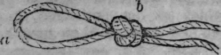
Fig. 6.
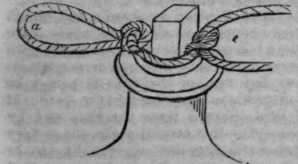
Fig. 7.
string securely round the neck of the stopper; now pass one of the ends through the loop (a), and then tie it firmly to the other end; the doubled cord is then to be placed over a bar or other support, then if the bottle is surrounded by a cloth to prevent accidents in case of fracture, and pulled down-wards with a jerk, the force of which is gradually increased, it will be found that in a short time the stopper is liberated. Two precautions are requisite, one is, that the strain on both sides of the stopper is equal; the other, that care be taken that when the stopper is liberated, it is not dashed by the rebound against any hard substance, which would cause its fracture. 16*
Continue to:


My Books

