


Climatic Relations Of Continental Deposits
Description
This section is from the book "An Introduction To Geology", by William B. Scott. Also available from Amazon: An Introduction to Geology.
Climatic Relations Of Continental Deposits
This subject, though of great importance in deciphering the earth's history, is extremely complex and can be but briefly outlined here.
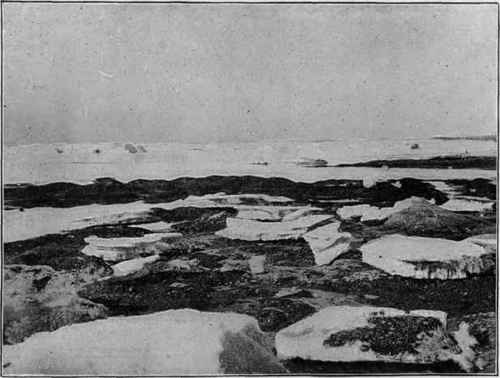
Fig. 123. - Deposit partly made by strandad ice, west coast of Greenland.
(Photograph by Libbey).
1. Polar Regions
The activity of frost destruction in polar lands results in the accumulation of great talus masses of sharply angular blocks and fragments, while the low temperature, even of summer, is unfavourable to chemical decomposition of the rocks and the consequent formation of soil. River deposits are not extensively formed, for rivers in the true polar lands are comparatively tew and small, while glacial accumulations, on the other hand, assume great importance. Small lakes are frequently found among the moraines, but their deposits are not made on a large scale. On the other hand, peat is very largely accumulated in the illimitable "tundras," or swamps, of the lower polar latitudes, the low temperatures retarding the work of decomposition.
2. Temperate Regions
The temperate regions are distinguished from the tropics on the one hand, and the polar lands on the other, by their frequent and wide changes of temperature and by the very great variety of conditions which obtain. In temperate climates with normal rainfall, river deposits, and sometimes lake deposits, assume the most important place, while glacial drift and moraines are local only and confined to mountain areas sufficiently high to extend above the snow-line. Such mountains are, in fact, extensions of polar lands into the temperate regions, and the deposits characteristic of the former accompany them. The temperate regions of pluvial climate are densely covered with vegetation, so that, except on sandy coasts, wind deposits are of small importance and the material laid down in the flood plains of rivers is not extensively sun-cracked, while vegetable accumulations are very extensively formed in swamps and bogs, especially in the cooler and moister parts. Pluvial climates, again, are highly favourable to the decomposition of the rocks and the formation of deep soils which are prevailingly brown in colour from the presence of hydrated iron oxide, or limonite.
In the semi-arid parts of the temperate regions wind-made accumulations of loess are developed very extensively, and in the more arid parts, river and playa and salt lake deposits become conspicuous. Sun cracks are highly characteristic of playa muds and around the margins of fluctuating salt lakes.
3. The Desert Zones
In both the northern and southern hemispheres, between the temperate and tropical regions, is an irregular belt of desert, encircling the earth. The deserts are not entirely rainless, but so nearly so that they have no drainage outlet. The Nile and the Colorado flow across deserts, but their sources lie outside of the desert zone, and water plays but a subordinate part in desert accumulations. Talus masses, due to the rapid changes of temperature, are very common in true deserts, where " all the mountains rise like islands out of an almost flat sea of talus "(Walther). Wind-blown sand is, of course, very characteristic of deserts, which lies in chains of dunes, instead of with a level surface; the sand grains are small, rounded and polished by attrition, often fractured by the sun's heat, and prevailingly of a more or less reddish colour. Salt lakes can exist only in arid climates, so that salt and gypsum are among the most characteristic of desert deposits.
4. The Tropics
The Tropics have a constantly high temperature with but small daily or seasonal range, and a very heavy rainfall, which, however, is usually confined to a part of the year. Chemical decomposition is thus very active and complete, and the soil accumulates to great depths. Especially characteristic of the tropics is laterite (see p. 104), the red colour of which tinges the river silts-Where the topography is favourable to such accumulations, enormous masses of river deposits are formed, as in the interior basins of South America, while the alternating wet and dry seasons, by reversing the movement of water in the soil, occasion the concentration and deposition at the surface of iron and limestone. Despite the great luxuriance of tropical vegetation, the climate is much less favourable to the formation of peat than is that of cooler latitudes, because of the rapidity and completeness of decomposition. It is almost needless to say that the climatic zores pass into one another by gradual transitions.
Continue to:


My Books

