


Spring Deposits
Description
This section is from the book "An Introduction To Geology", by William B. Scott. Also available from Amazon: An Introduction to Geology.
Spring Deposits
As our knowledge of microscopic plants increases, many processes which were believed to be purely chemical, are found to be dependent upon the activity of minute plants. At present, it is not possible to distinguish accurately, in all cases, between the two kinds of processes.
Many springs precipitate carbonate of lime, on coming to the surface. The quantity of CaC03 which a given volume of water will dissolve depends upon the amount of C02 contained in that water, and the quantity of dissolved gas, again, is determined by the pressure to which it is subjected. When the spring-waters reach the surface, the pressure is relieved, much of the C02 immediately escapes, and more or less of the CaC03 is deposited as travertine in the neighbourhood of the spring, often in masses of considerable extent and thickness. The process is not always entirely chemical. The beautiful calcareous terrace formed by the Mammoth Hot Springs, in the Yellowstone Park, is, in part at least, due to the separation of the lime salt from the water by a jelly-like plant, which grows in the hot water and is spread in bright coloured layers over the surface of the terrace. The parts of the terrace .where deposition is no longer in progress can be at once distinguished by their white colour.

Fig. 87. - Ideal section through Mammoth Hot Springs, showing the water rising through limestone. (Hayden).
Siliceous deposits are much less common than the calcareous, because of the rare conditions under which silica is dissolved in any considerable quantity, hot solutions of alkaline carbonates being necessary for this purpose. In the Yellowstone Park, especially on the Firehole River, are great terraces and flats of hard white siliceous sinter, or geyserite, which have been formed and are still being added to by the innumerable hot springs and geysers. The silica is deposited partly by the evaporation of the water and partly by the action of Algce (minute plants) which flourish in hot-water pools. Similar deposits are found in the geyser regions of Iceland and New Zealand.
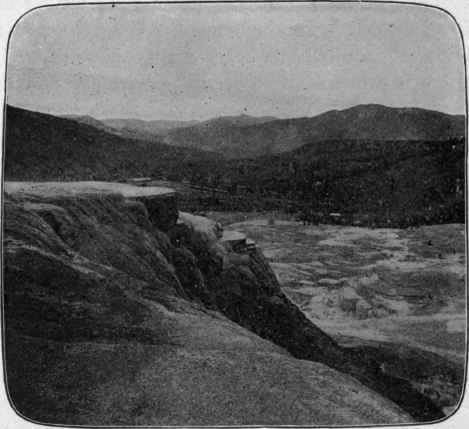
Fig. 88. - Travertine terrace of the Mammoth Hot Springs, Yellowstone Park.
Iron deposits are formed by the springs known as chalybeate, which contain the carbonate of iron (FeC08) in solution. Contact with the air speedily converts the soluble carbonate into the insoluble Fe203, which forms brown stains and patches on the channels leading from such springs, and considerable quantities of it collect in pools. Here again, organic agency may supplement the chemical work, for certain diatoms extract iron from the water, as other Algae extract lime and silica.

Fig. 89. - Crater of Castle Geyser, Yellowstone Park. The crater is composed of silica in the form of geyserite.
Certain mineral springs are of importance, as indicating a way in which mineral veins may have been formed (see p. 430). The Sulphur Bank Springs in the Coast Range of California are an especially instructive example of this activity. Below the depths to which the atmospheric influences penetrate, the fissures in the rocks are filled with hydrated silica, which is as soft as cheese and contains more or less cinnabar (sulphide of mercury). In other places the silica is hardened to chalcedony, and deposits of cinnabar mixed with iron pyrites fill up the crevices. The hot waters which build up these deposits are alkaline, charged with certain acids and alkaline sulphides. Near Virginia City, Nevada, hot alkaline springs rise through a series of fissures, in which they have deposited linings of silica, amorphous and chalcedonic, with some quartz, containing minute crystals of iron pyrites and traces of copper and gold. On the surface the springs have formed a thick layer of geyserite.
Phosphate Deposits are the only strictly terrestrial organic formations which require notice. These are principally derived from guano, which is the accumulated excrement of birds (in caves, of bats), and contains phosphates in large quantity. In rainless regions, such as the Peruvian coasts and islands, the guano may accumulate to great thickness without loss of its soluble matters, but in rainy districts these are largely carried away by percolating waters. Should the underlying rock be a limestone, it will be gradually converted from a carbonate into a phosphate of lime. Such is believed to be the mode of origin of the phosphatic rock of Florida and the West Indies. On the other hand, the phosphatic nodules of South Carolina are regarded as due to the action of swamp water upon underlying shell rocks, though the source of phosphoric acid is not well understood.
Continue to:


My Books

