


The Association Game. Part 3
Description
This section is from the book "Athletics And Football", by Montague Shearman. Also available from Amazon: Athletics and Football.
The Association Game. Part 3
So arranged the two elevens face each other on a field which is, or should be, 120 yards long by 80 yards wide, and is bounded by goal-lines and touch-lines in the same way as in the Rugby Union game. When the ball crosses either line it is dead and out of play; but if a player kick the ball over his own goal-line the opposite side have a 'corner kick,' from which they have a fair chance of shortly lowering the goal. When the ball crosses the touch-line a player (usually a half-back) of the opposite side to that which kicked it into touch throws it into play again from the point where the ball crossed the line. As the rule now stands,-the player throwing in must face the field of play and hold the ball over his head and throw it with both hands in any direction he pleases into play again. The rule was not always thus; originally it had to be thrown straight into play as in the Rugby game; then, to prevent scrimmaging and charging, the rule was in 1879 altered to allow the throw in to be in any direction; but such adepts did the players become in hurling the round ball with one arm great distances down the field towards the opponents' goal, that the rule was again altered to permit only a throw with both hands, which is much less effective.
The 'Associationists' play with a round ball proceedings commence by a 'kick-off' from the middle of the field, and then the players set to work each to do his respective duty.
The business of the forwards is to dribble and pass for offensive purposes, and to 'get away' the ball from opponents by stopping a dribble or intercepting a pass. To describe dribbling in the abstract is hard; it consists in running fast, giving the ball but slight kicks so as never to allow it to get beyond control; and further than this, the clever dribbler has to make feints with his legs and body so as to mystify his opponents as to the direction in which he proposes to take the ball. Nearly always it is advisable to slacken pace when the opponent is making for you, and watch his movements; if he rush down upon you, you may dodge away from him with the ball still in front of you, or if you see him stop you may fly past him in the same direction upon which you were originally bent. Some speedy runners when they have only one opponent near them have succeeded in passing him by kicking the ball out of reach of the opponent on one side and dodging round him upon the other. Experience, however, has shown that it seldom, if ever, pays for a forward to keep the ball long by himself; if he keep his eyes open he will soon see a companion free, while he himself is being borne down upon by approaching foes; then he passes, and it is in this passing - the choice of opportunity, the judgment in noticing what friend is in good position, the accuracy and quickness of aim - that the chief science of the forward game lies.
Each forward has to keep his own allotted position, and while the centre or centres should pass to the wings unless they are within shot of goal, the wing players should, as a rule, play to each other in pairs. Although this is the main rule, however, an inside wing player should never forget to play to the centre, or to 'cross' to the other wing when a good opportunity occurs. As the ball is taken down the ground the forwards follow up with it, not all hustling on the ball, but placing themselves in favourable position for a pass. As regards the pairs, too - right wing, left wing, or centres - they should more especially back up each other and not get separated, so that they may dribble backwards and forwards to one another like two parts of the same machine. Still, 'crossing' or wide passing is often very effective, as the opposing backs are always inclined to edge away towards the side of the ground down which the ball appears to be coming; and a clever 'cross' may give the players upon the other wing a clear field before them. Passing should, as a rule, be low along the ground, as the 'passee' can then take on the ball with less trouble and with less chance of losing time, while he gets it under control before starting off with it.
Upon other occasions, however, a high pass may pay better when a wing kicks to the centre in front of the opponents' goal and wants to give time to his own forwards to rush up and bear down the backs without being 'off-side,' and before the backs can get the ball to kick it away. When nearing the opponents' goal the passing should always take the form of 'middling,' or placing the ball before one's own centres to enable them to shoot at goal. Rarely, if ever, does a long shot at goal pay, for the goal-keeper has time to intercept it coming, and those who are unselfish enough to pass in the very mouth of the goal are rewarded by seeing the frequent success of their side in matches. The centre, whose object at other times is to get the ball away to his wing men, should, when the opponents' goal is near, keep the ball near the middle at all hazards. Then it is that the wings close up with precision until the goal is surrounded like a fortress, and either falls from one of the shots that are peppered away at it, or is cleared by the goal-keeper or backs.
Often, however, from one defensive kick the ball gets into the control of the defending side, and the play surges away to the other end of the field before a minute has passed.
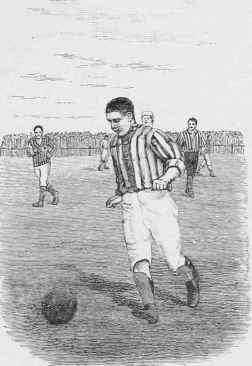
A forward.
So valuable, it will be seen, is accuracy of aim with the feet in passing, middling, and shooting at goal, that it must be learnt by the brilliant player, and the man who is clumsy with his legs, slow and uncertain in the direction of his passes, and apt to overrun the ball in his dribbling, fails as a player until he can overcome these defects. A player, to learn accuracy of aim, must not only know how to score a goal with a swift low shot from his toes, but must learn to pass, middle, or dribble, with the sides of his feet. When running fast often the best way to make a pass is to use the outside of that foot which is nearest to the proposed recipient of the ball. The best 'middles,' too, are made by a hard kick with the inside of the foot, and many of the safest shots at goal have been made with the inside of the foot. A greasy ball on a wet day may slip away from the toe, while a side-stroke is much more likely to be accurate.
Continue to:


My Books

