


The Association Game. Part 4
Description
This section is from the book "Athletics And Football", by Montague Shearman. Also available from Amazon: Athletics and Football.
The Association Game. Part 4
To sum up, then, the centre player should play to the wings except when near goal, and then he should play at the goal; the wings should play together closely, and always middle to the centre when near goal, and should not wait too long to bring off their 'middle.' Nothing is more common than to see a wing player work the ball up to the extreme corner of the ground, and then turn and kick back towards the middle. The result is that not only are the men of his own side now in front of the ball if they have backed up, but even if they are not offside the defending backs have had time to rally round the goal and defend it. Bis dat qui cito dat should be the motto for the wing player when he nears the opponents' goal. The wing player also should do what dribbling there is to be done, should pass the ball before he is hampered, and should, like every other player, never move from his place on the field or lose touch of his wing companion. The centre should shoot quickly and low, and never shoot until he sees an opening for a goal.
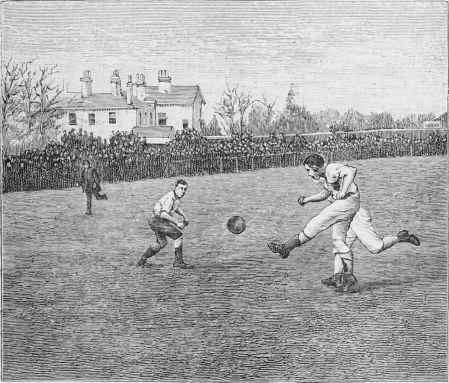
A nasty jar.
As regards the defensive part of a forward's work, or the taking of a ball from another, the same rules apply to the forwards of every place in the field. They must not be misled by the movements of the man who has the ball, but should watch where the ball is and so plant themselves that they are bound to intercept it. Judgment alone can tell them whether they are to wait or to bear down for a charge. If a collision is inevitable, let the forward get his shoulder well down and be leaning well forward. If he be underneath in the charge his opponent will be forced up and will fall back, or if he be firmly planted and shoulder and hip are acting well in concert, he is likely to stand like a pillar while his adversary falls prone upon the field. Still, charging when unnecessary is always a waste of power, but the forward should never neglect to hustle, if not to charge, the opponents' half-backs, for by rushing at them he may do much to disconcert their aim.
Since these are the qualities of the good forward in the Association game, it will readily be seen that there is nothing to prevent the smallest man, if he be thick-set enough to be steady upon his pins, from surpassing his bigger brethren. In the older game, when dribbling and charging were the chief essentials, the heavier men scored more than they do at present, although of course even now, as collisions are necessarily frequent, weight must always tell. But big strong men like R. H. Macaulay, the old Etonian, whose weight, pace, and stamina are undeniable, are often inclined to play clumsily, and selfishly at times, although upon other occasions they seem unsurpassable. In one celebrated final tic for the Cup, the gigantic Scottish forward, Dr. Miller, played opposite J. Brown, a clever little thick-set player in the centre, and to our mind the little man showed all the best of the play, although the doctor had the reputation of being the best centre and goal-getter in Scotland. The best type of forward player, however, is the fast, sturdy man of medium height, like W. N. Cobbold the Cantab.
There is only one other feature of forward play upon which we have not yet touched - the practice of 'heading,' in whicn all players, and especially the provincial teams, display such extraordinary proficiency. Backwards and forwards is the ball often bandied from head to head, each man having complete control over the force and direction of his blow. Goals are often 'headed' through, and for defensive purposes especially head-play is very effective. Upon the whole, however, spectators while admiring the skill can hardly help forming an opinion that this accurate 'heading' savours more of clowning than of manly play, and many would be glad to see some limit placed upon the exercise.
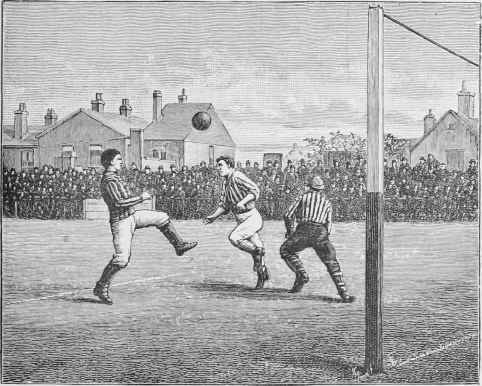
Heading.
The necessity of playing three half-backs has arisen from the wing-forwards of well-trained teams availing themselves to the full of the privilege of receiving a forward pass without being 'off-side' as long as the two backs and the goal-keeper are between them and the goal. These wings would hang about in front of the rest of their side for the chance of having the ball passed to them while they were standing behind the opposing half-backs; and this practice of waiting for the ball to turn up became so prevalent and so successful in scoring goals that for self-defence one 'half-back' has now to be told off upon each wing to keep an eye upon the prowlers. The remaining centre half-back bears the brunt of the regular halfback's work, which is to 'feed' the forwards of his own side. A good half-back must be a versatile player. He is so closely mixed with the forwards that he must know how to dribble upon an occasion, must be especially clever in taking the ball away from an opponent, must be a steady charger, standing as firm as a rock, never allowing himself to be brushed aside or sent sprawling, and above all, must be a steady kicker, kicking not hard and wildly, but lifting the ball when he wrests it from the adversary just over the heads of the surrounding opponents, and dropping it amongst his own forwards and just in front of that forward who is best placed to get away with a run.
It will readily be seen, then, that the half-back must, of all players on the field, keep his head cool, and his eye steady, for he should know at once and discern the possibilities of each changing position of the field. Nor can he always, when mixed up with the players, kick from the ground; he must kick when the ball' is nearing the ground or is high in the air; he must often kick backwards over his head, and withal, know where to place the ball, though his eyes are for the moment turned the other way. Not only too must his kicking be accurate, it must not be too strong, for his business is almost entirely to feed his own forwards and not to kick to the opposing backs, who are strong kickers and will return it over his own head. Often, too, his best tactics are not to kick at all, but to hustle the on-coming forwards and to let his own back thus get a clear kick over his head; when he does kick, accuracy of aim is of such importance that he must not try to be showy, but must know when to kick with the toe, and when, as is usually safer, with the instep. Such is, or such should be, the half-back, and for choice, the safest kick should occupy the centre, and the best tacklers should play upon the sides.
Continue to:


My Books

