


The Association Game. Part 5
Description
This section is from the book "Athletics And Football", by Montague Shearman. Also available from Amazon: Athletics and Football.
The Association Game. Part 5
How much coolness and safety are preferable in the long run to brilliancy is well known to the authorities of the Football Association, and for ten years in succession the Old Westminster and Clapham Rover, N. C. Bailey, occupied this position in the International team, though, during this decade, several more brilliant players appeared and disappeared again. Campbell too, the Scottish International, was another cool and wary player, whose 'heading' was superb in the days before 'heading' became a universally practised science. Wonderful is the skill that veterans in the Association game display behind the forwards. The Old Etonians have never been in the foremost rank of clubs since the white trousers of 'Old Kinnaird' ceased to form a feature of their side in the field.
Before we leave the criticism of half-back play we should mention that there are one or two other points to which the half-backs must attend. They, at least, cannot be blamed for indulging in 'heading,' for heading is often quicker than 'footing ' when the ball is high in the air. The halves at the sides too must learn to throw in from touch, for this duty as a rule devolves upon them; and when, as is usual, three half-backs are played, the corner kicks should be taken by one of them, as the whole of the forwards can thus be left free to close round the goal. Sometimes, too, the half-back has, after a corner kick, an opportunity for a shot at goal. Finally, the half must not be lazy in 'falling back' when the tide of play has rushed past him. By such slackness in aiding the other defenders many a goal which might have been saved has been lost.
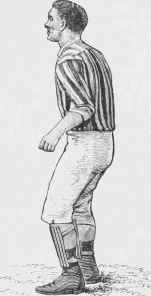
'To keep an eye upon the prowlers.'.
A 'back' player even more than a half-back must be strong with his legs and on his legs. Some years ago, to counteract the sneaking tactics of wing-forwards, several provincial clubs only played one back, as with this arrangement the attacking forward became 'off-side' as soon as he stood behind the defending half-backs, and being off-side could not take the ball when passed on to him. But in spite of the cleverness of this dodge of placing adversaries in the wrong, a single back was found unable to stop combined passing rushes of the forwards, who could always escape one back by judicious middling. The practice, therefore, never took firm root, and each team now plays two backs even although they have three half-backs as well. The chief requisites for the backs are accurate and powerful kicking, and ability to kick not less efficiently, although charging or being charged at the moment. Above all, the two backs must play with each other. When one advances to charge the forward the other must drop back to receive the ball if the kick and charge of his companion are ineffective. Often it is the business of one back to hamper or harass an opponent while his fellow kicks the ball.
Each back also must watch the half-backs, who, as we have seen, often adopt similar tactics and hamper the man, leaving the ball for the back. It is, however, the combination play of the two backs with each other which makes the defence really effective. To describe all the varying tactics is almost impossible, but any player knows well how the two regular backs of a club play together as it were by instinct, while perhaps in an International match when two brilliant backs, one say from the North and another from the South, are put together, each kicks splendidly, but the ball is often got past or between them. Perhaps, it is something more than long practice that made the brothers A. M. and P. M. Walters, the Old Carthusians, play such an admirable combination game with one another. It is this combination between backs which should be cultivated even more than it is at present, and we look to seeing in future years still greater excellence in this respect than is shown by the average club team, although the cleverness in kicking which can be seen to-day can hardly be surpassed. But to return to the several duties of each back player.
Not only must he 'tackle' an opponent with precision, but when his companion is tackling a rush, should keep his attention open for the 'middle,' which is likely to be attempted, and which it is his duty to watch. Or again, when the player and ball have been taken past him, he must follow back and hamper and hustle the forward whom he is catching up, never attempting to charge him from behind, but trying to shoulder him round and send him staggering off the ball when the leg which is nearest is off the ground and his weight is thus balanced to lean away from the back who is hampering him. When once he has separated the player from the leather the back may turn the ball with a screw kick, or the mere worrying and hustling of the dribbler will at any rate help to spoil his middle or his shot at goal. Never must the back allow an opponent who has passed him to get away. He must hustle and worry at him as long as the man retains the ball before him. But it must not be forgotten that as the best of worrying tactics cannot always succeed, the back should rarely risk the ball being kicked over his head by advancing too far up the field.
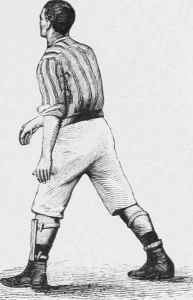
A back.
A back should not dribble; once or twice, perhaps, in a match when a forward is charging him he may dodge for an instant with the ball to get a freer kick, but his main aim is to send the ball hard back without the slightest loss of time. So he must be continually practising kicking from every position; straight forward, straight backward, over the head or sideways, with every part of the foot, and with the ball high or low about him; indeed, long-kicking has now reached the position of an art. The back knows almost as well as a lawn-tennis player when to 'volley' or 'half-volley,' and when to stop the ball before he kicks; and again, when he should kick with the toe or when with the instep, when he should kick true or when he should 'screw.' Finally, he must be what few lawn-tennis players are - ambidextrous; in other words, he must kick with equal accuracy with either foot. To describe all the different positions in which a back may have to kick is hardly possible, but a word or two may be said as to 'volleying' or 'punting,' and kicks which screw the ball round.
Continue to:


My Books

