


The Association Game. Part 6
Description
This section is from the book "Athletics And Football", by Montague Shearman. Also available from Amazon: Athletics and Football.
The Association Game. Part 6
The back who wishes to return the ball before it reaches the ground has usually time to face in the direction he wishes to kick, and he then receives the ball fair on the instep with the leg well raised, so that the thigh is almost horizontal; occasionally he may have to volley over his head, when the leg must be lifted higher still, while the foot is at least perpendicular with the ground. Seldom, however, will the back kick over his head, as it is impossible to give much force upon such an occasion; more often, when receiving a ball straight from another back, or when kicking it on the bounce, the back who cannot get behind the ball gets at its side and swings round the outer leg with a sweep, striking the ball either with the toe or with the side of the foot. By such a blow the ball is often 'screwed' round into a curve, a comparatively simple kick which looks wonderful to the spectator. As, however, the back is generally required to make long as well as accurate kicks, it is usually safer, if the field be clear, to stop the ball and kick hard from the ground. It is obvious that for force of kick a heavy leg and heavy boot give advantages; and, indeed, it is said that the larger his feet are the better it is for the back player.
One celebrated back player of the famous Wanderers Club in former days was so well gifted in this last particular that he received the name of 'Spondee,' his feet recalling that metrical figure to the imaginative. There can be no doubt, at any rate, that a strong, heavy man, both for offensive and defensive play, has a great advantage at back; but it is difficult to find many heavy men who are active enough to succeed in the tricky kicking which is so often requisite.
Perhaps the most important position upon the whole field is that of the goal-keeper. He must have a cool head, a quick eye and hand, and the longer reach he has with his arms the better. Although, too, he has only to defend the space between the posts, and all his work has to be done between the posts or within a few yards of them, he must be ready to display the greatest possible activity within his limited circle. In days gone by goal-keepers used to kick far more than they do at present; they 'dropped' and 'punted' often, and it was not unusual to see a Rugby Union back player set to defend the goal in the Association game. One player, indeed, R. H. Birkett, of the Clapham Rovers, achieved the distinction of earning his International colours in both games, playing back in several years for the Rugby Unionists and in goal for the Association eleven. Several players, like H. Wace and D. B. Roffey of Cambridge, have represented their universities at both games; but Birkett, we believe, is the only player who earned the double International distinction.
Nowadays, however, when the forwards close round the goal and make a combined attack upon it, kicking is at a discount, and the goal-keeper seizes the ball in his hands and throws it away or occasionally 'fists' it out, i.e. strikes it straight back with his fist without losing time in catching it. Some players, too, catch the ball first, and then instead of throwing it away strike it with the fist or fore-arm away from the goal. But as a rule, when a shot is made at goal, the goal-keeper catches the ball and throws it away with both hands almost in one motion. There are occasions when there is not even time to catch the ball, and the player has to kick with whatever foot is nearest to the ball; and as such emergencies may always occur, a goalkeeper must be selected who can be depended upon to kick well with either foot if required. As a rule he should seize the ball with both hands and then kick if the ground is clear; but if he is being attacked in the very mouth of the goal, he should throw away to one side or other and not straight in front of him, for the more to the side he throws the more difficult it will be for a foe to score a goal with the return which will inevitably follow if a friend does not get away with the leather.
Of course, if time and his position permit, when he 'clears' the goal he will send the ball to a friend who can get away with it and thus avert the danger; but this is not always practicable. At all costs, when the shot is coming straight he must stop the ball and divert its course; sometimes, when the ball is coming high, the only chance of doing this is to knock it up so that it may pass over the goal, though this manoeuvre gives a 'corner-kick' to the enemy. But whenever he can he should fling out well to the side, and then the goal may be relieved once and for all.
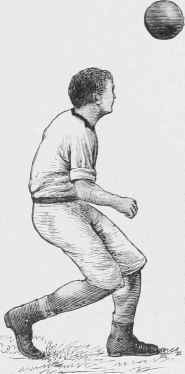
A half-back.
A word should also be said as to the goal-keepers duties when the enemy have a corner kick. First he must see that he is well surrounded by his own side, for if the ball drop well in front of the posts he may be sure that the opponents will try to charge him over and thus hustle the ball through the goal.
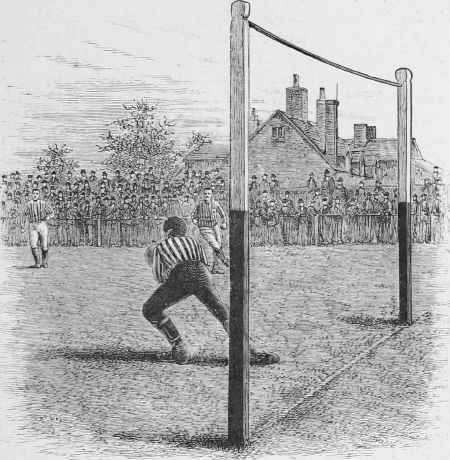
Defending the goal.
If he be well protected he can then stave off all danger, for by jumping at the ball as it comes within reach and having the advantage of being able to use his hands while the others cannot, he may be able to knock the ball well out of danger.
Good judgment is also of service to the goal-keeper in helping him to decide when he shall run out from the goal to take the ball. If he make a mistake in doing this the error is a fatal one, as the goal remains undefended. But there must always be occasions where by running out the 'custodian' can seize the ball and get it well away, whereas by waiting he may allow two or three of the enemy to make a combined assault upon the 'fortress.' The goal-keeper must on these occasions see with half a glance when he is perfectly certain to secure the ball if he run out, and then convert his decision into action at once. A goal-keeper has no time to think twice in Association football; indeed, readiness of resource and agility of action are indispensable to success. When the enemy bear down the goalkeeper must be leaning forward with his weight upon the toes and not upon the heels, as he must not only be able to turn in any direction when the 'shot' is made, but must be ready to turn first in one direction and then in another as shot after shot now high and now low is sent back to him after each return.
Continue to:


My Books

