


The Association Game. Part 7
Description
This section is from the book "Athletics And Football", by Montague Shearman. Also available from Amazon: Athletics and Football.
The Association Game. Part 7
It is sometimes little short of marvellous to see goal-keepers like Arthur, of the Blackburn Rovers, or Macaulay, the Scottish International, stop shot after shot in rapid succession, turning from side to side without ever losing presence of mind or balance of body. The goal-keepers of to-day have no easy task when the attacking forwards have learnt to pass one to another in the jaws of the goal; and the best that can be said of the modern goal-keepers is that they have proved themselves equal to the task. Doubtless players in this position were as plucky and resolute in the days when Kirkpatrick kept goal for more than half an hour to the end of a match while one arm was hanging broken from his shoulder; but the modern players have better tactics to contend against and are equally successful in their defence. Perhaps we should add for the benefit of the uninitiated, before we finish our discussion of goal-keepers, that although they can use their hands to stop the ball, they may not do so to stop or hold an antagonist, and that unlike their brethren of the Rugby game, they may not run with the ball more than the step or two which they may require to take their kick.
Such is the Association game, and such are the duties of the various players, but no description can avail to convey a thoroughly accurate idea of the game as a whole. The feature of modern Association play is essentially the combination shown by the team. While each player has his own place to keep, the field at each kick changes like a kaleidoscope, each player shifting his place to help a friend or check an adversary in the new position of the game. Complete appreciation of a sport which has been brought already to an admirable pitch of skill can only come from playing in, or, at any rate, from watching with a knowledge of detail, games in which good men take part. The one generally admitted drawback to the game is the frequency of the disputes which arise over the questions whether this or that player was 'off-side' when he took the ball on from a friend. Long before that useful official the referee became a regular feature of the Rugby Union game, he was a necessity in Association matches.
While it is comparatively easy in Rugby football to judge whether a ball has been thrown forward or not, it may fairly be said to be impossible to judge infallibly at any given moment, while the ball is dodging to and fro, whether a player has three of his opponents between himself and his adversary's goal. To prevent disputes, then, as soon as the ' passing on' game was adopted, every match came to be attended by an independent referee; but even the ablest official in the world cannot be everywhere upon a football field, and often as the game is stopped by the referee's whistle, often again do the losers or the crowd feel a grievance at a decision or believe that a goal would have been disallowed had a claim been made. Some have suggested an alteration of the off-side rule, but no two critics are satisfied as to what the alteration should be. Some wish to return to the Rugby Union rule, and to allow no 'passing forward' at all; others think that there should be no off-side rule at all, and that passing forward should be allowed anywhere and everywhere; others, again, would like to return to the old Sheffield rule. It must not be forgotten, however, that it is the legalisation of 'passing on' which has made the game what it is.
If the old Rugby Union rule be again adopted, the game will once more return to the old style, when individual dribbling was of greater importance than skill in combination play. Still almost anything would be an improvement which would put an end to the frequent disputes and to the pauses in the game which occur when a claim is allowed and the whistle sounds. Sit finis litium is a maxim as admirable for sportsmen as for jurisprudents.
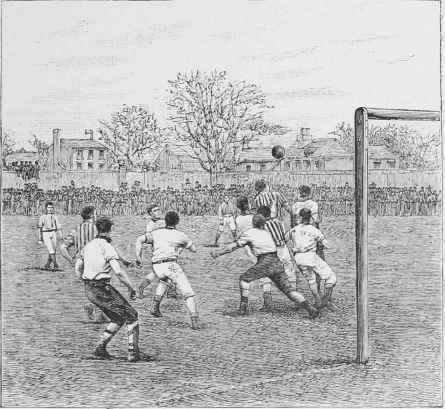
'The field at each kick changes like a kaleidoscope.'.
We have not, however, as yet explained how disputes are settled upon the field, both in the Rugby and Association games. Some years ago each side appointed its own umpire, and both agreed upon an independent referee, the latter only interfering when the umpires disagreed. But it was found that not only was this system slow and cumbrous, but that there was a tendency with some clubs to appoint umpires who acted as mere partisans and always decided in favour of their own side. The present practice then was adopted by both Rugby Union and Association players, of having only one arbiter of disputes upon the field, an independent referee who has power at any time to stop the game by blowing his whistle.
From what we have said about Association football the reader will gather that in our opinion its history during the last fifteen years is simply a record of increase of skill both of kicking and passing on with the individual players and of combination with the team. Experientia docet, and it does not cast any reflection upon the players of a few years ago to say that when the Corinthians met Queen's Park in 1894 the form was vastly superior to that of the Wanderers and Old Etonians when they met about twenty years before. Those who can beat all comers in their own day need fear no disparagement from subsequent comparisons. The old champions performed when Association football was in its infancy, and the capacities of the game for skilful development were not fully understood. Nowadays the game not only has professional exponents, but keenness of competition has forced up the amateurs to as high a pitch of skill as is shown by the professionals. The old school, however, console themselves with the assertion that even if the skill be greater the enjoyment in the pastime is less than it was in days gone by. ' In our time,' says the old stager, 'we played for fun, and we enjoyed the rough and tumble of a manly sport.
Continue to:


My Books

