


Part II. Of Playing The Game. Chapter I. Of Driving In General
Description
This section is from the book "The Art Of Golf", by Bart W. G. Simpson. Also available from Amazon: The Art of Golf.
Part II. Of Playing The Game. Chapter I. Of Driving In General
It is a common complaint that, with so many things to be thought of at golf, accuracy is almost impossible. This is not the way to state the case. It should rather stand: If points of style are thought about and trusted to, bad shots will be frequent. That there is some secret which, if discovered, would make our driving infallible is a belief which dies hard. Nostrum after nostrum is tried day after day. Hope is quickly followed by a despairing desire to break the whole set or spitefully to present them to a friend, so that he too may suffer. Time after time the golfer thinks he has discovered what he was doing wrong. He gushes about it, or gives half-a-crown to the professional who has found it out. Alas! there is no side road to golf. It can never be certain. With careful aiming for each shot, it may become pretty steady, but even with this there will be better and worse drives. It would be going too far to say dogmatically that nothing but aim must have a place in the golfer's thought, although it is perhaps best so; but certainly if stance, or swing, or address are dwelt upon it must be as subsidiary points. ' There is something wrong about my style,' says the golfer, ' which is causing me to drive so short.' 'Not at all,' say I; ' aim more accurately.' Hand and eye and body must concentrate themselves on, restrain themselves to, hitting cleanly, fairly, firmly; not greedily, wildly, gaily. The golfer cannot afford to allow a favourite muscle to disport itself. The eye is officer, the muscles liners, each doing the duty required of them and no more. The tongue only may wag as it will without doing harm or good.
Plate I.
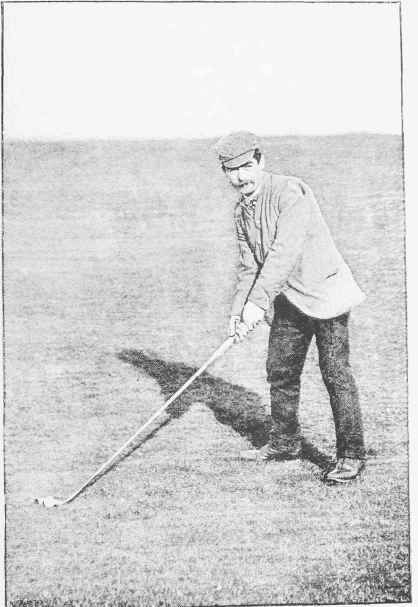
ADDRESSING FOR A DRIVE.
There is no alternative. It is of no use to say to the ball, ' I will make thee magnificent gifts if thou wilt yield thy secret. I am ready to wrench and thump for thee, to stand nearer or further from thee, to bend the knee. I will imitate the swing of a Morris to conciliate thee.' The ball wants none of these self-glorifying gifts. Abandon body and will to hitting, and the hidden secret of the mystic 27 1/2 shall be revealed.
Still, the amateur golfer must be allowed to theorise to some extent. It is a necessary concession to him as a thinking: animal. Within the indicated limits, it will do little or no harm; but because he does not think the professional is better than the amateur, the uncultivated beats the educated player. The former finds enough intellectual pabulum for his duller brain in the prosy principles of simply slogging. To grasp the idea of doing so, sufficiently occupies his thoughts. For an educated man to confine himself to so narrow a range is irksome. The professional's theorising does not go beyond 'I hit lazy - I heeled - I topped - I sclaffed - I toed.' To perceive so much is an effort of observation. The amateur must consciously exclude thought, if he is to confine himself to such elementary facts. It is noticeable that he (in distinction from the professional) asks, ' Why did I heel - top - sclaff - toe?' - and if golf is to be a pleasure, not a business, he must be allowed to ask these things. The amateur, if keen, is inductive, deductive, inventive. If not, he is apt to give up the game as too simple. On the other hand, if he does not recognise 'hitting the ball ' as his business, theory as his recreation, he becomes so bad a player that he nearly gives up.
'Keep your eye on the ball,' is the categorical imperative of the golfing world; below which there is room for much harmless digression. Say that I am playing very well, but that there is some irrational difference between my style with short spoon and driver. A professional would not know this of himself, or, if told, would not care. It is outside the range of his ideas. ' I'm driving fine,' he would say. But your amateur cannot rest till he has corrected one of the styles into uniformity with the other, or found a rational cause for the difference. If A. drives high, B. low, is it possible that A. with a university education, can rest satisfied with merely observing this fact? No. He will try to find out why, and, having done so, will either modify his style, or register to himself the conclusion that he prefers to drive high. The amateur ought to think. The man who buys a baffy because he can't drive with a cleek has not a cultivated mind. If he carry both - if his set is composed of a lot of preposterous inventions of his own, all of which he uses in turn, he increases the difficulties of the game indeed, but is nevertheless noble in not accepting defeat at the hands of any club.
Experiment, so long as the major premise is not lost sight of, is the recreation which may be allowed to the golfer whilst attending to his business. It is a necessary concession to human nature; it is the spoonful of jelly with the Gregory's mixture; it is the working man's half holiday, and a great many other analogous things. By all means let us have our clubs long or short, heavy or light, upright or flat. The golfer may be trusted in the long-run to give up anything which is too fanciful, although for a time he may spoil his play with a fad. It is harmless to buy clubs from professionals for gold, no better than what are for sale in the shops for four shillings.
The player may experiment about his swing, his grip, his stance. It is only when he begins asking his caddy's advice that he is getting on dangerous ground. A professional can play. It does not follow that he can teach others. He can comfortably assimilate foods and drinks (more particularly the latter) which would prostrate those he carries for on a bed of sickness. Is he therefore an authority on dietetics? But being constantly asked for advice, the professional has a few stock prescriptions which he gives recklessly, doing more harm than good. So anxious is the golfer to learn without plodding that he uses these eagerly. The truth is, your caddy is a good judge of distance and direction. He can advise well what club to take, but as to how to use it, he may show, but ought not to be asked to advise. For instance, the player is persistently driving to the right or to the left of the line he wishes to follow. Let him correct his stand, but let him do so accepting the fact that he is standing wrong because his eye is at fault. Let him try to see straight. He ought to come away from his ball, and take up his position afresh with careful reference to his intended direction. But the usual thing is to accept the caddy's dictum (stand more behind' or stand 'more in front') blindly, and, without looking up, to scuffle about with the feet. When told, 'That will do," the player either misses, being stiff and twisted; or - what is more common - he scuffles back to where he was at first, like a sitting hen moved from her eggs, and drives off the line. Having done this latter a dozen times, it seems that the position the caddy advises must be the solution of the difficulty. He, who has been driving persistently to the right, has got into the position shown in diagram No. 1; in other words, his left foot has got nearer the ball than the right. which it has a strong natural inclination to do, and the tendency is to drive in the direction of the arrow, and not of the dots. What ought really to be done is that the player stand up naturally and aim carefully. The result of applying a correction such as 'stand behind' will not make the ball go straight until the awkward position of diagram No. 2 is reached.
Continue to:


My Books

