


Part II. Of Playing The Game. Chapter I. Of Driving In General. Continued
Description
This section is from the book "The Art Of Golf", by Bart W. G. Simpson. Also available from Amazon: The Art of Golf.
Part II. Of Playing The Game. Chapter I. Of Driving In General. Continued
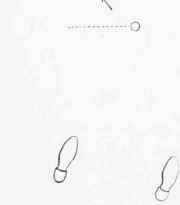
Fig. i.
It may seem that if the advice, instead of being, as it always is, 'Stand more behind,' were 'Change the position of one of your feet,' o the result would not be to produce the style of Fig. 2. But this would alter the player's distance from the ball, and, instead of being the beginning of a cycle of fatal and deceptive good driving, would inaugurate a round of tops, heels, or pulls, to the immediate discredit of the caddy. If I wished to be cynical, I should say, therefore, 'Change one foot' is the better advice. But no! the proper thing to do is to try again. Anything else is absurd. Were a caddy to say, ' You would drive better with my arms,' or were he to offer the loan of any other limb, the nonsense would be evident. Yet the absurdity of using his eyes does not seem apparent. The player allows himself to be put in position like a lay figure. Even suppose he understands the orders, and does pose as the caddy intends, a lay figure cannot hit a ball. One man's mind cannot work another mans body.
The following is a specimen of what may be expected if a player hopes to drive by taking advice instead of aiming at the ball with his own eyes.
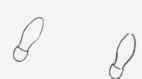
Fig. 2.
Player (1st shot). - ' Why did I heel that? '
Caddy. - ' Drawing in your arms.'
Player (2d shot). - 'Why did I pull that?'
Caddy. - ' Drawing in your arms.'
Player (heeling again). - ' There! I did not draw in my arms that time.'
Caddy. - ' No, sir, ye cut it.'
Player (4th shot). - 'There's that confounded heel again.'
Caddy. - 'Ye didna cut it. Ye hit it clean enough that time; but ye were stanin' that way.'
Player (examining his club face after a vicious top). - 'Right off the heel too. What on earth is the meaning of it?'
Caddy. - 'Ye're fallin' in on the ball.'
Player (6th shot). - ' Another top.'
Caddy. - ' Ay, ye fell right back.'
Player. - 'Oh, hang it! with so many things to be thought of all at once, steady play is almost impossible.'
Having heard all that passed I here remark with a smile - meaning sardonic and oracular - 'Not almost, but quite impossible.'
Another error, nearly as bad as to take advice blindly, is for a player, when standing wrongly, to try to pull or push the ball according to the correction for direction desired. Let him rather correct his stance. Faults covered by faults do not cancel each other. The second fault only gives the ball an additional chance of escape from the way it should go. Far the wisest course is to apply a direct remedy. The player whose driving is feeble should hit harder, unless it is because he is nipping, or not hitting off the middle of the club, in which cases he ought not to nip, or should aim for the centre of the head. It must be admitted, however, that it is much easier, for the moment, to apply indirect corrections, and few indeed are the formed golfers on whose style the cicatrices of early patchings are not visible. Some of these are almost harmless; but others may cripple the player permanently, although at the time, like new brooms, they sweep away the ball clean. For instance, there is a class of stereotyped faults whose origin is traceable to a miserable time when every ball was hopelessly-heeled. If the wretched man (oh, how despondent he was then !) had only attributed his misery to the true cause - namely, that he was heeling - the fault would have corrected itself. But he found a royal road to the middle of his club. You see the former victims of heeling either standing nine feet from their ball and taking: a header at it, or so crouching on their haunches that you are astonished, when the stroke is made, to find player and ball are not both left seated. If you see a golfer draw his club so slowly back that ten is easily counted before it begins to return, as a tyro he has been one of those who fervently wished that balls had no top. Again, there are men who face the east when they mean to go north. The sole ambition of these has been to drive a very long ball. They are victims to the truth that a ball so struck will sometimes go further north than one aimed to that part of the compass. But what does it profit when it as often goes east or west? Such fill men's gardens with golf-balls, and lose many more in the waves of the sea.
Plate II.

TOM MORRIS DRIVING ( 1 ).
Plate III.
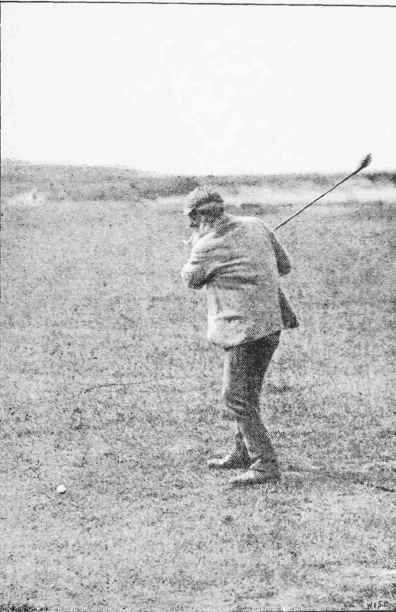
TOM MORRIS DRIVING ( 2 ).
(' It's coming.')
Plate IV.
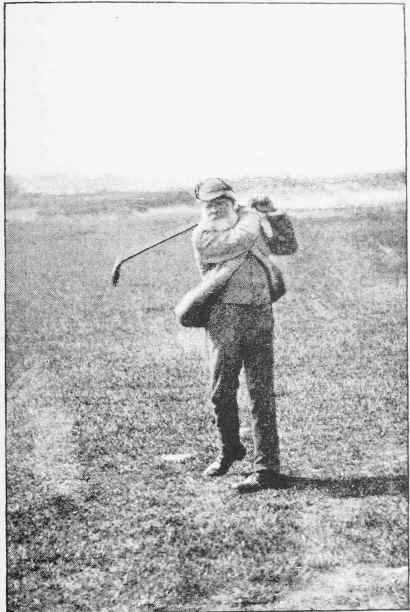
TOM MORRIS DRIVING (3).
Do I maintain, then, the reader may ask, that every one ought to have the same style? By no means; on the contrary, for you or me to model ourselves on a champion is about as profitless as to copy out Hamlet in the hope of becoming Shakespeare. If we have a neat style, so be it; and if we began before our hair was grey or gone, it probably so is. But for a fat man to model himself on a swank youth is frivolous. We cannot ignore our deformities. Our shoulders are heavy, our fore-arm puny; it is useless to rebel. A very easy long swing is impossible with such a configuration. We may play well - beat the swank youth very likely, - but only if we are content with a stiff style. Are we lank and loose-limbed? So will our driving be. if left to develop naturally.
On the other hand, there is no more fruitful source of bad golf than to suppose that there is some best style for each individual which must be searched out by him if he is to get the best results out of himself. In a broad and general way, each player ought to have, and has, a style which is the reflection of himself - his build, his mind, the age at which he began, and his previous habits. The ex-cricketer reflects cricket. The rowing-man has a straight back, and there are characteristics in each golfer the history of which it is more or less difficult to trace. This is his style; and however much he may feel he modifies it, to an onlooker it will remain the same - because it is the same. It is not the general principles that a man has before him (of these he is seldom conscious) when trying to find out his absolutely best. It is some minor detail of which he exaggerates the importance - some particular twitch, which has arrested his attention after a very satisfactory drive. This will be stubbornly pursued till it is exaggerated into a mannerism to which it is secretly believed everything good in his driving is due. If golfers could only become con vinced that no mannerism is of the slightest value, that there are fifty different styles (by style I m< here the petty variables of which alone we are conscious) in which a good shot can be made, that it is not indispensable to repeat in the next the same movements felt in one good shot, bad ones would be less frequent. There is, I repeat, a categorical imperative in golf - 'Hit the ball;' but there are no minor absolutes. There is no best shape, or weight, or lie of clubs - no best stance, grip, or swing. From the nature of the case, one does not change his driver during the round; but the other things may vary every shot - nay, will, unless one makes a point of preventing them, sacrificing ease and accuracy to a consistency which, if stubbornly insisted on, may permanently cramp driving. There is no better proof of this argument than to watch a boy of about twelve, who hits every ball clean and (for his strength) far, of whom there are very many. At this age even the broad features of style are unsettled. At one moment he swings round his neck, at the next round his shoulder, his feet near together or wide apart, according to the unconscious fancy of the moment. And yet each ball flies away with unerring certainty. This should teach us that when we think we see what we are doing wrong, or what we are doing right, that when we cling to this bit of style or avoid that, we are merely distracting our attention from the main issue
Continue to:


My Books

