


Chapter IV. The Wind And Hills
Description
This section is from the book "Hints To Golfers", by O. K. Niblick. Also available from Amazon: Hints To Golfers.
Chapter IV. The Wind And Hills
Utilizing the Wind
When there is no wind a ball may be sliced or pulled without any great loss of distance, but in a wind the slightest inaccuracy becomes ten times exaggerated and the amateur often finds himself hopelessly out of the running. To the inexperienced golfer, therefore, the wind generally proves a hindrance, although it can often be utilized in the same way as when sailing a boat.
When playing in a wind, because one has to stand more firmly on the ground, it is better to stand with the ball opposite the centre of the body and not attempt to get that balance ordinarily so desirable. The swing, also, should be particularly easy as one's natural inclination is to make an extra effort. •
When the Wind is Blowing from Behind
To swing the club correctly with a strong wind blowing from behind is not as easy as one would imagine, as the player not only has to fight to maintain his balance but has to guard against the wind blowing the club down too quickly. As the ball should be sent high into the air, some players use a higher tee than usual or, if the teeing ground slopes upward, tee a hanging ball; others play for a slice as the left to right spin starts the ball high.
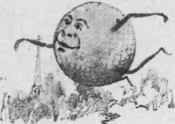
Free as a bird.
(51)
When the Wind is Blowing Directly Towards the Player
As the object now is to keep the ball low, a low tee should be used, or, better still, no tee at all. Many players, if the teeing ground is a downward slope, tee a hanging ball to get a forward spin, some playing a half cleek shot which gives the ball great running power; some a running approach shot which keeps the ball close to the ground; some playing with the face of the club well over to keep it low; others playing for a pull. This last stroke, however, is the perfection of golf and is only attained after years of practice.
Continue to:


My Books

