


Holding The Club
Description
This section is from the book "Hints To Golfers", by O. K. Niblick. Also available from Amazon: Hints To Golfers.
Holding The Club
In driving, one should not check the swing with the concussion of the club head with the ball It is not hitting the ball as a hammer hits a nail, but sweeping the club head on to the ball, or a "swipe," as it is sometimes expressively termed, the stroke increasing in velocity as the club head comes forward and having its greatest speed at the moment of contact with the ball. Because it is a sweep and not a hit, the way the club should be held in the hand is an important factor, some players holding the shaft in the left hand and guiding it with the right hand, while others hold it firmly in both hands. Holding it wholly in the left hand and guiding it with the right gives more elasticity to the shaft with the concussion, while with a firm grip with both hands one gets more control over the club and brings into better play the muscles of the right arm. But, in whichever way the club is held, the right hand should be below the left so that, with the backward swing, the left arm, which has the longest distance to travel, may have the shortest arc to travel through.
The Grip
1. Grasp the shaft a few inches down the leather in order to control the swing better.
2. Hold the shaft in the left hand in that part of the palm next the thumb, the hand being enough over to have the V-shaped part of the hand between the thumb and forefinger, on a line with the top of the shaft when the hand is closed, the fingers being grasped tightly around the shaft and the thumb across it in order to get the firmest grip. With the left hand in this position, the wrist joints do not become cramped when the club rises over the right shoulder.

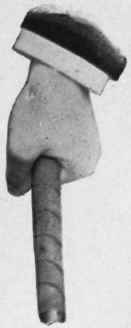
3. If the club is to be held loosely in the right hand, it should be laid across from the upper joint of the first finger to the lower joint of the little finger, the hand being enough over to have the V-shaped web nearly on a line with the top of the shaft, the right thumb being laid loosely across the shaft and against the forefinger. This grip allows the shaft to fall back into the V-shaped web with the backward swing and against the forefinger with the forward swing, which gives elasticity to the club with the concussion.
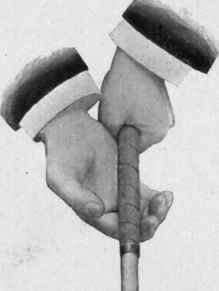
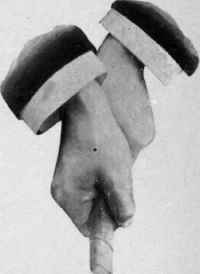
4. If the club is to be held firmly in the right hand, it should be held either with the shaft close to the base of the thumb, with the thumb across the shaft, and with the hand far enough under to have the first and second joints of the fingers uppermost when the hand is closed. Or it should be held with the shaft in the palm of the right hand next the lingers, the thumb diagonally across the top of the shaft when the hand is closed and the hand only enough over to have the first joints of the fingers uppermost. With the first grip, one is able to put all the strength of the right arm muscles into the swing, and with the second grip one gets a freer movement of the right wrist.
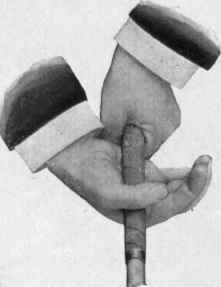
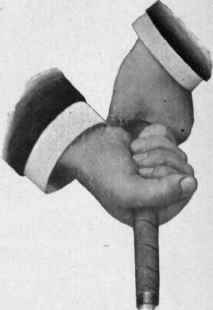
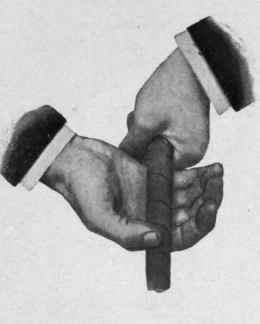
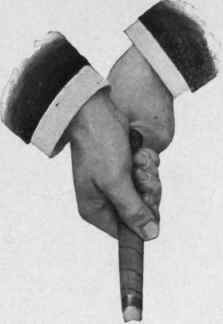
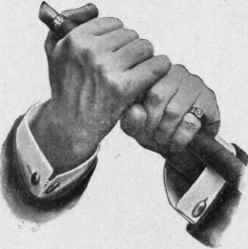
5. As the backward movement of the wrist is never as great as its forward movement, and as the backward movement of one wrist has to work in unison with the forward movement of the other, whichever grip is taken both hands should be held close together because the further the hands are apart the less the wrists can work together, as the difference of the arc through which the wrists have to travel increases as the hands separate. Many drivers, therefore either overlap or interlock the left hand with the right in order to have the wrists as near together as possible.

Suggestions
By relaxing the grip of the right hand with the concussion one gets that snappy movement so necessary for a long drive.
By holding the face of the club at an acute angle with the ground, the face comes in contact with the ball at such an angle that the ball is kept low, and when playing with a loose grip with the right hand, this is best done by gripping with the left hand further over than ordinarily ; and when playing with a tight grip with both hands, it is best done by having the right hand further under.
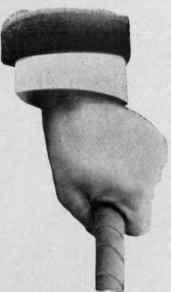
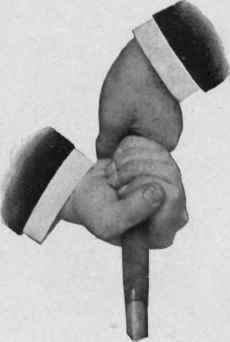
When the face of the club is turned back, it comes in contact with the ball at such an angle that it sends the ball into the air. When playing with a loose grip with the right hand, this is best done by gripping with the left hand not so far over as ordinarily, and when playing with a tight grip with the right hand by having the right hand further over.
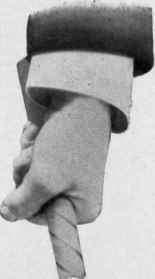
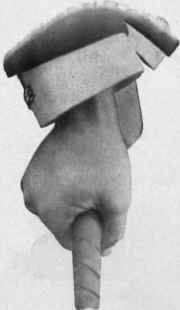
Continue to:


My Books

