


Chapter IX. Recovering From Difficulties
Description
This section is from the book "How To Play Golf", by Harry Vardon. Also available from Amazon: How To Play Golf.
Chapter IX. Recovering From Difficulties
LET us be bunkered. For a very long while we have delayed the evil happening. We have played many shots with a variety of clubs; even have we putted. We may, indeed, have arrived at the conclusion that the task of tapping the ball into the hole is easy. It is so occasionally. If we happen to have developed such a spirit of triumphal elation, perhaps it is time that we began to look on the dark side of things. Self-reliance is good, but exultation is often fatal to the person engaged in a golf match. Paradise may descend upon him, but it has a way of flitting without notice. It leaves him in a cold, hard world, which is all the more trying because of the joy of the preceding minutes - precious minutes to the golfer. Let him remember therefore, that there is always the possibility of his having to approach a shot with chastened feelings. At the most unexpected period, the cold, hard world may claim him as its own; that little world with steep sides and a base of sand, or - worse still - miserable clay.
When we make our way into a bunker in order to extract our errant ball from its clutches, we can possess no more suitable spirit that that of dignified chasten-ment. Personally, I have long since come to the conclusion that it is unwise to entertain any notion about performing heroics in hazards. The best thing to do is to look for the easiest way out, and take the line of least resistance. There are, naturally, situations in which we must endeavour to accomplish an almost superhuman feat, as, for instance, when the opposition is twelve inches from the hole in the same number of shots that we have expended in making the acquaintance of the bunker; but in ordinary circumstances there is no scheme more profitable - or perhaps I should say less unprofitable - than that of searching for the simplest means of escape and trusting to the saving of a stroke in the short game in order to avert the loss of the hole. And the more moderate the player, the more strongly is this policy to be recommended. I really believe that many a long-handicap man regularly tries to accomplish greater deeds with a niblick and a half-buried ball than any first-class golfer would dream of attempting. My advice to the bunkered player is - "Don't be greedy; be content to get out."
I need scarcely say that these remarks are based on the assumption that we are about to play a real bunker shot. The ball is nestling down in the sand, or other yielding substance, in such a way that we cannot see the bottom of it. When Providence presents us with a good lie in a bunker; when the ball is teed-up, or, at any rate, poised with some degree of lofty bearing, then we can pick it up cleanly with the club that seems most suited to the occasion, having regard to the nearness of the face of the hazard, and try for distance. As I will explain in a subsequent chapter, professionals generally play the push-shot in such circumstances. For the present, however, let us consider that we are endeavouring to rescue the ball from an exceedingly unpleasant place.
We must fix our eye on a spot an inch and a half or two inches behind the ball, and determine to delve right into the bunker - as far into it as we can penetrate - with a forcible blow of the niblick. We shall need a full swing for the purpose. It can be as full a swing as for the drive, but it must be a considerably more upright one because we want to dig the ball out of its retreat. There should be no element of the sweeping action about this stroke. The player should turn his body well towards the direction in which he wants to go (a stance a little more open than that for the mashie shot); take the club up fairly straight to the top of the swing, and bring it down vehemently into the sand an inch and a half or two inches behind the ball, throwing his body slightly forward and nearly all his weight on to the left leg at the moment of the stab. He need not worry at all about nicety of touch - that is, when he is really badly bunkered. The club should not come into contact with the ball at any part of the stroke. The player must determine to make a mighty cleft in the sand - or whatever the substance may be - behind the ball, whereupon the latter will be forced out of its ensconced position and often hurled a considerable distance. Do not trouble about a follow-through. The effort should finish with the club-head buried in the bunker. All that you are trying to do is to create such a disturbance at the back of the ball as will cause that object to move out of the hazard, and when the niblick has made its way into the selected spot, it will have done its work.
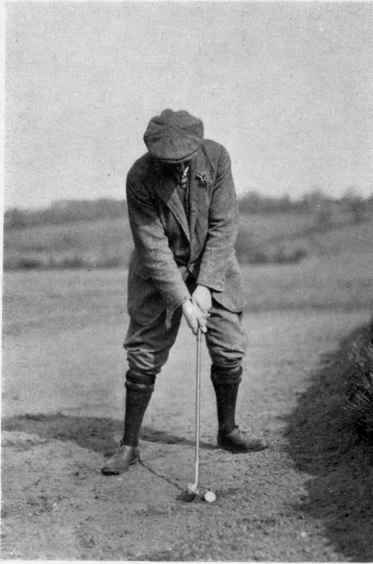

BUNKERED.
Stance for the niblick shot.
Top of the swing for the niblick. The weight has shifted over to the left leg rather than the right, so that the club may be brought down to dig forcibly into the soil.
The less distance you want to go, the more sand you take. The point here made hardly needs emphasizing. You must always hit hard in a bunker (that is a golden rule), and it is obvious that the farther you dig behind the ball, the less the latter object will be influenced by the disturbance. Sometimes you have to excavate as though you were starting to make a grave for yourself. I must confess that on a strange course a shot in a bunker often partakes of the character of a speculation, since there is little opportunity of telling the consistency of the foundation. When a first-class player takes two strokes to recover from a hazard, it is generally because he has failed accurately to estimate the density of the substance. He has aimed too far behind the ball. Nobody is allowed to ground the club, or in any way test the nature of the base, and even the man of experience sometimes forms a wrong judgment. It is not often that the person of long and varied observation misses his first shot in a hazard through an attempt to do too much with a half-buried ball. His fault is usually the modest one of trying to do too little. My own watchword when I am badly bunkered is "Moderation " (of ambition as well as language). It pays in the end.
Continue to:


My Books

