


Recovering From Difficulties. Part 2
Description
This section is from the book "How To Play Golf", by Harry Vardon. Also available from Amazon: How To Play Golf.
Recovering From Difficulties. Part 2
In the chapter concerning the mashie, I have mentioned the danger of endeavouring to lift the ball into the air on the face of the club. The same warning may be proclaimed in regard to bunker shots. Far better is it to dig down behind the object with all your might, than to try to push the niblick under the ball and lift it up with the club. The sand - or even harder stuff - if agitated in the right place, and with plenty of power, will nearly always release its victim. When the ball is close to the face of the hazard, it is often possible to play a cut shot in just the same way as with the mashie. The lie for this purpose must be a good one, but granted such a favour, the shot is well worth trying by the golfer of some accomplishment. Frequently it enables him to reach the green without a further expenditure of strokes. Naturally, a line to the left must be taken (in such circumstances he will generally have to escape sideways whether he decide to try the cut or simply perform the stab), and there must be, as with the mashie, a distinct attempt to draw the club across the ball after an upward swing in which the arms have pushed the implement slightly away from the body. This, however, is only a stroke for a peculiar situation - a good lie near the face of the bunker guarding the green. In the ordinary way the game is to bury the niblick forcefully behind the ball. Do not be afraid of burying it too deep; you cannot go too far into the sand. It is often possible to obtain in this manner a shot of very useful length.
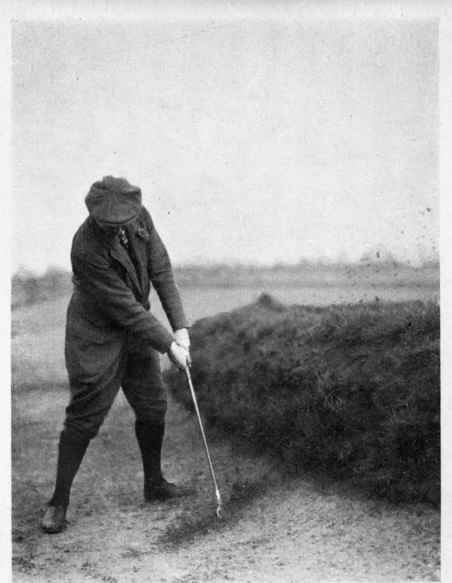
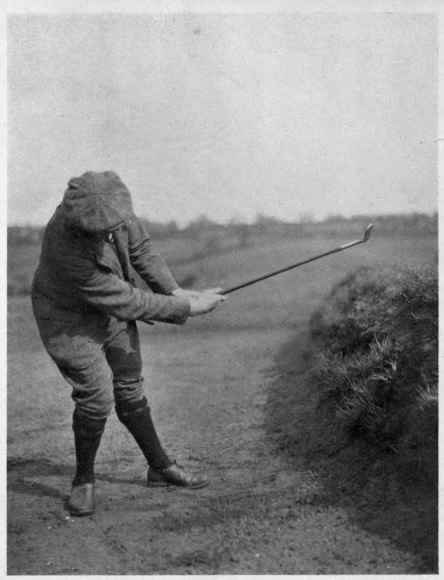
BUNKERED.
Finish of the niblick shot, with the club remaining in the soil.
A frequently seen but incorrect method of playing a niblick shot.
It is a scoop - an attempt to carry the ball on the club - which, generally speaking-, is impossible.
Even in clay, as, for instance, in dry ditches, the tactics here described can be practised; although as clay is usually fairly dense and resistive, it is necessary in such circumstances to aim only a little way behind the ball, say, from half an inch to an inch. If you try to take two or three inches of this tenacious earth, you may get it all right on the face of the implement, but without urging the ball clear of the hazard. Still, unless you feel that the opportunity is excellent for making a cleanly-hit shot, the thing to do is to dig. I have very seldom seen soil so hard that it cannot be excavated, although sometimes a great amount of vigour is necessary. I shall never forget a wonderful shot which Joshua Taylor played in a distinctly clayey ditch at Clacton-on-Sea. He must have buried the head of his niblick nearly a foot below the surface, but the ball came out all right. Indeed, if I remember aright, he laid it dead.
Sometimes on courses of more or less ancient architecture, the ball is found tucked up against the back of a bunker. On modern courses such a situation is scarcely ever presented, because the twentieth - century method of making bunkers is to go down almost straight for several feet in forming the back of the hazard. The whole of the bunker is below the surface of the ground, and its depth is much the same at all parts. This is unquestionably the best principle, inasmuch as a ball which just trickles into the hazard slides down the precipitous back wall and runs sufficiently far forward to give its proprietor a chance of getting at it with a club. It is one of the tendencies of the day, this inclination to use the underground regions; we go down a lift into the bowels of the earth in order to travel in a tube, and we find our up-to-date golfing trouble below the surface.
The old type of bunker began almost level with the ground; and it was completed by the erection of a bank on the far side. There are thousands of these bunkers still in existence, and when the ball just trickles into one of them so that it lies close up against the shallow back wall, the position is absurdly unhappy. Sometimes it is necessary to cut right through the several inches of turf in order to execute the stab shot. It is occasionally the only alternative to playing out sideways. And none of us like to pursue our golf as the crab walks or the donkey goes up a hill; it seems so utterly un-heroic to tack off the appointed line. Still, I would not discourage the moderate golfer from adopting the safer course of poking his way out to either flank when he finds himself hemmed in at the back. His dominant determination ought to be to recover in one stroke. If he can get a long way out, well and good; if the situation is at all involved, let him be content to struggle clear of it by a matter of a few yards, and offer thanks for such a small mercy, provided always that it is procurable at a cost of no more than one stroke. It is a foible of the average golfer that, when he has taken six at a simple hole in a medal competition, a bunkered shot at the next hole often ruins his card beyond all chance of redemption. The reason is simply that he tries to do something wonderful in the hazard so as not to be debited with another six. The reward often comes as a shock; he gets a seven instead of a six.
When the ground is very hard, it is sometimes a blessing in disguise to be in a bunker near the green. If you know your bunker (know that it is not of a nature that wreaks awful vengeance upon the visitant), and are on good terms with your niblick, it is frequently better to be in the sand than on the grass. This remark is not mere philosophy; it is good advice. After a drought, it may be very difficult to make the ball stop on the green, even though you play a good approach from the fairway. If you know how to execute a bunker shot, you can take so much sand as to put an inevitable check on the ball and make it rise so sluggishly as to stop somewhere near the hole. In some circumstances it is safer when playing a long shot up to the green to hug the wing hazards, and even get into one of them, than to send the ball straight up the middle and risk a lot of trouble beyond the hole.
Continue to:


My Books

