


How To Drive. Part 3
Description
This section is from the book "How To Play Golf", by Harry Vardon. Also available from Amazon: How To Play Golf.
How To Drive. Part 3
Up to the present I have not attempted to describe seriatim the actions which produce the perfect swing. I have endeavoured to emphasize a fact which is unknown to or unhonoured by thousands of players, to their frequent discomfiture - namely, that the operation consists of twisting the body corkscrew-like by the aid of the club and arms; not of lurching away from the ball, and then making a hefty lunge at it. That point having been appreciated, let us now consider the operation in detail. The stance is comfortable; the toes are pointing outwards; the ball is distinctly nearer the left heel than the right, and the right foot is a few inches in front of the left - or, at any rate, not behind it - so as to facilitate the finish. Begin by taking the club-head back almost parallel with the ground for a few inches. It must, however, rise a little. At the same time start to turn the left wrist inwards towards the body and to screw the right hip round towards the back. If the head be rigid, the top of the left leg has to turn and move outwards a trifle in response to the pressure from the right hip. It cannot do anything else since something has to give way. As a natural result, that left knee bends. The right leg should be almost stiff. There is the inauguration of the winding-up process, which has merely to be continued to produce the desired effect. The body must be screwed up as far as it will go, and to prevent it from trying to escape the ordeal by a slackening of the legs, it is necessary to see that the left heel, although it rises, does not turn out of position to any appreciable extent. The pivoting on the left foot must be done on the inside of that foot, from the big joint to the end of the big toe. Here, then, we have the body wound up - the left wrist, the right hip, the top of the left leg, and so down to the ankle, all screwing in sympathy and producing a spiral-like attitude. To make certain of none of the effect of this twisting slipping away, it is important to remember to press firmly on the ball of the left foot and not to shift the heel sideways. The strain will be felt a little; it should be. Having wound up the body as tightly as possible ("trussed like a fowl," as I once heard the position described, although even a prepared fowl is not twisted so much), no part of the mechanism must be allowed to slip. As it was screwed so must it be unscrewed.
If you have gone up properly, you ought to experience little difficulty in coming down correctly. I do not say - as some people do - that you are sure to come down correctly, because you may make the grievous mistake of throwing out your arms. There is one admirable means of preventing such a sure producer of disaster. It is to aim at an imaginary something to the right of the player and about a foot behind the line in which he is standing. In teaching the game, I often take up a position such as that indicated for the "something" and say to the pupil, "Now try to hit me as you bring the club down. I'll see that you don't, but try to." The idea can be practised by placing any object at a point towards which the club should go at the beginning of the downward swing. The only road to a straight shot is to send the club well out to the right and a little behind the body at the beginning of the downward swing. Then it will come round with a "Swish," gathering pace all the while, and the ball will go as straight as an arrow - well, as far as you can send it.

Stance.
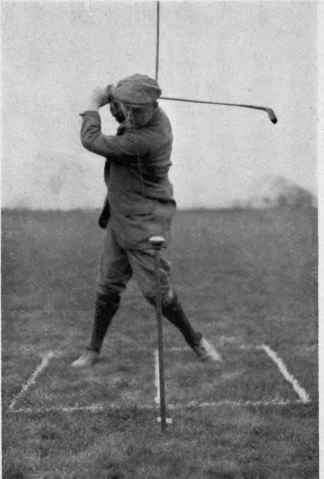
THE DRIVE OK BRASSIE SHOT.
Top of the Swing. The head has remained practically still save for a slight turn. It has not swayed. The right leg has stiffened with the screwing of the hips, and the left knee has bent inwards.

Finish. Ail the body movement has been done from the hips, and even at the end of the follow-through, the head has moved only very slightly towards the mole.
Arnaud Massy has a curious custom which never fails to put his club on the right track at the start of the downward swing. It has aroused a lot of comment from time to time. I have seen it described as Massy's "pig-tail," Massy's "twiddley-bit" and whatnot, and a great deal of wonderment has been expressed as to why the Frenchman does it and the possible effects of it. What happens is, that, at the top of the swing, Massy makes a strange little flourish, a circling in the air, with the head of his club. Whereas most men, having gone up, promptly start to come down again, Massy waits to perform this "twiddley-bit." It would be a fine thing for any of us if we possessed the same habit. By giving the club-head that little turn at the top, he pushes it out behind him so that it is almost certain to come down right. It is practically impossible for him to throw his arms forward since they have been urged into the proper track by that flourish which makes the club-head circle away from him. For the average golfer, however, it is sufficient to remember to aim slightly behind at the beginning of the downward swing. There should be no movement at all, except of the arms, until the club is halfway down. It must be first recovered from behind the head while the loosened fingers are coming back on to the shaft. Then, when it is well out to the right, a point or two behind the player, and just beginning to gain impetus, the whole body unwinds, round comes the club, and the stroke is a fine one. A good swing is a certain means of hitting the ball. In order to convince pupils of that fact, I have often closed my eyes tightly and driven without looking at the ball after having taken up the stance and made the address. The proper swing cannot fail.

Continue to:


My Books

