


How To Drive. Part 4
Description
This section is from the book "How To Play Golf", by Harry Vardon. Also available from Amazon: How To Play Golf.
How To Drive. Part 4

COMING DOWN.
The wrong downward swing: The body has turned too soon and the club has therefore been pushed forward.
As the club should comedown, i.e., behind the flayer.
Yet it is certain that the majority of golfers sow the seeds of a foozle in the first movement. As the average player takes the club back, he moves his body in the same direction and throws all the weight on to his right leg. At once everything starts to go wrong. It is a natural inclination, but it is easy to overcome if you determine that, rather than go the same way as the club, you will go the opposite way. The proper thing, however, is not to disturb the balance at all. A common failing which is wrapped, so to speak, in the one just described, is that the player does not fight against the left shoulder. He perhaps starts the upward swing well enough, but then he sees the left shoulder coming under his chin - which is just where it ought to be at the top of the swing. But it takes him by surprise and seems to alarm him. He dodges away from it, and the result is a wrong back swing. Rather let him move, if move he must, in the opposite direction.
I have said nothing about the follow-through because it is the result of the "Slow back" is an excellent rule for the novice, and even for the advanced golfer. But by "slow back" I do not mean taking the implement back at snail's pace. Very often the maxim is dinned into the ears of the beginner with such assiduity that he worries himself almost to death in his endeavours to make the upward swing as slow as possible. That is as bad as too rapid a movement. There is a happy medium. As proficiency encourages confidence, the back swing is apt to become faster and faster, but there is no advantage in that development, because there is nothing to hit at the top. Sometimes one sees a player take the club up at lightning pace, with the result that it not only drops behind his head, but reaches very nearly down to his heels. Pursuing that plan, the golfer can depend upon suffering fairly often from the effects of overswinging. He has to loosen his grip entirely and hurl himself forward to hit the ball.


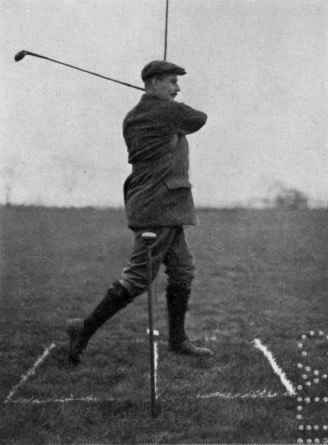
FAULTY MOVEMENTS.
A wrong back swing and perhaps the most common of faults. The body is swaying away from the ball. The left arm is too high and the position of the left wrist is very bad. It will be observed that the indicator has signalled the mistake.
A wrong position at the top of the swing. The head and body have straightened, making it very difficult for them to resume the sa?ne position as during the address. The left knee is not sufficiently bent, and the left shoulder when coming round has pushed the head out of position.
A wrong finish. The body is leaning away from the ball and towards the pole at the back. J he head litts, j* been lifted too soon, and the result will usually\lie^ either a top or a slice method; it is not the method itself. If the swing has been properly executed the follow-through will be all right with the body twisting round so much as to be facing the hole. The head will be over the right shoulder, leaning towards the spot from which the ball has been dispatched. It will go forward with the body a few inches as a result of the momentum which it has obtained during the downward swing. That will be its first movement. If the head be erect it must have been moved too soon, producing, in most cases, a top.
Now we have seen the operation as it should be - the inward turn of the left wrist, the screwing round of the right hip, the pivoting on the inside of the left foot, the bend of the elbows that causes the grip to temporarily relax (save for the thumbs and forefingers) and the shaft to drop behind the head, the aiming at an imaginary object to the right about a foot behind the player, and then the natural sweep round of the club which strikes the ball smoothly, yet with all the power of a hit, and finds the weight equally distributed, as it was during the address. If, instead of winding up the body, you merely move it to one side, you shift the weight so far away that you cannot often get it back in time for the impact.
When the ball is "cupped," and the player still desires to use a brassie through the green, it is useless to endeavour to nip right into a small indentation in the ground and at the same time get well under the ball. The disposition to attempt it may be strong, because it seems that one ought to make sure of lifting the ball out of the depression, but it will come out all right if the player aim an inch or two behind the object. What he needs to do is to make the club cut through the edge of the cup - that is to say, through the top of the turf which forms the cup. That will enable him to get at the ball. Consequently, whether he aims one inch or two inches behind the ball depends upon the extent to which it is ensconced in the abominable hollow. With the rubber-core, however, there is seldom real necessity to take a brassie in a cuppy lie. An iron club will usually obtain the required distance. That is one more phase of the simplifying of golf.
These are seven golden rules of the golf drive: -
1. Keep the head steady and do not let the left heel turn outwards - then the body can only wind up when the arms go back.
2. Grip firmest with the thumbs and forefingers - they are not so well adapted as the other fingers to the purpose of taking a strong hold, and they are the most important of all for the purpose of the golf grip.
3. Let the club-head lead, the left wrist turning inwards, the arms following the club-head, and the right hip screwing next.
4. Don't throw the arms forward as you start to come down as though you were mowing grass. Rather throw them back, and let them come round in their own way from that point.
5. Let the movement of the right shoulder be steady and rhythmic; it should have nothing in the nature of a sudden drop or jerk.
6. Don't be afraid to hit hard; if you are swinging correctly, hard hitting is not "pressing."
7. Keep your head still until the club has struck the ball.
Continue to:


My Books

