


Mashie Shots. Part 2
Description
This section is from the book "How To Play Golf", by Harry Vardon. Also available from Amazon: How To Play Golf.
Mashie Shots. Part 2
Now as to the method of winding up and unwinding the body; that is to say, the method of making the swing. As I have already said, the knees are all-important. There should be no rigidity about any part of the body except the head and feet. The head must be still; and the feet must be planted firmly on the ground. For the rest, the posture should be one of moderate relaxation, with a distinct element of slackness at the knees. The pivoting, so to speak, has to be done at the knees, which must be in such a position at the start that they can control the twisting of the body without allowing such twisting to be communicated to the feet. In short, the player practically screws himself into position with his knees, and unscrews himself with his knees - although he must not forget to so "time" the movements of his arms and hips that they work in perfect unison with the lower joints. Knees, hips, and arms should act in concert; the proper swing for the mashie will then result.
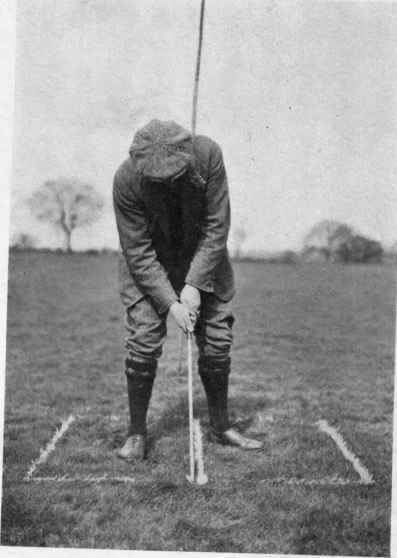

THE ORDINARY MASHIE SHOT.
Stance. The right knee is appreciably bent, and most of the weight is on the right leg.
Top of the swing. 'The right knee has stiffened. The left knee has bent, and is supporting the greater part of the weight. The hips have turned slightly, but most of the pivoting has been done at the knees.
As the player stands addressing the ball with a firm grip of the club, especially in regard to the thumbs and forefingers, let the weight of the body be supported by the right leg. To get comfortably into that position, it will be necessary to bend the right knee. As the club is taken back, the body screwing round at the hips rather less freely than in the case of longer shots, the right leg naturally stiffens. In fact, the knee of that leg really governs the stroke. Directly it is rigid, the screwing should stop. The backward swing is complete. The left knee will have bent slightly, as shown in the photograph of the mashie shot at the top of the swing.
It cannot have avoided doing so if you have remembered not to lift the foot from the ground. The safest advice is that the player should not raise either heel from the ground when executing anything less than a full mashie shot. And the latter, as I have already said, is merely a stroke for an exceptional occasion. For the three-quarter, half, or shorter swing - that is to say, for the normal mashie shot - the left foot should be flat on the turf as the left knee bends outwards. It is easily possible to obtain a three-quarter swing without moving that foot one iota. The downward swing, which amounts to unwinding the body by returning the right knee to the bent position, ought to be satisfactory so long as the player resists these three common failings: - Dropping the right shoulder with a jerk; bending the right wrist at the moment of impact in a sudden effort to push the club under the ball; and looking up too quickly. These are golfing sins in any kind of shot; but the temptation to commit them is never stronger than when the mashie is being used. The right shoulder should come round with rhythmic steadiness, and it will usually do so if the executant sternly repress the inclination to bend his right wrist as he comes to the ball - the result of a flash of fear that he may not, after all, get the face of the club under the object. The club will go under the ball all right if the swing be proper. The player should aim, as with the iron, about half an inch behind the ball; the loft of the mashie will then do what so many persons try to accomplish with their right wrists. I am certain that forty of every fifty bad golfers owe their weakness with the mashie to this obsession in the matter of trying to shovel the ball into the air. They endeavour to carry it, so to speak, on the face of the club. That is impossible. What usually happens is that they strike the ground about three inches behind the ball, and a fearful foozle results. If they could summon the determination to hit their mashie shots with the same freedom from anxiety to scoop the ball as they enjoy when they are driving, they would improve rapidly. The club will produce the loft; the player need not bother about it. A good golfer when using the mashie thumps the ball. He never scoops it. That is the difference between the right way and the wrong way.
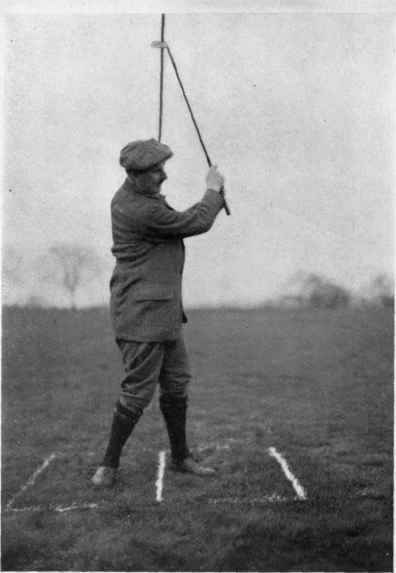

FINISH OF THE ORDINARY MASHIE SHOT.
For a stroke of, say So yards. The position is one of comfort, obviously nothing like hard work has been associated with it, and the weight is equally divided.
For a shot of less distance.
The desire to look up quickly is a natural one. When we are playing an approach of this kind, the spot which we are trying to reach is near and well defined. It is the space within a few yards of the flag. Consequently, there is anxiety to see immediately whether the ball is there. It will never be there unless we look at it long enough to strike it accurately. The head must be kept still with heroic determination until the follow through is under way. The action of the right foot is purely a matter of the finish, when the ball has been despatched on its journey; but the player will be assisted to preserve the correct balance for the whole stroke if he determine to have that right foot fixed to the ground even at the end of the shot. He can move it to such an extent that he turns on to the inside of it at the finish of the follow-through, but he should be chary of lifting either heel off the turf at any point of the swing. It is dangerous to give such freedom to the feet, because it is apt to undermine that perfect stability of stance which is so necessary.
Continue to:


My Books

