


Mashie Shots. Part 3
Description
This section is from the book "How To Play Golf", by Harry Vardon. Also available from Amazon: How To Play Golf.
Mashie Shots. Part 3
Here, then, we have the formula for the ordinary pitch-and-run stroke with the mashie - a formula which has the approval in practice of all the good players I have ever seen, and the principles of which apply from the three-quarter swing down to the little chip. There is another shot of a more complicated character. It is the mashie stroke played with cut. It is one of the shots that have helped to raise golf to the standard of an art. Unfortunately, it does not now produce with such certainty the effects which it invariably gave in the days of the gutty. It was possible in those times to pitch the ball right up to the hole with the assurance that, if the cut had been properly applied, there would not be a yard of run at the finish of the carry.
The distance had to be accurately estimated; and the ability to impart the spin had to be cultivated. Knowledge systematized and practised in this way would give the desired result with unfailing regularity. Nowadays one cannot always be sure what the ball will do. It is necessary to allow for a certain amount of run, and my own personal experience is that the player is apt to change his mind during the swing as to the spot at which he shall make the ball alight. He does not know how far it will skid, even though it be influenced by all the cut imaginable. It is a great pity that this element of uncertainty has been introduced into a really beautiful shot. Another misfortune is that many of the younger golfers of undoubted skill are so imbued with the spirit that makes them play for the pull that they never try to master this shot, which is nearly all carry. They do nothing but pitch and run.
Still, if the mashie shot with cut has been discouraged by the bouncing properties of the rubber-core, it remains a valuable stroke, and often the only one that can be attempted with any hope of laying the ball close to the hole. We may feel almost distracted when we reflect that, in any case, it is sure to run some distance, we know not what; but we must try it when we realize that the ordinary shot will of a certainty run too far. The stance is naturally a matter of great importance.
There should be, as previously, a distinct bend at the knees. The right foot should be advanced two or three inches nearer to the ball. The left foot should be drawn back a little, making the toe point more towards the hole than ever. The ball should be just about opposite the middle of the left foot. It can be readily perceived that the effect of this stance will be to turn the whole body more in the direction of the hole than for the plain mashie stroke. That is as it should be.
Now what we want to do is to draw the face of the club quickly and cleanly across the ball at the instant of impact. At the critical moment, the implement must be travelling across the line of flight, from right to left, so that directly it touches the ball the latter begins to spin. Clearly, then, we shall not swing as in ordinary circumstances. This cut shot is one of the few strokes in golf in which the head and body must - and should - sway a trifle as the club goes up.
Instead of keeping the arms close to the body, the player should push them away from him during the backward swing. He should push them away to such an extent that, as the right knee stiffens, the weight is thrown on to that leg instead of on to the left. There will be no twisting at the hips. The body will simply follow the club back. It is the necessity of this slight swaying movement that renders the shot so difficult of perfect accomplishment. Do not strain to take the mashie up too far (the cut shot is generally a fairly short one); then there will be little danger of overswaying. The club will come down in the same track as that which it occupied when ascending. At the moment of impact the arms should straighten, and the wrists should tighten. From the nature of the upward swing, the club is necessarily coming down across the ball, but everything should be done to accentuate that effect. Do not be afraid to make a distinct attempt to draw the mashie sharply and cleanly across the ball at the instant when the two come into contact. It is a shot for a skilful golfer because, to make the most of it, the object must be struck with the utmost accuracy. For that reason, it is advisable to hold the club at the lower part of the grip, the better to keep the head of the implement under complete control. The place to play for is 10 a spot a yard or so to the left of the pin since the ball, if cut in the proper way, will naturally screw to the right on reaching the ground.

Stance.

THE MASHIE SHOT WITH CUT.
Beginning of the upward swing. The club has gone outwards instead of behind.
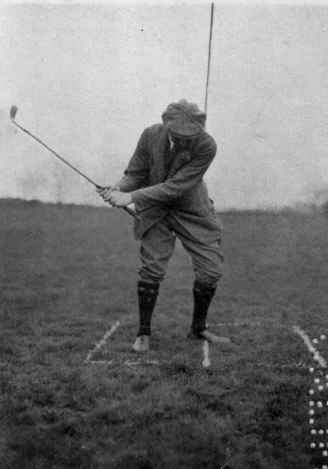
Top of the swing. The left knee has bent forward con siderably. This is in response to the desire to get the head into proper position after the slight sway enforced . . by the body following the club at the start of the swing.
Nowadays, a great number of people like to play their approaches with niblicks. Being much more lofted than the mashie, the niblick is well suited to the purpose. It imbues the golfer with a deal of confidence, inasmuch as he feels that the ball will not run far from such a club. And confidence is an asset. For the indifferent golfer, however, I cannot help thinking that the niblick is considerably harder to use than the mashie. The former club usually has a very sharp edge, and unless the ball be hit with great precision, that edge is apt to stick into the ground and spoil the shot as well as the turf. Nowadays tools called mashie-niblicks are popular. A warning that I would offer to the player who fancies a niblick for approaching is that he should not use it on an important occasion unless he is thoroughly intimate with it. To know the driving power of the club is essential. That power varies amazingly in different niblicks, and unless you are aware from constant use how far the ball will go off the implement, it is better to employ an ordinary mashie. And once you have come to understand the strength of your niblick in approach shots, do not change it because it fails you once or twice - unless, of course, it has an obvious fault. It will take you a long while to learn the peculiarities of another. To know your niblick - if you employ it for that department of the game which we are discussing - is a matter of supreme importance. In bunkers, you often have to use it whether you are on good terms with it or not.
Continue to:


My Books

