


Chapter XVI. The Most Useful Strokes And Finishing Touches
Description
This section is from the book "Taylor On Golf Impressions, Comments And Hints", by J. H. Taylor. Also available from Amazon: Taylor on Golf: Impressions Comments and Hints.
Chapter XVI. The Most Useful Strokes And Finishing Touches
SPEAKING now of the most useful strokes a man can make himself proficient in, I think the best and most paying of all is the approach shot. A player of the game will readily understand what I mean by this, but for the benefit of the inquirer or young beginner I may point out that an approach shot proper means, as it is generally understood, the playing of a stroke over any distance up to a hundred yards.
I am quite aware that an approach shot is the most difficult of any to play properly, but when properly mastered a man will find its great utility and value immediately. The stroke is a difficult one, from the fact that it is, or should be, played solely from the wrists. There is not a semblance of body swing about it; it is wrist work, and that alone, from which success is attained.
Every atom of the work in a stroke such as I am now describing comes from the wrists - I am now speaking in a broad sense - and those players who are possessed of naturally flexible, yet strong, wrists hold a great advantage. But others should not be discouraged by any inability to do all that is required at their initial appearances and attempts. The art of playing any particular stroke cannot be learnt without the expenditure of time and trouble. It is continual brainy practice, bearing the advice of the tutor in mind, that has made our foremost players what they are at present.
The most popular club, I think, is admitted to be the mashie. Up to the time of its "arrival," as they say in America, the niblick, with its short, heavy squat head, was used for the greater portion of the rougher work encountered while playing a round. But now it has, to a great extent, gone out of vogue, although on some courses you may still discover players who continue to include it amongst their impedimenta.
Still, it is only during recent years that the mashie has been used as a club with which approach shots can best be played. Formerly the golfer, amateur or professional, in playing a shot of this description invariably used an iron ; now the mashie has been found to be better adapted for the purpose, with its short, deep blade, than the long, narrow blade of the iron.

TOP OF SWING FULL MASHIE STROKE.
It would be quite an easy matter to argue out the why and the wherefore of this favour being accorded it at considerable length, were I so disposed, but I think it will be amply sufficient to say that in the mashie the weight is better distributed and balanced; hence, when it is once used, like a famous toilet preparation, we "use no other" - for this particular kind of stroke, at all events.
Supposing now that the learner has accomplished one portion of his self-imposed task, and has become fairly proficient in the use of some of the clubs, he must not rest content with the degree of excellence to which he has attained, for the finer, more delicate, and finishing touches of the game have yet to be learnt.
More than a passing acquaintance must be gained with what I will term the intermediate clubs-clubs that are brought into very frequent use when finesse and skill are required to assist the player in the more delicate parts of the pastime. Additional clubs to those I first named may not be absolutely necessary to the ordinary player, to the man who is quite content to play a moderately good game, but I would certainly recommend their being used as the player's game improves, for a golfer cannot know too much about his own particular sport.
These additional clubs fill the gaps that have been left in the endeavours to acquire a full capacity to play the game. They are a driving mashie and a mashie iron, possessing the same style of blade as would be found upon an approach mashie, but not having so great a lofting power, owing to the shape of the blade.
These clubs, though, I should like to mention, possess the same advantages over the iron for long shots as the approach mashie has over the iron for the approach shot alone. They are better balanced clubs, the weight is concentrated in a more favourable position, and it is in these points, small, but all-important, that their advantages lie. Their possibilities are great when handled properly, and any young player who desires to rise superior to the general standard cannot take too much pains over them.
I fear a casual reader may possibly think, from a perusal of the foregoing, that most of my hints have been devoted to the young man alone, but they are meant for all who are inexperienced, irrespective of age.
I may assure my readers that there is no reason why any man, even after the first blush of his youth has passed, may not become in time a good golfer. The Championships, of course, are not likely to be within his compass, but the same may be practically said all round, for they can only fall to a few of the very best performers; but given good health, good eyesight, and a determination to see the matter through, there is no reason at all why the average man should not be capable of holding his own with his club friends.
When a man has reached, I will say, thirty-five or forty years of age, his inclination is in the direction of the steady game, a style of game at which I feel confident he may do well. He will not be inclined to strive after effect or to "play to the gallery," as not infrequently happens with the younger generation of golfers.
The tortoise, it will be recollected, succeeded in defeating the hare. "Slow and sure" is another crusted, but apposite saying, and personally I am by no means certain that the steady, careful game is not after all the most sensible one.
There can be no denying the fact that the one thing necessary in the game is steadiness and stamina combined. There is, of course, an advantage in learning the game when young, but yet there is no reason to despair of getting well up in the lists even if a man has found it impossible to handle the clubs until he has reached the late thirties.
In proof of my statement in this respect I may instance Mr. C. Hutchings, of Hoylake, as an example. Mr. Hutchings did not commence playing golf until, comparatively speaking, late in his life, but after this brilliant example who will be found bold enough to say that to learn late in life is an impossibility? Mr. Hutchings at the age of fifty-three is not only capable of holding his own in excellent company, but has actually become the winner of the amateur championship, and if one man is able to do this, why not another?
A golfer who has taken up the pastime somewhat late is generally safe and sure, if not exactly brilliant in his methods of play. He wins his matches by the mistakes made by his opponents, and provided he devotes his attention to the cultivation of the steady game, he should do well.
An oldster learns quite as readily as the youngster, and in the majority of instances proves himself to be a far more tractable pupil. The young man is apt to break out into open rebellion over the tedium and monotony of the slow game, safe though it may be, and, as a consequence, attempts to run before he is really capable of walking without assistance.
But his senior is made of more solid material; he is quite content to plod along with the Anglo-Saxon determination that has pulled us out of so many tight corners in the past, and will do so again in the future. So, to my older readers, this is my advice: Don't despair and think it an impossibility for you to be capable of playing a good game, even should your muscles have lost some of the pliancy of youth. A good instructor, and a due observance of his rulings, are all that is necessary, and in a twelvemonth, provided a man displays the slightest aptitude for the game, he should have advanced far enough to be capable of holding his own in good company.
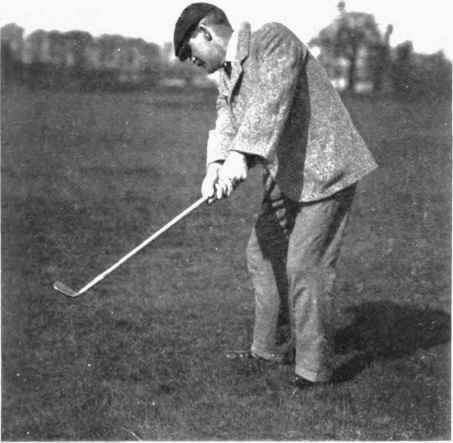
ORDINARY MASHIE STROKE. AFTER HAVING JUST STRUCK BALL.
While engaged upon these hints, a few remarks upon the clubs used in the game may not be entirely out of place. At once I should like to make it entirely clear to the intending player that he need not fear the pastime would be at all likely to develop into a costly pursuit, in consequence of frequent smashes and accidents sustained during the term of probation. This is far from being the actual case; the comic papers notwithstanding, breakages are wonderfully few in number.
There are, of course, times when the playing of a stroke may lead up to the involuntary departure of the head from the shaft of a club, but such an accident as this only happens on very rare occasions. The materials used in the manufacture of clubs have improved vastly since the game has come into real prominence, the clubs themselves have been improved with the rise of the pastime, and there are now, despite the increased number of players, far fewer smashes than was formerly the case.
Another noticeable feature in the manufacture of clubs is the tendency displayed by the various makers to form the heads much shorter than was the case even ten years ago. During this time experiments have been made, experience has been gained, and it has been at length discovered that the striking power can be concentrated. The sequel of this additional knowledge has been the making of various improvements, such as this shortening; indeed, the tendency has been to make the whole of the club lighter and not of so great a length, either in the head or in the shaft.
In this respect, though, it is important to note that there is not really any fixed pattern, for players with different styles may favour various types of clubs. A tall and a short man, again, will scarcely find the same length of shaft suit both, but although the tendency of the day is to shorten the shaft and to make it lighter and stiffer, finality of design has yet to be reached.
One player may feel disposed to favour something out of the usual pattern, but such a thing as this will always occur in every branch of sport, and finally the club manufacturer will discover that it is impossible for him to improve upon his productions.
So, with but one word of advice, I bring my hints to a close, trusting they may encourage more than a few to follow up the game in the manner it deserves. This advice is-purchase the best goods of a good maker; it is a method that repays a thousandfold the slight additional expense incurred.
Continue to:


My Books

