


In Hazards. Part 2
Description
This section is from the book "The New Book Of Golf", by Horace G. Hutchinson. Also available from Amazon: The new book on golf.
In Hazards. Part 2
A modicum of common-sense will be of more assistance to a player in a bunker, provided that she has grasped the two great elementary facts that it is the sand behind the ball, and not the ball itself, that is to be struck, and that the swing must be vertical, than any amount of theories. A very prevalent mistake is to play the shot in too much of a hurry. Many people are so annoyed at finding their ball deeply imbedded, that they make up their minds at once that the matter is hopeless. They say, ' Oh, I will just have one shot at it, and see what happens,' without any expectation of a good result. They then take a wild hit, embed the ball still further, and pick up in a rage or resignation according to their disposition. Now there are very few lies, even in bunkers, which are quite hopeless. Before attempting a shot the player should study the ball carefully. She should take into consideration the state of the game, she should note the steepness of the face of the bunker, the lie of the surrounding country, the length still to be achieved before the green is reached, and last, but not least, the consistency of the sand. It will depend on all these things how much or how little should be attempted. The first point to be remembered is not to try for too much, to be satisfied with what is fairly probable, not what is just possible. If the hole is quite near at hand, and if a straight shot is feasible, a straight shot should be tried. But if a straight shot is very unlikely to succeed, the player must be content to get out to either side, or even to play straight back on the line from which she has come, rather than run the risk of leaving the ball still in sand for the subsequent stroke. If the green is still some distance away, the lie of the ground should be noted with a view to the succeeding shot. A sacrifice of direction in the first instance often means a decided gain afterwards in the ease with which the next stroke can be accomplished. The quarter from which the wind is blowing also affects the decision. When all these points have been thought out and the stance taken up, the shot should be played deliberately. Hit hard, as hard as you can, with a straight up and down swing, but do not hurry. Maintain this deliberateness in all bunker shots, even when the ball is lying fairly clean. Hurry is fatal. On paper it sounds as if the player would become rather a nuisance if she paused at each bunker shot to think out all these points. But with experience the golfer gains the power of rapid judgment, and the habit is soon acquired of seeing at a glance the best tactics to pursue.
One feels a delightful sense of power on successfully making a long shot out of sand, but the effort to obtain too much distance is the source of many mistakes, and the cause of many a spoiled score or lost match. It is never well to be greedy. Safety lies in moderation. A medium-weight iron often proves a reliable club when a ball is lying clean in sand. A considerable distance can be reached with it, and there is usually sufficient loft on the face to make the ball rise quickly. A cleek may be used with advantage in some hazards, but it is not a really safe club to take in sand, as with it the player is very likely to fail to get the ball away. It may be taken as a desperate expedient when a match is going badly, and the only chance of success lies in the forlorn hope of making an extraordinarily long and good recovery. But, as a general rule, the possible gain in distance is not so great as to justify running the increased risk of failure. When a ball is lying clear in sand, the player in making the shot should fix her eye on the ball itself, and not on the sand behind it. She need not take any sand with the shot, and the endeavour should be to pick up the ball as cleanly as possible. The swing may be a shade less vertical. One of the chief differences between a beginner and an experienced golfer lies in the latter's knowing her limitations and using her clubs accordingly, while the former with happy optimism tries impossible shots and trusts to luck to carry her through. When the novice has learned to recognise what she can reasonably hope to accomplish, she may be said to have passed one of the most important stages of her novitiate. It may be said here that all through the green a great deal depends on the exercise of judgment in deciding which particular club to use for each particular shot. Of course, in numbers of cases the choice is obvious, but in many others it is very difficult. A good caddie, who is familiar with the player's ordinary game and knows her good and bad points, can often give very helpful advice. The question to be decided may be the possibility of reaching the distance with a certain club, or the picking up of a ball out of a doubtful lie with some special club, or the chance of carrying a distant bunker or hazard, or any other of the numerous knotty points which occur so frequently in a round, and which add so much to the interest of the game. A good plan to follow is to play a bold game in a practice round, and a cautious game in a match. It is a mistake for a beginner to be too 'canny,' as she may cramp her play. We never know what we can do until we try, and improvement without running risks is impossible.
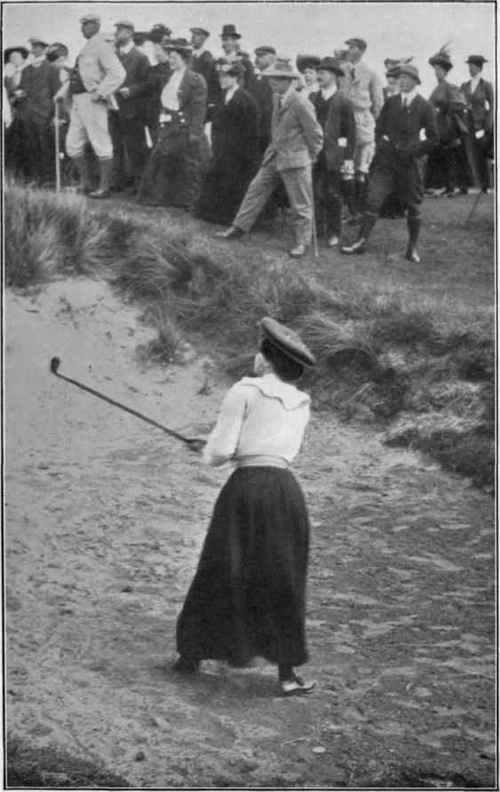
BUNKER SHOT Mrs. It. A. Cramsie.
[To face p. 332.
Bunkers and hazards vary very much on different links. On some the hazards are quite distinctive and are well known to fame. Such are the Maiden at Sandwich, the Water Hole at Ranelagh, the Station-master's Garden at St. Andrews, and the Crater at Portrush. To negotiate successfully any of these is a feather in the beginner's cap.
So far, we have only dealt particularly with sand bunkers; we now turn to hazards of other kinds. The definition of a hazard in the rules is, 'any bunker, water (except casual water), sand, path, road, ditch, bush or rushes.' In the same paragraph it is stated that sand blown on to the grass or sprinkled on the course for its preservation, bare patches, sheep tracks, snow and ice are not hazards. The beginner will do well to study Rule 25, which deals with what a player may or may not do in a hazard. The most important points are, that nothing may be done which can in any way improve the lie of the ball; that the club shall not touch the ground, nor shall anything be touched or moved, before the player strikes at the ball, except that he may place his feet firmly on the ground for the purpose of taking his stance; and that in addressing the ball, or in the backward or forward swing, he may touch any grass, bent, bush or other growing substance, or the side of a bunker, wall, paling, or other immovable obstacle. The last clause is comparatively modern and has very much simplified bunker play. The permission to ground in permanent grass in a hazard has been deleted from the revised rules.
Continue to:


My Books

