


Part III. Men Of Genius. Part 4
Description
This section is from the book "The New Book Of Golf", by Horace G. Hutchinson. Also available from Amazon: The new book on golf.
Part III. Men Of Genius. Part 4
Scotland has certainly never produced a finer all-round athlete than Mr. Leslie Balfour Melville. An international football player, the best bat in Scotland, he also won the Scottish lawn-tennis championship, though I cannot think that the northern climate could ever permit this game to reach a very high standard. When he turned his attentions seriously to golf, he quickly made his presence felt, and crowned his achievements by winning the amateur championship at St. Andrews in 1895. He has always been a little more formidable at St. Andrews than anywhere else, and no one has won so many medals over what is undoubtedly his favourite course. His style is often cited as a model for the young player, and the true deliberate swing, with the fine follow-through of the arms in the intended line of the ball's flight, is worthy of imitation. Like all St. Andrews players, he is a master of the running approach, and unlike some of them, he is also a beautiful pitcher. He plays all his approaches with rather a stiff wrist, but he keeps his body beautifully still - one of the main factors of successful iron play.
Mr. S. Mure Fergusson learnt most of his golf at St. Andrews, though he has also played a great deal in the south. His style slightly resembles Mr. Balfour Melville's, especially in the deliberate back swing and fine follow-through. He has one stroke peculiarly his own, which he calls his push-shot, and it is the only shot of the kind which really merits the name. It differs very materially from the push-shot as played by Vardon, etc., which in their case is a misnomer - stab-shot would be more appropriate. Mr. Fergusson takes his club back a very short distance, and seems to literally push the ball with his arms, the wrists being kept quite rigid. It is a very powerful stroke, and especially useful against a head wind. Although he never actually won the amateur championship (he reached the final at Hoy lake in 1894, only to lose to Mr. Ball at the last hole), he has a splendid record, which is only to be expected from a player of such power and determination.
No list of those, who I trust will not resent being designated as the older generation, is complete without some mention of Mr. Charles Hutchings, who accomplished the unparalleled feat of winning the amateur championship when a grandfather. He is one of the few players who, though handicapped by a comparatively late start, still attained to the highest class. Very straight and steady with all his clubs, he possessed great power of forcing the ball from a bad lie, and was invariably a beautiful putter.
Mr. Alexander Stuart was another very fine player, and though he never won the championship, he won the Irish championship, and had a splendid record, especially at St. Andrews. He had a long deliberate swing, and drove a beautiful ball with apparent absence of effort.
Mr. H. H. Hilton is a very interesting personality in the golfing world, not only on account of his wonderful record, but also as supplying a link between the old and the new schools of golf. His many successes include two open championships, three amateur championships, and he capped all previous records in 1911 by winning the amateur championship both here and in America, and by failing by the narrowest possible margin to win the open championship at Sandwich. He is the most scientific of all the great players, and possesses the most complete mastery over all his clubs. To perfect control of trajectory he adds the power to hook and slice at will, though personally I prefer his driving when he is not going out for the hook. He is the greatest master of the spoon, his half-shot with that club being a most striking feature of his game. He is a great believer in the (quite pleased) follow-through - his own might almost be described as a 'fling,' by reason of its very exuberance. Another characteristic is the care with which he adjusts his feet in relation to the shot intended. He is facile princeps at the short game, especially with the mashie, when a quick stopping shot is necessary. The ball on these occasions is played boldly up to the hole with lots of cut, and drops like a poached egg at the hole side.
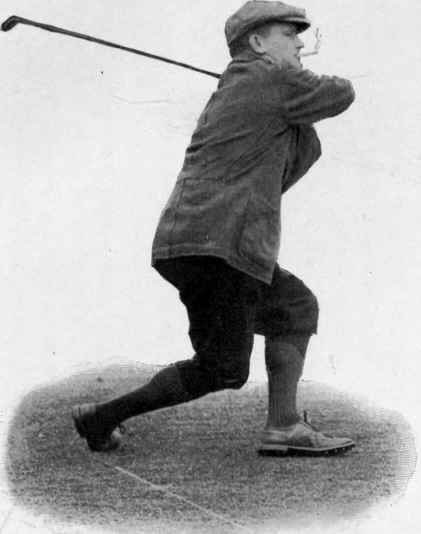
H. H. HILTON.
(a little anxious)
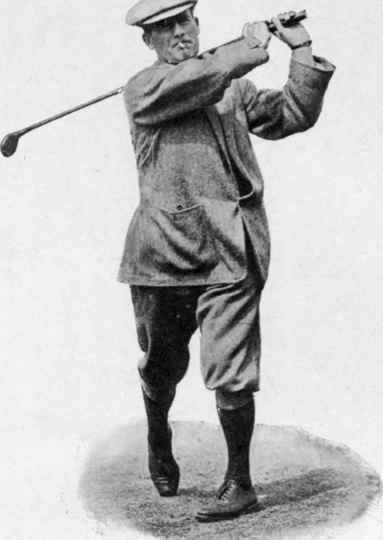
H. H. HILTON.
His opponent in the memorable final of the amateur championship at St. Andrews in 1901, Mr. J. L. Low, is also a very scientific player, and a very good judge of the game. He is also a leading figure in golfing politics, and is the author of several golfing works of no little merit. He is a great exponent not only of the theory of the wooden putter, but also of the correct style of wielding it, his methods being in direct contrast to many who favour the old-fashioned type of weapon, whether it be made of wood or aluminium. Mr. Low trusts entirely to his wrists, taking the putter well back, and striking the ball a beautifully free blow. His running approaches are nearly as great a feature of his game, and are also played in the correct style, i.e. with a smooth stroke and a rising club, and not with the species of jab so much affected by some of the younger school.
In the early 'nineties a most formidable young player began to make his presence felt in the important events, and in 1893 reached the semi-final of the amateur championship. But it was not till 1896 that the late Mr. F. G. Tait succeeded in winning the event which proved a veritable triumph for him, as in addition to winning the St. George's Cup, he defeated Messrs. Hutchings, Laidlay, Ball, Horace Hutchinson, and Hilton successively, his play, especially in the final, being a revelation. He very nearly succeeded in winning the open championship at Muirfield the same year, and won the amateur championship for the second time at Hoylake in 1898. He reached the final again at Prestwick in 1899, only to be defeated by Mr. Ball at the thirty-seventh hole. In addition to these feats, he won every important event at St. Andrews, and again and again proved himself to be not only indubitably the best player in the Royal and Ancient Club, but probably the greatest amateur Scotland ever produced. To what heights his genius might have attained with the rubber-cored ball (which he never had the chance of playing with) can only be conjectured. His style gave an extraordinary impression of control and latent power, and when occasion demanded he seldom failed to produce a great effort. He possessed a wonderful temperament, and always played in the true sporting spirit - without which surely games lose most of, if not all, their true value.
Continue to:


My Books

