


Canada. Part 27
Description
This section is from the book "Canada - John L. Stoddard's Lectures", by John L. Stoddard. Also available from Amazon: John L. Stoddard's Lectures 13 Volume Set.
Canada. Part 27
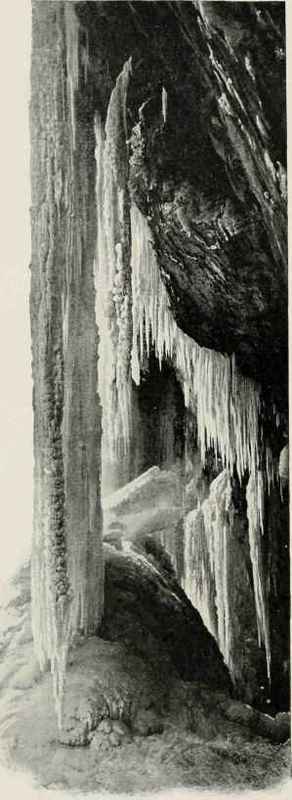
Behind The Horseshoe Fall In Winter.
Niagara never is monotonous. Although, in general, the same, in detail it is always different. Its surface offers infinite variety. Splendid in sunshine, sombre in the storm; foam-flecked at one point, spray-swept at another; frolicsome here, forbidding there; snow-white in its swift rush across the upper ledges, a massive wave of emerald on the brink, a scintillating flood of broken prisms far below - the element of fear is much less characteristic of Niagara than that of joy and exultation. True, I have looked upon the scene at night, when all was weird and terrifying; when the hoarse warning of the rapids, the sullen thunder from the dark abyss, the pale wraiths rising from the seething caldron, and the vast size and mystery of the cataract's dim, white wall, swaying against the darkness like a ghostly curtain, awak ened in my soul unutterable dree But let me ever more remember it, as I last saw it, in the brilliant sunlight of a winter day! The myriad-handed genii of the frost had decked both shores with frozen spray in all conceivable forms of ornamentation, apparently composed of spun glass studded with innumerable diamonds. Across the great gulf stretched a glittering viaduct of ice, suggestive of the rainbow bridge which, in the Norse mythology, led to Valhalla, dwelling of the northern gods. From this magnificent, iridescent arch a slender shaft of sun-illumined vapor mounted slowly heavenward to a point hundreds of feet above the torrent, and there dissolved in the blue empyrean, like a mist of pearls. It seemed the Naiad of Niagara.
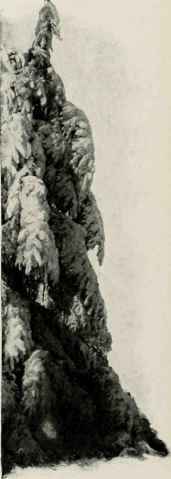
Iced Foliage.

Iced Foliage.

A Scintillating Flood.

Prospect Point, Day.

Prospect Point, Night.

Decked With Frozen Spray.
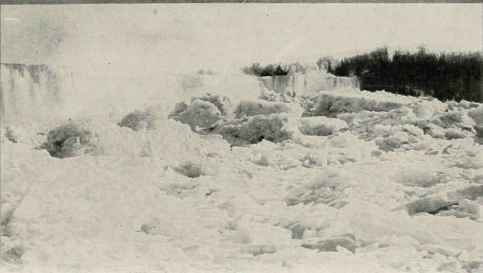
The Ice Bridge.

American Fall And Ice Mountain.
The Canadian Province of Ontario has a population of two and a quarter millions, or forty-three per cent. of all the inhabitants of the Dominion. More fortunate, too, than lands which suffer from a heterogeneous mass of undesirable immigrants, all of these residents, save about three and one half per cent., are native subjects of the British Empire, and fully four fifths of them were born in Canada. The origin of their ancestors is, however, suggested by the names of many of Ontario's towns and villages, such as London, Edinburgh, Glasgow, Ayr, and Dumfries. Moreover, out of the forty-four cities in the Dominion which can claim a population of more than five thousand, twenty-two are situated in this province. Under these circumstances it is not strange that Toronto, the capital of Ontario, has now two hun-dred thousand inhabitants, and is the second largest city in Canada. To be the capital of a country like Ontario is no mean distinction. Even to those familiar with the enormous size of some of the western States of the American Union, the vast proportions of this Province are astonishing; for it is twelve hundred miles in length, seven hundred in breadth, and has about twenty thousand more square miles of territory than France and Corsica combined.
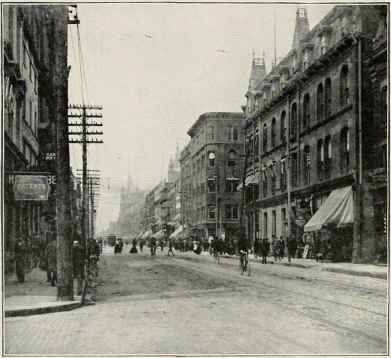
Yonge Street, Toronto.
This section of the Canadian federation offers a fine example of an imperium in intperio; for, while both Ottawa and Toronto are within its limits, the latter is the seat of the Provincial, the former that of the Dominion government. To those who are unacquainted with the constitution of Canada, this calls for a word of explanation. Though many points of similarity exist between the governments of Canada and the United States, in other respects the systems are entirely different. The great Republic has for its chief executive a President chosen by the people. The great Dominion is presided over by a Governor General appointed by the sovereign of the British Empire. Assisting this official are, first, a Senate of eighty members appointed by him for life on the recommendation of his Privy Council; and, secondly, by a House of Commons, containing two hundred and fifteen deputies, elected for five years by the people on the basis of a liberal franchise. Each of the seven Provinces has, however, a separate government of its own, consisting of a Lieutenant Governor, who is nominated by the central government, and is in his turn aided by an elective legislature, assembled in either one or two houses, as the respective Province may prefer. The powers vested in the federal parliament relate to the post-office, customs duties, navigation, currency, banks, taxation, military defenses, and other matters of national importance. The various Provincial governments, on the other hand, deal with direct taxation for local purposes, municipal and charitable institutions, education, and the ordinary administration of justice. The intimate connection of these forms of government is perhaps best seen in the fact that, as the parliament of the Dominion has the power to disallow any act of a Provincial parliament, so the imperial parliament of Great Britain has the right to disallow, within a similar space of time, any act of the Dominion government.
Continue to:


My Books

