


Bohemia. Part 2
Description
This section is from the book "Bohemia - John L. Stoddard's Lectures", by John L. Stoddard. Also available from Amazon: John L. Stoddard's Lectures 13 Volume Set.
Bohemia. Part 2
Even the names of towns and railway stations are frequently unrecognizable in their novel forms. Prague, for example, changes into Praha, Brunn to Brno, Olmutz to Olomouci, Eger to Cheb, and even our old friend Pilsen contracts to the catarrhal Plzn! Nor is this all. In Prague itself, - the cosmopolitan capital visited by so many foreigners, - the names of streets and signs on the electric cars are for the first few days incomprehensible. In the Bohemian Exposition, held in Prague in 1908, scarcely a name or notice was displayed in any European tongue, save Czech! I therefore walked about, unable to decipher scores of titles, rules, and explanations, which certainly in such a place might well have been expressed in one of the better-known Continental languages. Formerly this was not so. The names of streets and all the numberless announcements necessary to a city's life were given in both Czech and German. This was a rational arrangement, advantageous to all parties; first, because Czech is not, and never will be, understood by foreigners; and secondly, because Bohemia still belongs politically to the Austro-Hungarian Empire, where the official speech is German. But now in both Bohemia and Hungary their own respective languages are, as far as possible, exclusively employed, and the bewildered tourist is left to puzzle out the meaning of their simplest words. At first the stranger is annoyed by this. It seems to him exasperating and absurd, as well as antagonistic to the interests of a people who would gladly see more foreign visitors among them. But gradually he comes to understand and even to sympathize with the situation. It is not due to foolish self-conceit or chauvinism, or to an inconsiderate wish to force the foreigner to learn their language. The cause lies deeper. The language-question is the storm-centre in the conflict between Czech and Teuton.
Were the political situation changed, the German signs would probably reappear to-morrow. In both Bohemia and Hungary the strenuous insistence on the unrestricted use of the vernacular is one of many indications that both these lands are in a state of unrest and transition; that both are waiting for the death of the old emperor, Francis Joseph, to make some new and startling demands; and that it may be then a question not of words alone, but deeds. Austria tried -no doubt with good intentions from her point of view - to crush out the Bohemian language, as Prussia is endeavoring today to stop the use of Polish in her eastern provinces. But to a spirited people nothing is so precious as its mother tongue. This is particularly true in Bohemia, the origin of whose literature is practically identical with that of her religion. In the ninth century the earliest Christian missionaries, in order to supply their converts with a written language, invented one for the Slavonic race, with characters somewhat resembling those of the Greek alphabet, and into this translated the Bible and the writings of the Saints. Thus the Christianity of the Czechs is fundamentally associated with their language, - an added reason why the latter cannot be suppressed. It is, moreover, a remarkable fact that this great question of the preservation of Bohemian has been a matter of contention between Czech and Teuton for a thousand years. For German bishops, from the first, so bitterly opposed the new Slavonic tongue with its distinct linguistic liturgy and ritual, that it was necessary twice for the pope to intervene and settle their disputes. Seen therefore in this long perspective, the Czech's avoidance of Teutonic speech, and even his removal of the German version of his street signs, are better understood. The policy is really a reply to Austria's attempt to stifle Czech expression; and so intense and universal is Bohemian feeling on this point, that even religious differences are forgotten in comparison.

A Bohemian Peasant.
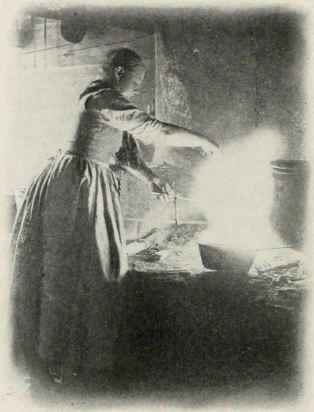
A Czech Cook.
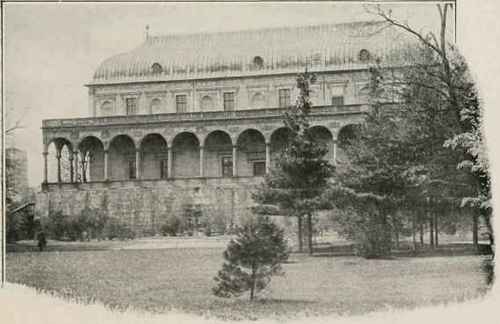
The Belvedere Palace At Prague.
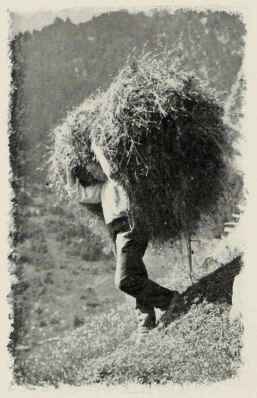
Haymaking In Bohemia.
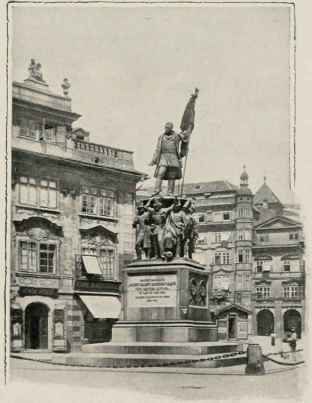
The Radetsky Monument At Prague .
Continue to:


My Books

