


Bohemia. Part 3
Description
This section is from the book "Bohemia - John L. Stoddard's Lectures", by John L. Stoddard. Also available from Amazon: John L. Stoddard's Lectures 13 Volume Set.
Bohemia. Part 3
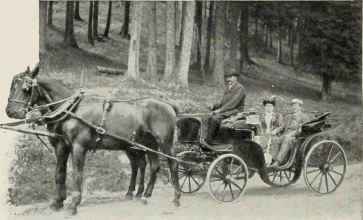
Driving Through Bohemia.
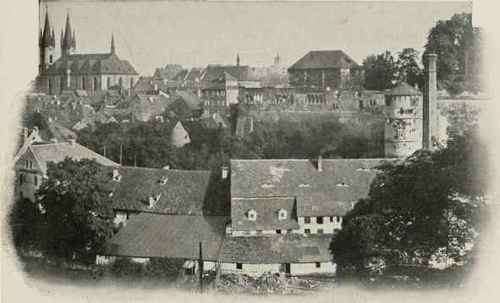
The Old Bohemian Town Of Eger.
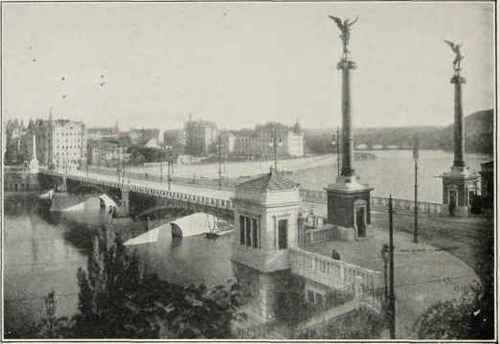
The "Czech" Bridge At Prague.
Thus, many good Czech Catholics revere the memory of the Protestant leader, Hus, because he was a sturdy champion of their native tongue, employed it in his preaching, and drove from it implacably some importations from the German. Moreover, the linguistic difficulties of the traveler, caused by this national sentiment, are for the most part merely visual. Every Bohemian whom he is likely to encounter can speak German, and will do so to help a foreigner, however reluctant he may be to use a word of it among his countrymen. French, too, is spoken fluently and always with great pleasure by the educated Czechs. This is quite natural. Like France, Bohemia stands in fear of Germany's expansion. Like France, she sees with dread the Teuton's growing power. A common sentiment establishes sympathy between them. A common interest promotes their friendship. Some deputations, sent from France, have met here with receptions, not alone polite and cordial, but immensely stimulating and enthusiastic. In truth, the associations which unite the Czechs and French date from remote antiquity. Thus, the Bohemian sovereign, known before his coronation as John of Luxemburg, fought with the French, in 1346, against the English under Edward III. at Crecy, and perished in the hottest of the battle on that well-contested field. It was, indeed, at Crecy, that the young English "Black Prince" gained his spurs, and then and there adopted for his own the triple feather-crest of the fallen ruler of Bohemia, together with the motto "Ich Dien," since then worn by every Prince of Wales. As illustrating, also, the prodigious influence exerted at that time by Bohemian monarchs, it was half humorously, yet half seriously, said of John of Luxemburg, that nothing in Europe could succeed without the aid of God and the king of Bohemia!
Prague is the essence of Bohemia, as Paris is of France. All other cities of the country, interesting though they are, remain subordinate to it. The idol of the Czechs, the focus of their politics, the cradle of their culture, the altar of their patriotism- how can it fail to be a sanctuary of inspiring memories? It is a place where history was certain to be made. As the chief meeting-point of Slav and Teuton, it was inevitably destined to become a centre for conflicting thoughts, impassioned parties, and volcanic life. It is, moreover, one of the handsomest cities in the world. And yet, not merely handsome. Its features have a virile combination of both strength and symmetry, approaching grandeur. Eight centuries of art have made it beautiful. Reminding one of Paris and Moscow, it yet differs from them both. Its seal of individuality is as personal as the cartouche of a Pharaoh. Its physiognomy is one of smiles, until one sees it unobserved and, as it were, in profile. Then it is stern and sad, and one intuitively feels that in the drama of humanity Prague was assigned a tragic role. A veil of mystery enshrouds the origin of every ancient city. In Prague this veil is woven with particularly pleasing threads of poetry and romance. As in the case of Carthage, "Dux femina facti." The Dido of this Slavic city was Libussa. In the latter part of the fifth century, a Croatian chief, named Czech, after subduing the Celtic race of Bojen then residing here, is said to have settled in Bohemia with his tribe, and to have called the country by his name.
One of his heirs to sovereignty had three daughters. The youngest of them, known as Libussa, was famous not alone for beauty, but for wisdom. Her countrymen, indeed, revered her as a kind of sibyl, and she was thought to have the gift of prophecy. Among her treasured utterances was a glowing prediction of Prague's future greatness. It was to be a city "whose renown should reach the stars." Upon the death of her father, the people chose Libussa for their queen, and promised to accept as sovereign whomever she herself selected for a husband. She therefore sent two messengers to a certain part of the country, where she declared they would discover a laborer plowing with two oxen. To him they were to offer her hand in marriage, and with it the kingdom of Bohemia. No sooner said than done. The messengers departed, found their man, and brought the astonished plowman to the city, where the young princess promptly married him. There is a rumor that this little comedy had been prearranged, and that the handsome laborer was a prince disguised. At all events, this young Bohemian Cincinnatus, who bore the name of Premysl, is said to have built a castle on the noble height, where rises now the splendid Hrad-schin palace, and to have traced the limits of the future city with his plowshare. Thereafter, every time that a Czech prince was crowned, he wore upon his feet the shoes of Premysl, in memory of his famous ancestor, and as a guarantee that he would guard the interests of the peasant class. How much of this romantic story can be true? No one can tell. But let us not entirely reject it. Love, sturdy labor, and a pledge of justice are factors far too precious in the founding of a kingdom to be lost. Woe to the land that has no legends! What seems indubitable is the fact that Premysl was the founder of a dynasty which, starting somewhere near the year 752, ruled in Bohemia till 1306. Indeed, the present Emperor of Austria is said to be a descendant of Premysl in the female line.
Continue to:


My Books

