


Bohemia. Part 4
Description
This section is from the book "Bohemia - John L. Stoddard's Lectures", by John L. Stoddard. Also available from Amazon: John L. Stoddard's Lectures 13 Volume Set.
Bohemia. Part 4
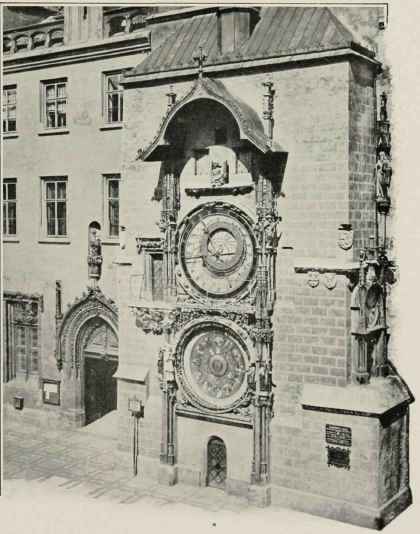
Old Astronomical Clock,Prague.

The German Theatre, Prague.
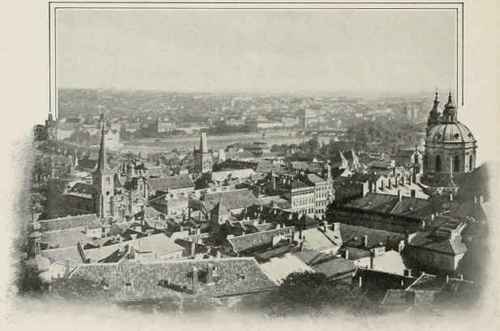
General View Of Prague.
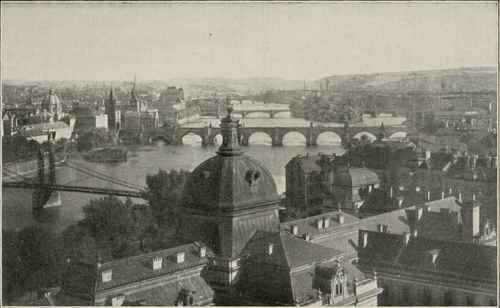
Prague.
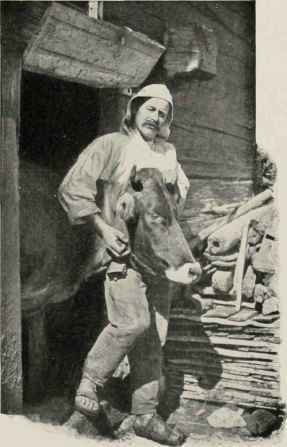
A Czech Farmer.

A Hall In The Bohemian Royal Palace.
A river, not unlike the Seine at Paris, passes through this Slavic capital. Germans have named this stream the Moldau. Bohemians always call it the Vltava. One gladly pays the Czechs the compliment of using their own word, especially as it is easy to pronounce. Five bridges span its often swollen and tumultuous current, and one of these - whose English name is "Charles' Bridge," derived from its illustrious founder, King Charles IV. - might truthfully be called the nucleus of the city's life. Its site has been a place of crossing for a thousand years. How many wooden bridges were successively erected at this point, and swept away, no one can say. But, in 1157, Queen Judith caused to be constructed here the first stone bridge which Prague had ever seen. Even the founding of the present structure antedates the sailing of Columbus for America by more than one hundred and thirty years, and its huge, massive piers have weathered centuries of storm and flood. Till 1841 it was the only path of communication over the Vltava, and hence it is often spoken of to-day -despite the existence of four stalwart rivals - as the Bridge of Prague. Along its parapets are thirty statues or religious groups, - fifteen on either side, - the gifts of pious princes or devoted laymen in comparatively recent times.
At first, the only ornament on the bridge was a gigantic crucifix, and probably the structure would be more impressive, were this still the case. Yet, although scarcely one of all its sculptured forms repays inspection as a work of art, it is impossible to deny their general effectiveness, viewed at a little distance, in connection with the edifice which they adorn. Moreover, one of them is famous, and revered by millions. It is the large bronze figure of Bohemia's patron saint, the celebrated John of Nepomuc, who from this bridge, in 1383, and at a spot now indicated by a marble slab, was thrown into the river by the order of his sovereign, Venceslas IV. Tradition states that this Bohemian king had quarreled with his wife, and wanted to be rid of her. Anxious to find a plausible pretext for condemning her to death, he asked the queen's confessor, John of Nepomuc, to tell him secretly the sins of which she had accused herself. The priest refused. 'The consequences of his bold fidelity to duty followed speedily. Beginning with imprisonment and cruel torture, they ended in his death in the Vltava. According to the legend, the body of the loyal victim was not carried down the stream, but floated for some time upon the river's breast, while five stars formed a coronal above his head. These stars are represented, rather inartistically, now above his statue; but where such reverence is felt for the original of the work, art is a secondary matter. On the sixteenth of May, - the festival of the saint, -enormous crowds assemble annually here to do him honor, and the great bridge is blocked for hours by pilgrims from all sections of Bohemia, as well as from Moravia and Hungary. One smiles at many of the customs and beliefs connected with that scene; but, setting these aside, as part of an inevitable fungus on the tree of time, we find, as a legitimate basis for these centuries of admiration, the splendid courage of a man, who would not, even for his life, betray a woman who had trusted him, or in the agony of torture violate his priestly vow. Within the bur of superstition, therefore, we perceive this kernel of immortal truth, -that over valor such as his the waters of oblivion can never roll, and that around the memory of such heroes there will always shine an aureole of stars.
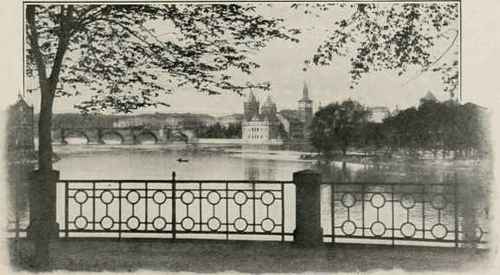
The Vltava, Or Moldau.
Continue to:


My Books

