


Gibraltar. Part 4
Description
This section is from the book "Gibraltar - John L. Stoddard's Lectures", by John L. Stoddard. Also available from Amazon: John L. Stoddard's Lectures 13 Volume Set.
Gibraltar. Part 4
Within these rugged cliffs goes on a life whose aim is to be lifedestroying. Beneath the surface of the promontory winds a labyrinth of galleries, as if it were a mighty ant-hill, whose formic colony had been replaced by one of men. At intervals, these corridors, all hewn and blasted out of solid rock at an incredible expenditure of labor and of gold, are pierced with loopholes, through each of which, half hidden by a dull gray boulder or a clump of spiny cactus, peers forth the muzzle of a cannon, capable of hurling shot or shell for miles upon their errand of destruction.

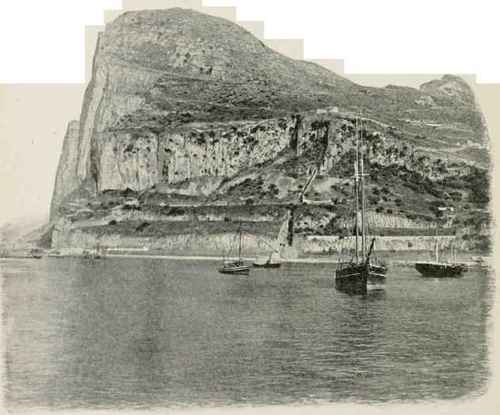
The Lion's Face.
I cannot tell which seemed to me the more astonishing, the excavation of these miles of tunnels, or the herculean task of dragging up to their positions, hundreds of feet above the town, this multitude of heavy guns. To aid in the latter work, huge iron rings were sunk in the rock at the most difficult points, and still remain memorials of the energy and effort necessary to haul such cannon to their present places. Moreover, in addition to these tiers of rock-hewn chambers, the British government has erected lines of formidable batteries along the base of the great headland, all planned and finished with the utmost skill and accuracy known to science. Gibraltar, therefore, has been made by man a military volcano, ready at any moment to burst forth in a devastation far swifter than a stream of lava, and deadlier than Etna's rain of red-hot stones. In fact, all other strongholds in the world are ranked in excellence, as they approach or recede from this ideal. Accordingly, one cannot be surprised to learn that more than two hundred and fifty million dollars has been spent on its defenses, and that the maintenance of Gibraltar costs Great Britain a million dollars annually, even in times of peace.
Cuffs With Rock-Hewn Galleries.

The Line-Wall Of Division.
Some British statesmen, like John Bright, have therefore urged the restoration of the fortress to the Spaniards, claiming that its advantages are not worth its cost; but after all her lavish outlay for so many years, it is improbable that England ever will retire from Gibraltar, and give it back to Spain for any equivalent which it is in the latter's power to furnish. It is, indeed, generally conceded that such an act on the part of Great Britain would be disastrous to her power and prestige. The guardianship of the route to India via the Mediterranean and Suez Canal is absolutely essential to the government which at present dominates Hindustan; and Aden, Egypt, Malta, and Gibraltar are four indissoluble links in the long chain which binds the Asian peninsula of three hundred millions to the small European island of thirty-three millions, much as the spinal cord connects the body with the brain. It is undoubtedly true that now, when steam has obviated the delays and difficulties formerly caused here by head winds, Gibraltar is less capable of hindering the passage of a hostile fleet, and armored cruisers could today without much trouble enter or leave the Mediterranean, so far as actual opposition from this fortress is concerned. But as a wonderfully defended base of supplies, beneath the shelter of whose guns Great Britain's war-ships could assemble, coal, repair their damages, and take on fresh troops, food, and ammunition, it is of enormous value. That England is convinced of this is evident from the care and money she bestows upon it; for it is said that there are at Gibraltar provisions and water tanks sufficient to maintain a beleaguered garrison of one hundred and fifty thousand men two years. Experience has, however, demonstrated the need of these elaborate defenses, combined with thorough preparation and eternal vigilance. The present masters of Gibraltar have not held it for two centuries without desperate fighting. Repeated efforts have been made by England's enemies to wrest it from her hands, and Spain at one time put forth practically all the treasure of the nation and her entire military and naval strength in a tremendous struggle to recover this undeniably integral portion of her territory. But the defenders of the rock from their incomparable position steadily beat back all assailants. On the remarkable siege of Gibraltar, which lasted from 1779 to 1783, at least one special volume has been written, possibly more. It forms a thrilling history, and one of the many conflicts which occurred here during those four years leaves on the reader's mind an ineffaceable impression of sublimity and horror.
Continue to:


My Books

