


Gibraltar. Part 5
Description
This section is from the book "Gibraltar - John L. Stoddard's Lectures", by John L. Stoddard. Also available from Amazon: John L. Stoddard's Lectures 13 Volume Set.
Gibraltar. Part 5
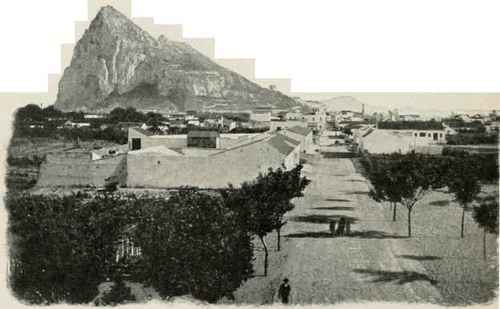
Inside The Spanish Lines.
On that occasion the united fleets of France and Spain, consisting of more than fifty line-of-battle ships and many small vessels, made an attempt to take the fortress, the ultimate success of which seemed to them certain. For this imposing combination - the largest naval display since the Spanish Armada - was commanded by ten admirals, and was supported by an army on land numbering forty thousand men, with heavy batteries.
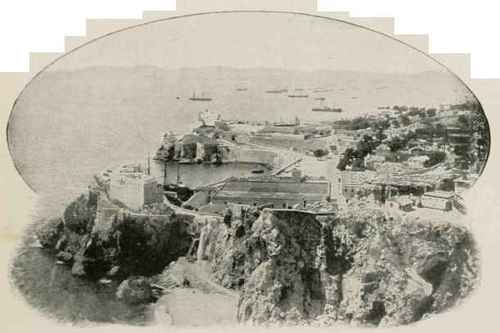
Ifications Along The Shore.
Opposed to this enormous force, "Old Eliot," the commander of the British garrison, had only ninety-six pieces of artillery and seven thousand men. The character of the combat which ensued can be in part conceived, when one considers that sometimes during its continuance four hundred pieces of the heaviest caliber were in action at the same moment, and at comparatively short range! The combined thunder of these guns, redoubled by reverberations from the cliffs, the shrieking of the shells, and the effect of hundreds of projectiles striking and exploding simultaneously on or within the rock, must have produced the very climax of the terrible in war. To this stupendous onslaught the British garrison replied with red-hot shot, to furnish which scores of brave soldiers worked like demons, not only at the portable furnaces and gratings provided for the purpose, but also, since these regular means were insufficient for the great demand, at bonfires, the cannon-balls thus heated being jocosely called by the gunners "roasted potatoes." These incandescent missiles proved the salvation of the English; for, in spite of the enemy's efforts to suppress the conflagrations kindled by the fiery deluge, their wooden ships became ignited, one after another, and on these blazing cruisers, helpless in confusion and distress, a well-directed fire from the garrison caused dreadful havoc.
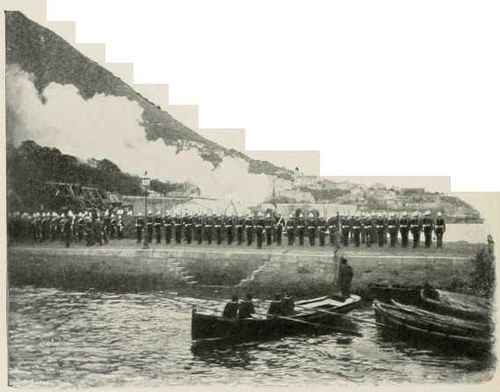
Soldiers Of The King.
The conflict lasted far into the night, and surely never has the sea presented a more awful spectacle than that of these proud war-vessels floating on a mass of water red as blood, and licked by flames which etched their masts and spars in lines of fire upon an ink-black sky. Meantime, upon the hapless ships, as well as on the others coming to their rescue, a shower of glowing shot kept falling like the bolts of doom, while the dark headland, like a rock-ribbed battleship, poured broadside after broadside from its tiers of portholes at the frigates, clearly visible in the light occasioned by their own destruction. Frequently, too, the horror of the scene was made still more intense by an explosion; when, as the fire reached a war-ship's magazine, its mighty hull rose from the water, cleft the air a moment like a molten geyser, and then with a prodigious roar fell back in splendor to its ocean sepulchre.
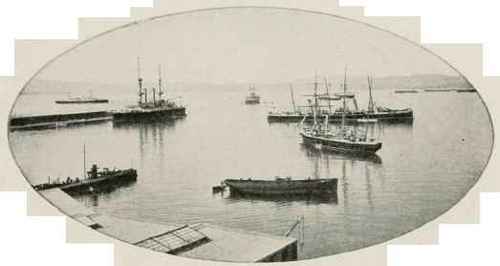
Where The Battle Was Fought.
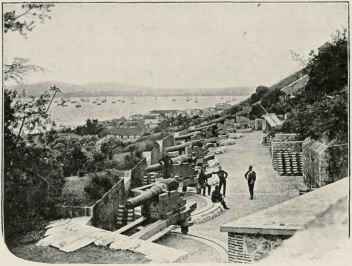
One Of Many Batteries.
During the century which has elapsed since this unparalleled siege, Gibraltar has been practically left in peace. Since the Napoleonic wars, especially, Great Britain's ownership of the rock, whatever may be said about the clearness of her title, has been accepted by the world as an accomplished fact, and none of the European nations has been rash enough to try to take the key of the Mediterranean from the mouth of the lion crouched beside the gate. Yet England has not slept through these decades of undisturbed tranquillity, nor let herself be lulled into a false security. She has gone on still further strengthening what a century ago appeared unconquerable, and has replaced her former ordnance here with cannon of much greater caliber, whose shot is lifted to the muzzles by machinery. "Old Eliot," as has been said, had only ninety-six guns; but in 1870 the rock had seven hundred, and since then many new ones have been added. Nor has this caution been uncalled for. The increased range of modern artillery has made it possible to shell the harbor of Gibraltar and the rock itself from a considerable distance within Spanish territory. It is indeed asserted that Spain is at present carrying out a plan for erecting on the mainland north of the promontory, as well as on the Spanish side of Algeciras Bay, no less than seventy heavy guns, whose fire could be concentrated on the British port. Someof these cannon are already in position, and constitute a danger not to be ignored, in view of the fact that, should a war break out between France and England, Spain would be very likely to ally herself with her immediate neighbor, Gibraltar being the anticipated reward for her assistance. So serious is this menace thought to be that British experts are advising that the two great dry-docks, which it was the plan of England to construct here, should be abandoned, and that instead of them a harbor and a floating dock should be made below the natural eastern bastions of the rock, which are assailable only from the sea.
Continue to:


My Books

